
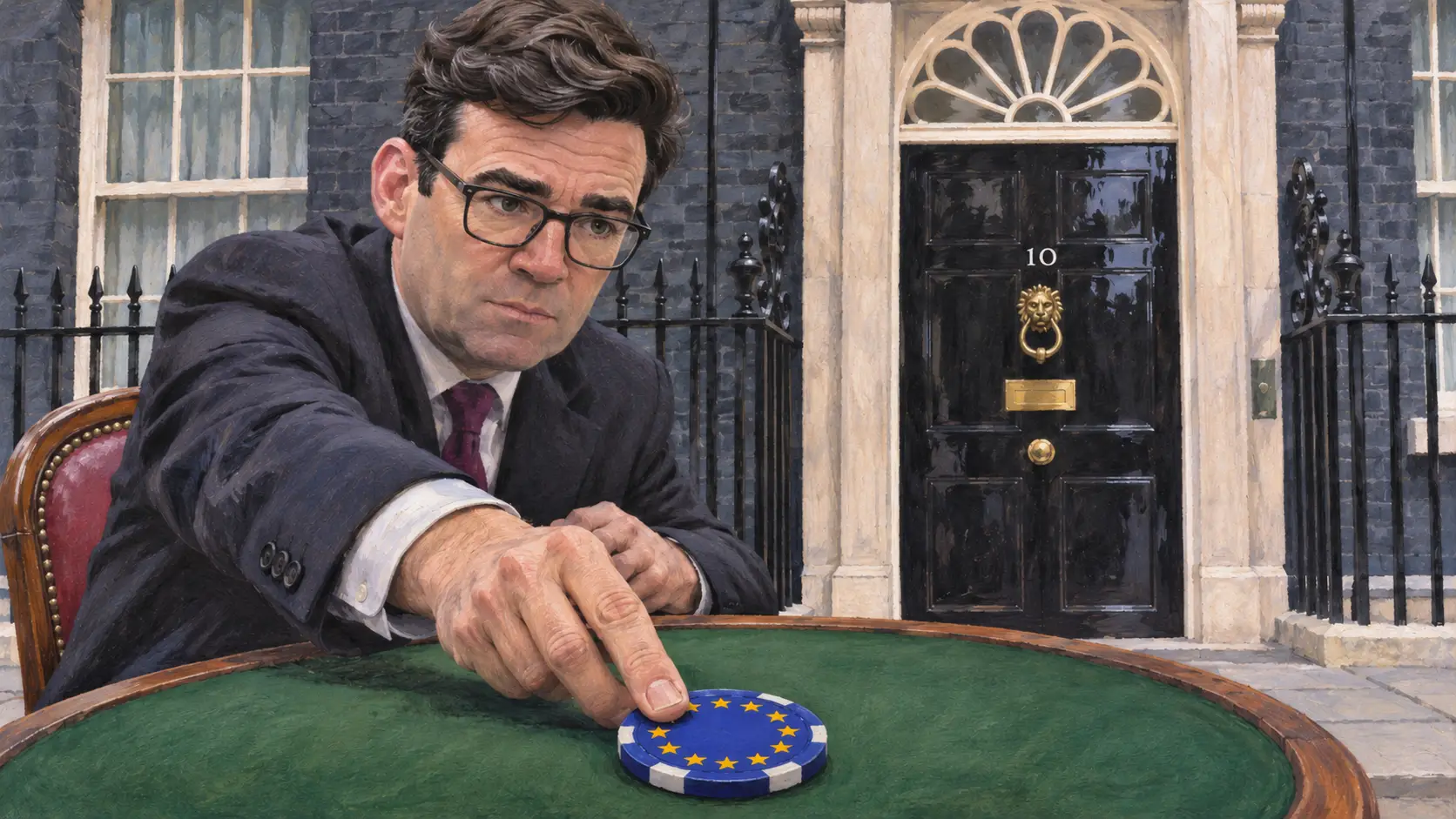
ANDY BURNHAM is no fool. He has risen to the top of the greasiest of poles and now lives at Number 10 Downing Street, which means he must be pretty ruthless too. He also had the political nous to remain Mayor of Greater Manchester for a decade. Before that, he served in the Blair and Brown governments and then joined Ed Miliband’s shadow team. He may not have achieved much, but in the torrid world of Labour politics avoiding a knife in the back is an achievement. Just ask Keir Starmer.
Anyone with a pulse knows that all is far from well in the UK. Cash is tight, recession is looming, living costs are rising and the government seems unable (or unwilling) to alter the country’s trajectory. Debates on Palestine, climate change, whether women have penises and immigration remain toxic and unresolved. Why, then, has Burnham decided to reopen the festering sore that is our relationship with the EU?
Following the referendum, Boris Johnson negotiated a festering turd of a deal, but at least a deal was done and business could operate on a stable(ish) basis. Labour’s 2024 manifesto ruled out rejoining the EU, its customs union or single market, or restoring freedom of movement. Burnham himself agreed to all of this when he stood for election in Makerfield this May. The manifesto included a commitment to negotiate a veterinary agreement to reduce border checks on agri-food products, but little more.
Yet Burnham wants to talk about more?
Some useful idiots in a range of think tanks have come up with a theoretical quantification of the “damage” Brexit has done to the UK as between four and eight per cent of GDP. This is, of course, utter bilge.
Brexit changed the entire economic picture for the UK, the EU and, to a lesser extent, the rest of the world. Had we stayed, both the UK and EU economies would have taken a different course. Modelling the gap between what happened and what might have happened is fraught with even more uncertainty than usual, to the point of being useless.
That’s no surprise to those who took an interest in the Brexit debate. The Remain camp (now rebranded “Rejoin”) played pretty fast and loose with their numbers during “Project Fear.” It seems Project Regret is no more honest. Burnham must know that too, so why is he stirring the pot over a harm he can’t measure?
The only possible explanation for reopening the Brexit wars must be that he sees a political benefit for himself and Labour
Burnham is no fool, although he was one of the more ardent Remainers. For reasons that I am genuinely unable to fathom, he believed that the UK was better off being governed as a vassal of Brussels than as a sovereign nation state. He’s neither an economist nor a historian, and has no experience outside politics. The only possible explanation for reopening the Brexit wars must be that he sees a political benefit for himself and the Labour Party.
As it stands, this government is failing on its own terms. The cost of living is rising, and the coming hikes in energy bills will further diminish household living standards, above all for the “working people” Labour thinks it represents. That is likely to cost Labour votes at the next election – if the economy lasts that long – and could cost it seats and even power. To a professional politician like Burnham, power is everything. While Starmer can slip back into a successful legal career, Burnham has no obvious fallback. He replaced Stamer because, it was said (and may still be in some places) that Burnham wins elections.
Remember, under first past the post, its winner takes all. The requirement is simply to get more votes than the other candidates. That’s achieved through having better looking policies than the competition (such as Blair’s mythical “Third Way” – which turned out not to exist, but only after it won him a landslide). Or you can make your candidates look better. “Blair’s Babes” compared well with sleazy Tories. As John Healey has no doubt explained, the UK economy is falling apart, so for Labour to win an election it must make the opposition look worse.
And that’s where the EU comes in. On a simple left–right spectrum, only the Greens sit to Labour’s left, and they love Europe. As Polanski’s posturing sends Green credibility over a cliff, it’s increasingly likely that some Green voters will return to a Labour Party that shares their enthusiasm for Palestine and net zero. The Lib Dems have many seats but few policies that set them apart. Disaffected Europhile Tories are thought to have swelled their ranks at the general election. If Labour crosses its manifesto red lines and starts to look like a party of rejoiners, it might attract some of them.
Of course, Kemi Badenoch is also after the former Tories who voted Lib Dem. With Brexit off the agenda, she can make her pitch on competent government. With Brexit back on the agenda, Badenoch is forced to choose whether the Tories are rejoiners or not. If she opts for a euro-sympathetic stance, even more of her party will prefer Reform. If she opts to stay out, she’ll struggle to win back Europhile Tory voters. Either way, Burnham’s Labour wins.
Reform could find itself fighting the Brexit battle all over again, when that’s not the country’s biggest problem
Some might think a pro-EU prime minister is a boon for Reform, and of course it’s likely to shore up the party’s share of the Eurosceptic vote, largely to the detriment of the Tories. It’s also true that Nigel Farage won the fight to leave the EU, so rerunning that battle should work for Reform. Perhaps. But Reform could find itself fighting the Brexit battle all over again, when that’s not the country’s biggest problem – by miles. The Europhile media (now possibly including The Daily Telegraph, and certainly its owner, Axel Springer) will focus on Brexit, leaving less room for Reform’s other policies, such as ending net zero.
It’s hard to say how restarting this fight will affect Restore, and I doubt Burnham has bothered thinking about it. Reopening the debate reopens the wounds that the Conservatives had almost healed and intensifies their fight with Reform. For Burnham, that’s a benefit worth the risk of proving Restore’s point. Break your own manifesto promises and you make it easier for Restore to argue that politics is rotten to its core and the only solution is to vote all the professional politicians out.
He probably hasn’t looked beyond the bubble of his advisors. The long-suffering British public, most of all the working people (of whom I’m one, even by the definition used by Emma Reynolds, the half-wit Chief Secretary to the Treasury) don’t like prime ministers who play politics while the economy sinks.
History wasn’t kind to Nero; it won’t be to Burnham either.



Comments: 1
Join the debate
Do you agree with this analysis, or is the author wrong? Have your say below.
No comments yet. Be the first to join the discussion.