
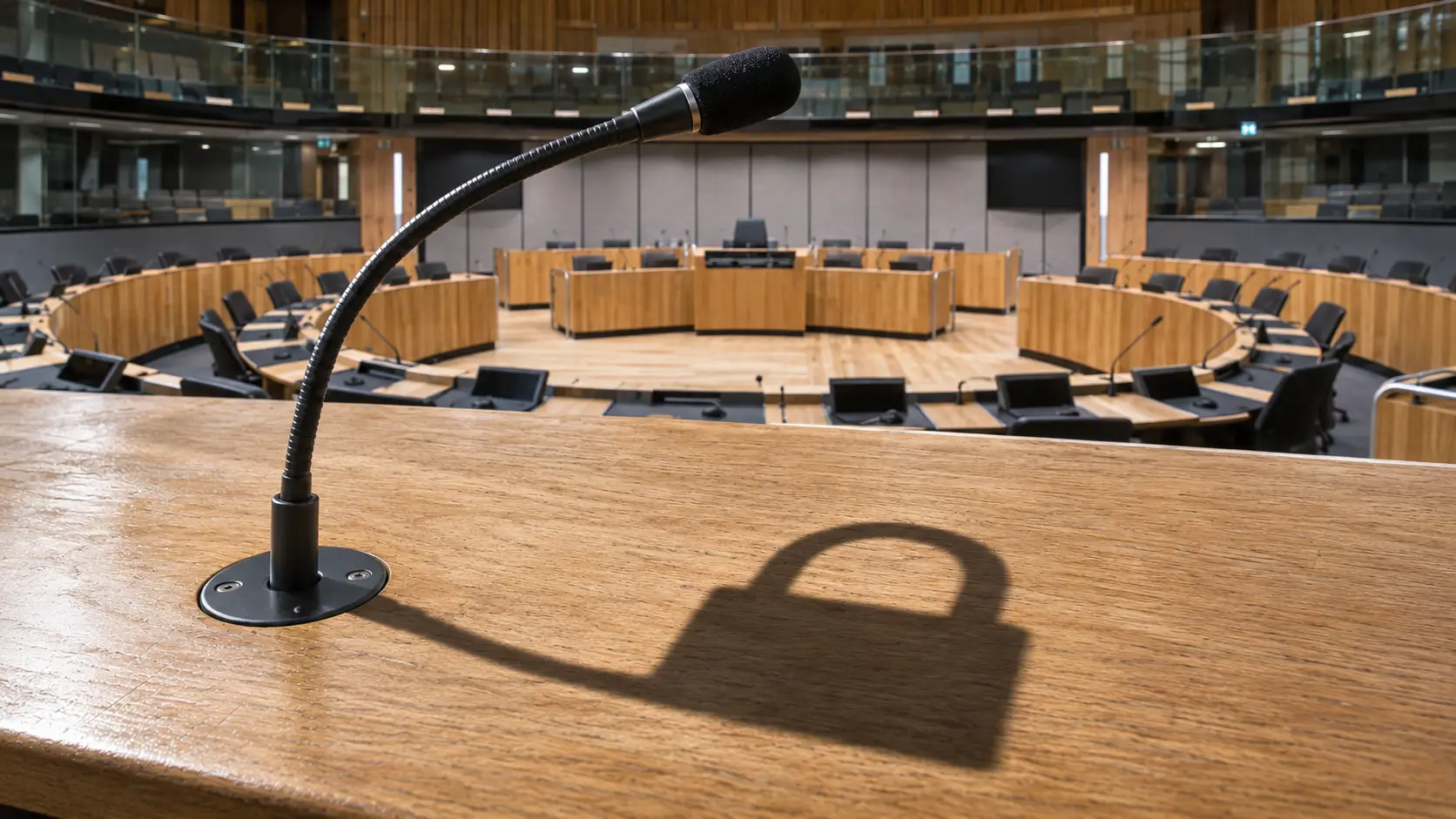
IN THE WELSH SENEDD, Reform MS Joe Martin was effectively gagged. During business questions on 10 November he asked for a government statement on the “demographic replacement of white British people taking place in the UK”. He noted that mass immigration and differing birth rates meant that “in just 37 years’ time, in 2063, we will be a minority in our own country”, that this had already occurred in London, Birmingham, Leicester, Slough, Luton and Manchester, and that a nation is “a family, which is capable of absorbing people of all races if done at a sensible rate, but not if it’s replaced altogether”.
Presiding Officer Huw Irranca-Davies later ruled the contribution “unnecessarily provocative and deliberately offensive”, with a focus on race and ethnicity that was “clearly discriminatory” and detracted from the dignity of the Senedd. Martin was told he would not be called to speak again until he apologised in the chamber. He has refused. Reform’s Welsh group, led by Helen Jenner, responded by partially boycotting plenary proceedings in protest at what they described as an infringement of free speech and the silencing of an elected member’s constituents.
Martin’s core claim is not an invention. Demographer Paul Morland has discussed separate projections by Matt Goodwin and David Coleman which suggest that white British people could become a minority in the UK in the early to mid-2060s. These are extrapolations from Office for National Statistics data and related analysis; they are contested in their precise timing and implications, but they are demographic projections, not conspiracy. Wales itself remains overwhelmingly white (93.8 per cent in the 2021 census), yet the direction of travel across the United Kingdom is plain in the figures.
That trajectory could accelerate. Prime Minister Andy Burnham has publicly called for an “honest discussion” about restoring free movement as part of a closer relationship with the European Union, floating single-market membership or even full rejoining. Free movement would reopen large-scale inflows.
Separately, Home Secretary Shabana Mahmood has reopened the UK Resettlement Scheme, with around a quarter of referrals expected to be Afghan women and girls and Palestinian refugees. Combined arrivals under the scheme and three new community sponsorship routes are expected to number in the hundreds initially, rising into the low thousands.
where does policing parliamentary language end and suppressing an argument begin?
These are deliberate policy choices that add to the numbers already driving the demographic shift Martin described.
Agreement with Martin’s wording is not required to see the problem. The Senedd has decided that his contribution crossed the boundary of acceptable debate. Its Presiding Officer explicitly said legitimate immigration questions could still be raised. But an indefinite speaking ban raises a question of its own: where does policing parliamentary language end and suppressing an argument begin? Legitimate questions about immigration volumes, birth rates and the composition of the population can be framed as “racist” and shut down by procedure. An elected member is barred from speaking until he recants. That should concern anyone who values parliamentary debate over managed consensus.
Reform is encountering the same pattern at Holyrood. Helen McDade has previously written in these pages about the tactics used against the party since its breakthrough in the May 2026 election. Since then, Reform MSPs have been repeatedly labelled racist, fascist and worse – most visibly during debates on face coverings, when First Minister John Swinney accused the party of having “brought racism” into the chamber, and ministers described motions as racist, Islamophobic and designed to foster hostility. Exact tallies from the official record are not always compiled, but the pattern of such language is frequent and largely unchallenged.
The double standards are obvious. Thomas Kerr has faced sharp rebukes for robust language; mild terms such as “chancers” directed at the opposition can draw intervention, yet “racist,” “fascist” and comparisons to the Third Reich pass without equivalent censure.
This occurs against a background of real threats to politicians. The murder of Ann Widdecombe in July 2026 remains the subject of an ongoing investigation; a man has been charged, and police have said a possible political motive remains under investigation. No one should prejudge a live case, but the climate of demonisation makes such risks harder to dismiss.
one side is expected to absorb abuse while the other is policed for tone
Holyrood’s Standing Orders are clear. Rule 7.3 requires members to “conduct themselves in a courteous and respectful manner” and to respect the authority of the Presiding Officer. The Code of Conduct reinforces standards of integrity and behaviour. These rules are enforced unevenly. When Reform members are the target of extreme labels, presiding officers rarely intervene with the same vigour applied to milder language from the Reform benches. The result is that one side is expected to absorb abuse while the other is policed for tone.
The charge of fascism is worth examining on its own terms. Historically it involved dictatorial leadership, extreme nationalism that suppresses rival groups or parties, the silencing of opposition, the erosion of independent democratic processes and media, and heavy state regimentation under centralised control. That is a serious description, not a parliamentary insult to be thrown at anyone who challenges an immigration policy.
Nicola Sturgeon’s tenure, with Peter Murrell’s tight organisational grip, exemplified concentrated power and intolerance of internal dissent. The SNP’s long dominance has featured relentless pursuit of a single constitutional goal, the marginalisation of unionist voices, and pressure on institutions and media that deviate from the approved narrative. Labour and Plaid Cymru in Wales have shown similar instincts when demographic or cultural questions arise: debate is curtailed rather than answered. Online “cyber nats” perform a function not wholly unlike the inter-war storm brigades – enforcing conformity through volume, harassment and the rapid isolation of dissenters.
When substantive answers are thin, the reflexive response is to intensify the moral labelling and suppress the questions
The SNP’s operating method tracks the psychological propaganda techniques associated with Joseph Goebbels: relentless repetition of emotionally charged slogans (“racist”, “far-right”, “divisive”), binary good-versus-evil framing that admits no nuance, and the designation of scapegoats. The illusory truth effect does the rest – say something often enough and it becomes received wisdom.
John Swinney is under pressure on multiple fronts: the costs and practical failures of “net zero” (or “net-stupid-zero”, as critics put it) and the damage to oil and gas, the contradictions of SNP positions on Brexit and the EU, and the continuing fallout from gender policy. When substantive answers are thin, the reflexive response is to intensify the moral labelling and suppress the questions.
None of this requires agreement with every Reform proposition. It does require the ability to discuss demographic reality, immigration policy and their consequences without being declared beyond the pale. History supplies repeated warnings about what follows when uncomfortable facts are ruled unsayable and only the approved narrative may be voiced. The Senedd’s decision to silence Joe Martin until he apologises is a small but revealing instance of that larger habit. Free societies do not treat “replacement” as a four-letter word.
With thanks to Mike Parker for his contribution to this article.


Comments: 0
Join the debate
Do you agree with this analysis, or is the author wrong? Have your say below.
No comments yet. Be the first to join the discussion.