

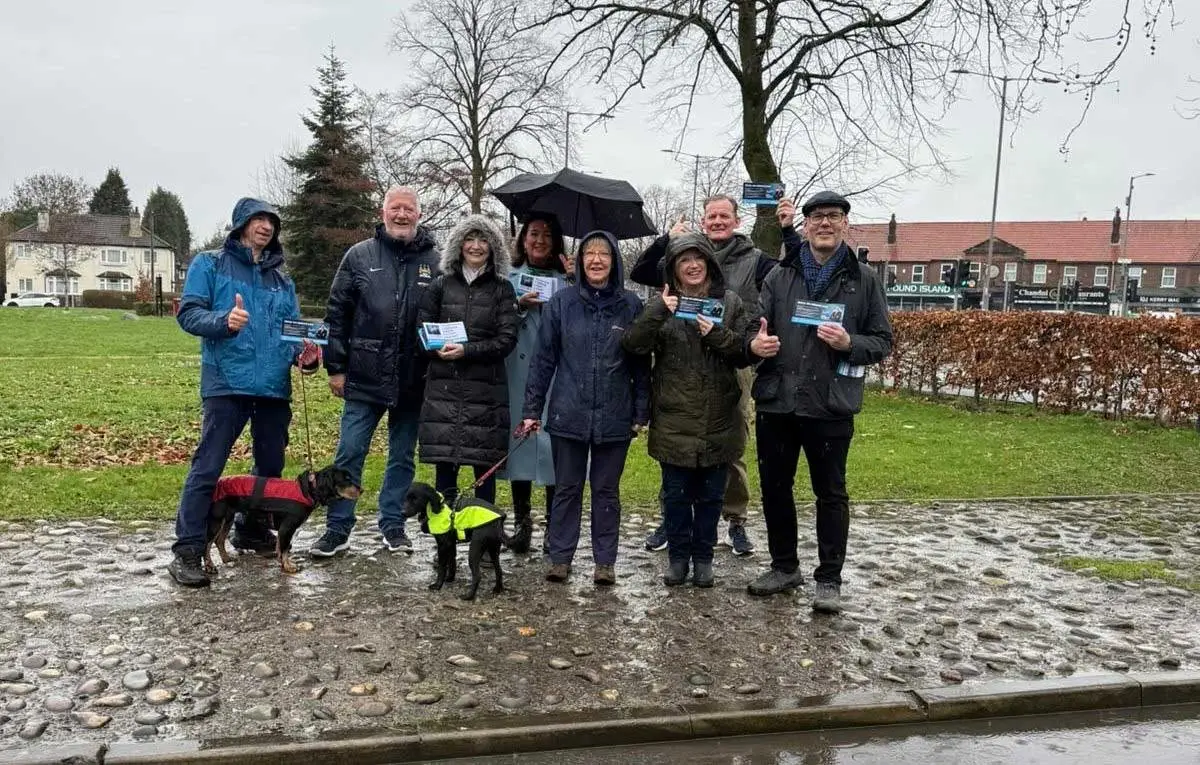
THERE was a general feeling of excitement when, at 6.30 a.m. on a weekday, I joined a coach full of Scottish Reform campaigners heading to Gorton and Denton for a day’s canvassing.
We had all seen the facts on TV – one of Labour’s safest seats; a constituency of two very separate halves with very different populations; a brilliant candidate much loved within Reform.
So it was all hands to the deck. It would be an interesting day. I’m a Scot with little experience of English urban areas, but I thought I knew what to expect from television coverage.
The experience was different from my expectations, both from the party campaigning point of view and in how it felt on the ground. Bear in mind this was midway through the campaign. There was no chaos in the Party office – they had a system and processed volunteers in an organised, friendly fashion. Crucially, when calling in volunteers from afar – something often overlooked – toilets were available.
a Vote Green poster, a Palestinian flag, and a Pride flag. The contradictions seemed glaring.
There was the inevitable difficulty of sending off a coach load of people who didn’t know the area with one map between them and the airy expectation that phones would suffice. I may seem like a Luddite, but multiple paper maps would have been far more efficient for allocating groups. Photocopying may be old school, but it works. Placing a local organiser with each large group, acting as host, would also increase effectiveness – a role for a keen activist unable to knock on doors, though I appreciate they may not have been available.
Our driver and Scottish organiser parked in the most central part of our allocated area. It took thirty minutes for my group of six to reach our starting point, by which time the excitement had faded.
The area was mostly standard terraced housing, not rundown. As someone remarked, it looked like Coronation Street. There was nothing remarkable about it. As is common on weekdays, very few doors were answered. Since we were in Gorton, we weren’t expecting strong results. It had been jokingly said, “send the Scots into the tricky area.”
But it wasn’t like a war zone, nor was it intimidating. Increasingly, it felt like a desert – an area where people seemed absent or hidden. It was extremely quiet, despite being near a major road: little traffic and almost no-one in the street. Usually, you see dog-walkers or parents with toddlers; here, we did not.
Canvassing is often a slog. The invention of video doorbells has made it harder; people can see who is there and, to be fair, why should they want to answer the door?
As the day went on, I realised I had seen virtually no-one in the streets, certainly no women
Increasingly, I noticed very many clearly occupied houses had curtains closed at the front, sometimes several in a row. These didn’t seem to be houses waiting for repairs. The area wasn’t run down – in fact, it was described to me by one young man (probably a Green voter) as a “multi-cultural, vibrant area”.
I achieved very few open doors. One or two houses with closed curtains were answered by scared-looking young women who opened the door a crack, indicated they didn’t speak English, and shut it again.
Of the doors that were answered, I found a couple of Reform voters – one older man, using strong language about how his area had completely changed. He described numerous Muslim couples viewing a house for sale in his street, and one “Jew who clearly wouldn’t be buying it to live in himself.” Some non-Muslims clearly live there, but it is not, by any normal definition, “multi-cultural”.
As the day went on, I realised I had seen virtually no-one in the streets, certainly no women. After school closing time, a few women in full burqas collected children and quickly disappeared indoors. They weren’t on the streets for long. I saw women in Western clothing only in the supermarket.
Rows of closed shops added to the sense of decline. There were only one or two small shops open. Shuttered premises are common everywhere, but I was struck by the absence of even a functioning coffee shop. There were a couple permanently closed. That too is widespread, but it suggests there isn’t much of a coffee shop clientele in the area.
What about the Greens? Writing this on election day, I am sure they will poll well there. The phrase “useful idiots” comes to mind. I thought about the young white man who said, “seriously? You’re coming here to this multi-cultural area….” If he has a female partner, does she feel entirely at ease there in the evenings?
One garden captured the mindset: a Vote Green poster, a Palestinian flag, and a Pride flag. The contradictions seemed glaring. What do they believe happens to gay people in Palestine? (In Edinburgh, I once asked a pro-Palestine protester about the treatment of gay people in Muslim countries. Referring to a gay British couple I know who cannot travel there, she replied, “they can stay here.”)
The only conclusion I can draw is that many convince themselves they are good people who want the best for everyone and therefore can support every “good” cause without contradiction. That lack of self-examination is deeply troubling, particularly when such thinking influences education and public institutions. Orwell’s 1984 feels less like fiction than a prediction: “War is peace. Freedom is slavery. Ignorance is strength.”
I simply felt transported to another country.
Surprisingly, I did not feel unsafe, even alone. I simply felt transported to another country. Judging by the few people I saw, I might have been on holiday in the Middle East.
From a campaigning perspective, I question whether there was value in canvassing that particular area. By that stage, organisers must have known there were no votes to win. Perhaps central office was following a rigid plan. In my view, it was largely wasted effort. Re-canvassing those streets would likely yield the same result: almost no answers, and possibly motivating the opposition. I hope others on our coach had more encouraging engagement.
I did, however, learn lessons. Areas like this are not “multi-cultural”; they are voluntarily ghettos. This wasn’t council housing where people may have to go where they’re told to. This was private housing that would suit many British families. (By “British” I include anyone born in Britain, regardless of background.) Such areas may begin mixed but can evolve into places where English is rarely spoken, where young women are afraid to answer the door, whether because they don’t speak English or for other reasons, and where women do not walk uncovered. And, yes, Sarah Pochin is right. We need to ban the burqa. How did we allow this to happen?
So what did I gain from the trip? I learned that I need to be bolder about speaking out on this issue. – even, perhaps especially, in Scotland, where there are fewer such areas at present. I learned not to retreat from discussing the realities of Britain’s communities despite the backlash. I learned that we need to make people who live in leafy, white Scotland care about all the country and all communities. And this might be because it is coming to a place near them.
I didn’t join Reform because of this issue. I joined because of the effect of our energy policies. But I’m renewed in my determination to discuss immigration – legal and illegal – whenever I can. If we value Britain’s Christian-based culture, we must defend it openly. We are in the last-chance saloon. Get out and help today.



Comments: 1
Join the debate
Do you agree with this analysis, or is the author wrong? Have your say below.
That was a worthwhile article, I did a similar trip in Leeds fifty years ago and came to the same conclusions, I did feel overwhelmed, perhaps because the streets I was on were red / grey terraced houses, quite daunting.
Ban Burqas and translator service, pass compulsory British lessons and exams, otherwise take a £ 10,000 ticket to wherever you came from.