

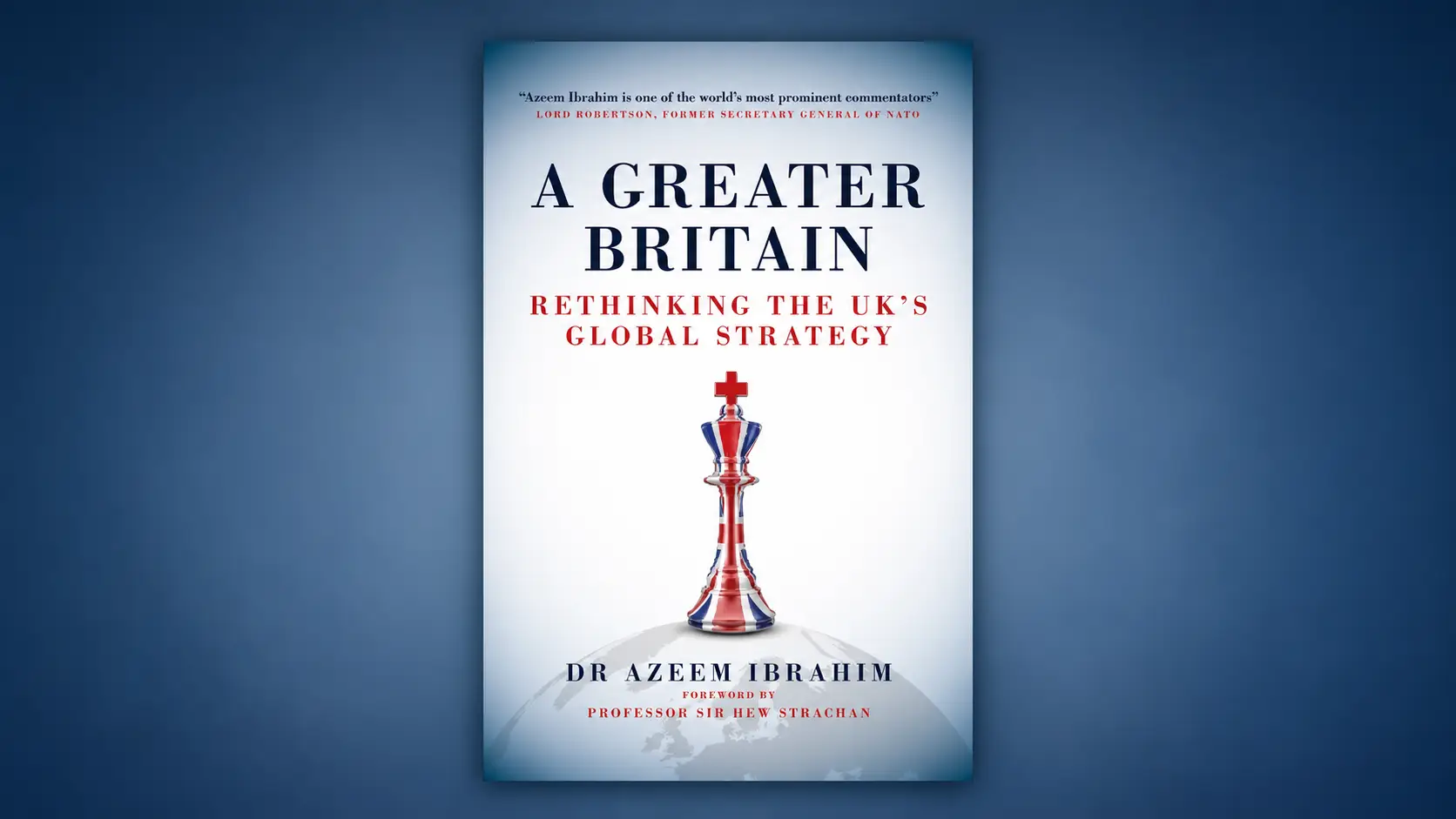
AZEEM IBRAHIM, originally from Scotland, chief strategy officer at the New Lines Institute for Strategy and Policy in Washington, gave Reform MSPs a copy of his new book A Greater Britain: Rethinking the UK’s Global Strategy. While I found it extremely informative in many respects, I found parts flawed.
The UK’s influence on the world stage, and our ability to negotiate good trade deals, depend on a strong economy, but recent governments have failed to deliver one. Reformers know that tax-and-spend, excessive regulation, mass immigration, and rising debt due to poor fiscal management and prolonged COVID measures, took us “down a negative feedback loop”.
After the Berlin Wall fell, “Britain and its allies assumed that open markets and democratic governance would spread inexorably”, but since 2008 the “democratising process has gone into reverse”. Weak Western leadership is at fault. In the absence of something akin to the Marshall Plan from the West, “average Russians associated ‘democracy’ with poverty, corruption and disorder”.
“Managed democracies adopt the form of democratic governance – constitutions, elections, parliaments, courts – but gut them of substance … the ruling elite claims to govern in the ‘true’ interest of the people but without genuine accountability.” Even in established democracies, elected representatives fob off decisions on civil servants and quangos.
To many countries in Africa and South America, Chinese authoritarianism seems more effective than Western democracy. We won the Cold War when our values were shown to lead to prosperity. Yet the UK economy grew by 43 per cent in the seventeen years before 2008 and by less than 9 per cent in the seventeen years that followed. Annual growth of just 2 per cent would have made each of us £5,000 a year richer, with an extra £250bn a year for the Exchequer.
Our media broadcasts our failures and projects colonial embarrassment rather than national confidence
Azeem makes the case for Britain as a soft power superpower, “the go-to source for solving the most pressing international challenges”. Soft power is “the ability to get what you want through attraction rather than coercion or payment”. On issues like Chagos, he berates Labour: “Doing things that sound ‘moral’ does not boost our soft power if we come out looking foolish and naïve.”
The UK is well placed, “largely due to its global cultural footprint, historic diplomatic reach, recognisable institutions like the BBC, leading universities and its role in shaping liberal norms through bodies such as the Commonwealth”. It is a pity that wokeness has eroded the credibility of many of these institutions. “Our media broadcasts our failures and projects colonial embarrassment rather than national confidence.”
Nasty regimes and ventures hide money in Western countries such as Switzerland. Azeem describes the use of “British Overseas Territories as havens to hide their ill-gotten gains”. Scottish Limited Partnerships, hybrid corporate structures under Scots Law, “can register overseas partners and conceal ultimate beneficial ownership, enabling opaque financial flows through UK jurisdiction”. We need to clean up our act.
“International legal order requires … an economic and geopolitical framework that regulates and sustains the conditions by which freedom, contract and law proliferate … International organisations are not intrinsically helpful … International courts may be populated by judges from the very states which are most concerned with undermining the international legal order.”
“China’s membership of the WTO could be listed as one of the most calamitous misjudgments the West has made … Rules and property rights are seen as obstacles to be maneuvered around.”
Azeem interprets Trump’s strategy as protectionist. But Americans voted for disruption of the current rotten system, and the president’s impulsive response challenged protectionism by China, the EU and others that distort US markets. Protectionism hurts everyone. Cheap imports are good. As Adam Smith argued, we can put the money we save into doing what we do best.
Azeem sees no good in cryptocurrency because it supports terrorism and malpractice. “The UK far-right agitator Tommy Robinson relies heavily on transfers of cryptocurrency for this reason, with funding mainly coming from the US (with Putin’s Russia allegedly contributing, knowing how destabilising Robinson can be to British democracy)”. Are you sure, Azeem?
The fatal flaw running through the book is Azeem’s belief in a “climate emergency”. He accepts the edicts of the World Meteorological Organization unquestioningly. He thinks that COP conferences are good and effective! He wants Britain to re-engage with international organisations and positively influence them, but the USA has withdrawn from such globalist bodies because their ideology runs counter to American interests – and good sense.
“Planning reform must unlock housing, transport and green infrastructure. The tax system must reward capital formation and skilled work, not punish ambition. Immigration policy must benefit the British people or else immigration itself must be curtailed. And critically, the UK must take energy security seriously.” Yet relying on intermittent “green infrastructure” undermines energy security.
“Green” energy is at the heart of the West’s economic malaise
He bemoans the pervasive EU regulatory environment but seems to regard the protectionist EU Green Deal Industrial Plan as valid. He says important things about cyber security and terrorist threats and then says, “the climate emergency itself is a major security threat”. He welcomes cheap, state-subsidised Chinese electric cars, yet acknowledges the threat China poses to our economy and way of life. “Green” energy is at the heart of the West’s economic malaise.
Azeem notes that predictive financial models are always wrong, being programmed using groupthink, with rubbish in and rubbish out. It is the same with climate models. Both fields are doomed by the “chaotic” interaction of the many factors involved. If climate change were only about human emissions, it would be easy to predict. Many experts conclude that this factor may not even have a large effect. Roman Britain was significantly warmer than today, and Julius Caesar didn’t drive an SUV.
Azeem parrots the WMO/UN prediction of mass migration in places like the Sahel because of climate change, when this area is greening due to more carbon dioxide plant food in the atmosphere. Migration arises from Muslim fundamentalism and corrupt African and Middle Eastern regimes. He talks about, “the death of coral reefs that attract crucial tourist revenue”, but the Great Barrier Reef is in its best condition since surveys began.
We should trust Adam Smith’s “invisible hand”
We should not use economic models to justify policy, but use basic, common sense principles that have worked before and then constantly adjust strategy as a hundred inconvenient, unpredictable factors try to blow us off course. Socialist state control always fails because it is ideological, insensitive and inflexible. We should trust Adam Smith’s “invisible hand”.
Azeem knows that turning our backs on North Sea gas is crazy, but still suggests that we use our influence to persuade poorer countries to make an energy transition – but to what? He advocates promoting green investment products and research money for nuclear fusion, a technology that has been thirty years away for the last thirty years. Since there is no climate emergency, we have time to develop new technologies that work and are affordable, perhaps including molten salt thorium reactors.
Azeem has endorsements from many prominent people, including Alan Mendoza, Chief Foreign Policy Advisor for Reform UK. If they share Azeem’s adherence to climate change ideology, we face an uphill struggle. Kemi Badenoch ignores the many Tories in the Conservative Environmental Network, but perhaps some in Reform have not made the reality transition so we can flush away toxic “green” energy subsidies, regulations and taxation.
I hope MSPs read this book. Scotland was once at the forefront of the Enlightenment and the Industrial Revolution, a leader in Western economic success. Can we turn Azeem’s best ideas into policy?


Comments: 0
Join the debate
Do you agree with this analysis, or is the author wrong? Have your say below.
No comments yet. Be the first to join the discussion.