

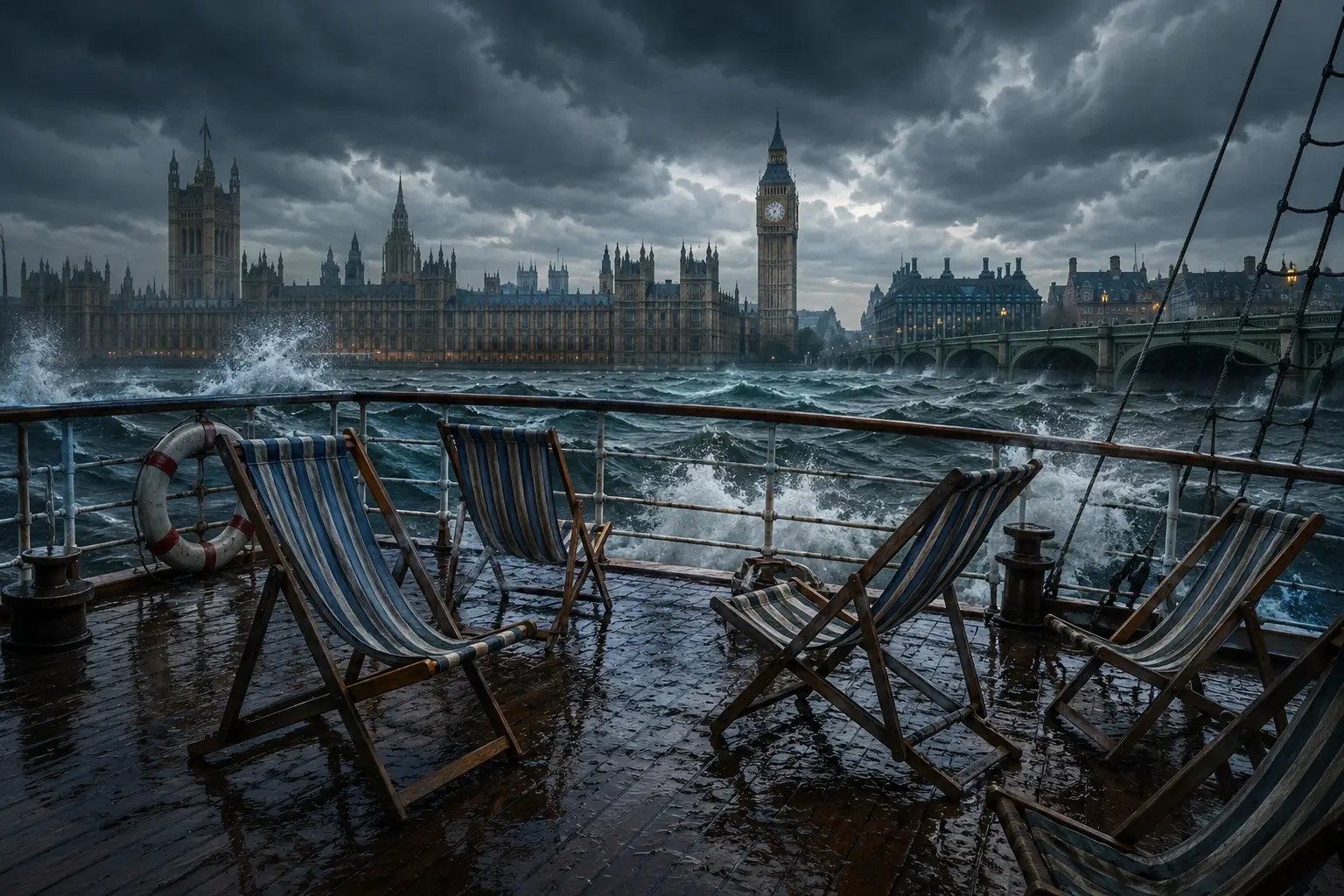
THE RECENT WESTMINSTER BY-ELECTIONS have not solved the problems that the UK faces. They have merely rearranged the deckchairs on the sinking ship of state. The band plays on while the captain is about to be replaced but the leviathan is still holed below the waterline, unseen by all but the few who are close enough to notice.
The passengers are currently oblivious to the structural damage that is not being repaired and, absurdly, being in a state of such ignorance, are inclined towards making the ship move faster, quickening its descent towards Davy Jones’s locker.
Rearranging the deckchairs is a common metaphor almost as old as the sinking of the Titanic itself in 1912. It is a distant cousin to another mythical example, that of Nero playing the lyre while Rome burned. The reason such metaphors survive is because they communicate quickly and effectively a parlous state of affairs where people who could save an existential situation are ignorant of the threat, naïve in their response to what’s happening around them — and inevitably doomed to their demise.
The by-election results have been the focus, but the underlying threats to the public finances upon which we all depend remain real.
In Aberdeen South the Conservatives pulled off a historic win, the first Tory by-election gain in Scotland since Pollock in 1967. Suggestions by Conservatives that Reform should not stand, because it would lead to an SNP victory, were shown to be both an unjustified lack of self-confidence and petty sectarian politicking. The electorate took a view and decided for itself that the Tories offered the best chance to oust the SNP, leading to both the Labour and Reform vote being squeezed, although Reform still increased its vote share compared to 2024.
In Arbroath & Broughty Ferry the SNP held on but both the Conservatives and Reform increased their vote share, though not enough to defeat the SNP even if added together. More telling was that in both seats the Labour vote collapsed from second place to fourth.
Almost all eyes were, however, on the Makerfield by-election, because it bestowed on one Parliamentary constituency the opportunity to change the Labour leader and hence the prime minister. It was, to some extent, a general election held only in one safe Labour seat. Yet such is the level of Keir Starmer’s unpopularity that Labour could have lost. No surprise then that, unusually for a by-election, the turnout of 58.75 per cent was greater than at the general election just two years ago, when it was only 52.5 per cent.
Labour voters see him as the last throw of the dice
In the end, Labour’s potential saviour, Andy Burnham, won the seat comfortably with an increased majority — but Reform also increased its votes and vote share from 31.8 to 34.5 per cent, despite being under attack from the right by a party that had no other ambition other than to do Reform down. “Restore” managed only 6.8 percent. As for the Conservatives, they failed to even break 1,000 votes and polled just over two per cent.
Clearly, Burnham attracted a good deal of personal support, which is no surprise given the context locally, as a local lad and popular mayor, and nationally as a possible replacement for a highly unpopular prime minister. Labour voters, I expect, see him as the last throw of the dice: an attractive Labour PM who might still be able to win.
Yet even Burnham still polled below Labour’s traditional high-water marks in that seat. In 1997 Tony Blair’s New Labour won 73 per cent, in 2001 it was 68 per cent and in 2005 it was still 63 per cent. Since then, the seas have been stormy and Labour has never reached such heights again, even in 2024. Makerfield is therefore a poor seat in which to discuss the relative strengths of right-of-centre opposition parties – but if we do, then Reform’s 34.4 per cent suggests it will be knocking on the door of Downing Street, though it may still need the support of an even smaller Conservative rump to obtain a majority.
The chances of Restore winning any seat other than Rupert Lowe’s own Great Yarmouth must be very slim, especially if Reform stands against Lowe to tie him down to constituency campaigning.
Of course Reform has its growing pains. It used to be called a one-man band, but now has known personalities banging the drum; it used to be said it had no policies, but now issues proposals on an almost weekly basis; it used to be said its commitments risked wrecking the public finances, but has since shifted positions to reduce such risks.
Until the Conservatives accept their past responsibilities, how can they be trusted with any in the future?
It is, however, stretched in Parliament where the Tory leader, Kemi Badenoch, has a weekly platform that maintains her high profile and inflates her party’s self-importance and sense of entitlement. Crucially, however, her parliamentary party has still not accepted how bad many of their policies were over its fourteen years in government. It has never apologised for grave errors of judgement on higher taxes and growing regulation, nor for squandering the Brexit opportunity. Until the Conservatives accept their past responsibilities, how can they be trusted with any in the future?
Now the political maelstrom leading up to Burnham’s return to Westminster — including but not limited to the scandal of Mandelson’s appointment and the crises across our military defences — has cost Keir Starmer his job. But the real news is being missed. Last week it was revealed, while most politicians were distracted by their own circuses, that the ship of state was taking in water at an unsustainable level. The UK government borrowed £23.3bn in May, which is £5.4bn (30.4 per cent) more than May 2025 and worryingly £5.6 bn higher than the Office for Budget Responsibility (OBR) forecast.
This higher-than-expected figure was heavily driven by another record high — the UK Government’s debt interest payments of £11.7bn, up £4.1bn (54.4 per cent) compared to the previous year. The figures in the previous month of April were similar, with borrowing of £24.3bn, £4.9bn (25.1 per cent) more than the same month in 2025 and £3.4bn above the OBR estimate.
The bottom line is that the borrowing levels of the current government mean that Andy Burnham has no money to do things differently. Given he will not countenance cutting spending at any meaningful level, he and his new Chancellor will have to borrow more, tax more, or try both. Issuing War Bonds when we are not actually at war (as we were in Iraq or Afghanistan) is simply dressing up more debt to make it more acceptable. The scale of interest payments will only grow and Burnham’s inability to deliver real change will lead to his own unpopularity.
Burnham is boxed in whichever way he turns
Last month, when speaking about Europe in Leeds, Burnham said, “I respect the decision that was made at the referendum and it is going to undermine everything I have said about strengthening democracy if we don’t respect that vote”. He confirmed, “I am not proposing the UK considers rejoining the EU”. Let’s wait and see. A good first step would be to abandon Keir Starmer’s unpopular “EU reset”.
Starmer’s approach of “More Europe” by easily accepting Brussels’ demands is even beginning to look unattractive to the Eurocrats, with complaints being voiced by European leaders that involving the UK will only make their life more difficult, more costly, and bring new problems. Oh the irony! And of course it will also incur yet more debt as we will be expected to pay the EU for a relationship that, with every other country, comes cost-free.
As the cost of the UK’s debt burden grows and markets prepare to take a dim view of any additional borrowing, Burnham’s room to manoeuvre will be significantly reduced. He is boxed in whichever way he turns — offering change but not having the funds to meet the bills that doing it differently incurs.
In essence, Keir Starmer’s Labour entered Downing Street because it was not the Tories – Starmer was not Rishi Sunak; now Burnham is entering Number 10 because he is not Starmer. While he appears a warmer, cuddlier, and more sympathetic personality the public will need more than just vibes to believe their lives, and the futures for their children, are getting better.
Merely changing captain and moving the ministerial deckchairs will, I suggest, not be enough to save our souls from the icy waters of Labour’s economic reckoning. Sadly, there are simply not enough lifeboats: businesses will close and jobs will be lost. A general election to launch a new ship of state cannot come soon enough.


Comments: 0
Join the debate
Do you agree with this analysis, or is the author wrong? Have your say below.
No comments yet. Be the first to join the discussion.