

I met him once, and briefly, at the drinks reception of the Battle of Ideas a few years ago. Church House, warm white wine, the free speech tribe at full volume, everybody working out who else was in the room. Claire Fox got up to thank the man who had made the whole thing possible and he stood there looking as though he would rather have been almost anywhere else. Not the performed modesty rich men learn somewhere around their second hundred million. Actual discomfort, shoulders up, eyes near the carpet, waiting for the applause to stop so he could go back to being nobody in particular.
I asked Claire afterwards what he wanted out of it.
“Nothing,” she said. “He just wants free speech to flourish.”
I have thought about that answer often since, because it is not the answer you normally get. Donors normally want things. A seat at the dinner, a word in the leader’s ear, a policy nudged an inch their way, an honour eventually, or at the very least the pleasure of being seen to be the man who paid. Delo funds weekends of argument at which half the speakers would happily have taken him apart on stage, then looked highly uncomfortable taking any credit.
Scroll forward. He announced he was moving back from Hong Kong so he could keep writing cheques to Reform, after Starmer’s £100,000 cap on donations from Britons living abroad, a cap introduced with all the innocence of a man moving the boundary rope while the other side are batting. None of this is a surprise to anybody who was watching. The scale is. Thirty six million pounds, the largest single donation in the history of British politics, on top of the millions he has already given this year, reported as a million a month between now and the last possible date of the next election, handed over up front precisely so that nobody has time to invent a rule against it.
When he first said he was coming home, the establishment had a small fit of the collywobbles and began muttering about a personal donation cap. Watch them now. Watch the goalposts go up on the shoulders of men and women, particularly the women (Stella Ctreasy, yes that means you) in a hurry.
But it’s the courage I want to talk about, because that is the part nobody in the Westminster commentariat will touch. Here he is in the Telegraph:
“Look at the way Christopher Harborne has been treated, as compared to, say, Lord Sainsbury, who has given well over £16m to Labour over the years, and millions more to the Liberal Democrats and the Remain campaign, or Lord Alli, brought back by Andy Burnham this month to raise money for Labour having paid for the last prime minister’s suits. Is it any wonder successful business people with a stake in mainstream society and a care for their own reputation are shy about writing cheques to Reform?”
He is right, and I can supply the evidence from my own address book. I have lost count of the people who have told me, quietly, at the end of a long evening about the state of the country. They agree with almost everything we say and cannot possibly be seen to help. Not because they doubt us. Because they have a business, a board, three hundred employees and a Twitter account belonging to somebody who has never met them. They remember Stop Funding Hate and its imitators, and they have watched what happens to a company whose founder holds the wrong opinion in the wrong week, the advertisers rung round, the suppliers leaned on, the trade press briefed, the whole grubby machinery cranked up by people who describe themselves, without laughing, as anti-hate.
And it isn’t only online, as the country learned in July when my friend Ann Widdecombe was murdered in her own kitchen. A man has been charged and the case is before the courts, so I will say nothing that could prejudice a trial, and we do not yet know what drove it. I will say this. Ann was 78, she was ours, she was killed at home in Devon in the middle of the day, and everybody in Reform felt the temperature change that week.
We know a good deal else besides. One Reform Member of the Senedd has been advised to close an office because of sustained attacks. Another has had a death threat against himself and his family investigated by South Wales Police since his election in May. George Finch, nineteen at the time and now running Warwickshire, was set upon in Nuneaton town centre while out with his date, called a fascist and a racist by a man who had picked the words up somewhere. Offices are attacked, windows go in, staff are followed, councillors are doxxed, donors are hounded, and the police are called so routinely that none of it is deemed news any more. That is the real measure of it. Not the outrage but the boredom.
Good people want to stand for us, women in particular, and are frightened out of it. I have had that conversation more times than I care to remember, and it always ends the same way, with an apology I have no business accepting.
So by writing this cheque, and by putting his name to an article explaining why, Ben Delo has painted a target on his own back. Metaphorically, and given the past few months, literally.
Yes, there’s the American conviction and the pardon that followed. He pleaded guilty to a failure to put adequate anti money laundering safeguards into his platform, which is a regulatory offence about systems and controls, and he was pardoned. It does not make him a money launderer, whatever the sub-editors are hoping you will infer from the shape of their sentences.
As an aside, watching Gabriel Pogrund complain that the story went to the Telegraph after he had asked about it “in good faith” was one of the smaller comedies of the week. I have rated Gabriel for years, one of the best hacks in the business. But a historically aggressive journalist rings up a party he has spent a year turning over and is then wounded that the exclusive went elsewhere? That is how the trade works, and every reporter in London knows it. His whining complaint diminishes nobody but him.
What the money actually buys is not influence. It’s cover. It buys the infrastructure of a government in waiting, agents in every seat, lawyers, candidate vetting, research, the dull expensive machinery that turns a movement into an administration. And it means the hundred smaller donors who would like to help and dare not are no longer the difference between winning and losing. Delo has taken the risk so they don’t have to.
There’s an older argument underneath this one. Delo belongs to an architype this country used to produce in quantity and now regards with suspicion, the Merchant Adventurer, the man who goes out with his own money and his own neck and comes back with something. A boy from Sheffield reads mathematics, goes east, builds a derivatives exchange out of nothing in a market the City of London had neither authorised nor troubled to understand, and makes a fortune at it. No committee in Whitehall commissioned him, and nobody in the Cabinet Office would have licensed him to try.
Committees never made this country. That was done by the Merchant Adventurers and the Levant traders, by Drake and Hawkins and the buccaneers, by Bristol and Liverpool and Glasgow, and later by mill owners and canal cutters and railway promoters, awkward provincial men, sharp-elbowed, often self-taught, usually detested by their betters. Little men made good by their own effort, and our history is littered with them. They tacked close to the wind and some of them did things I wouldn’t defend and won’t pretend away. But it was that lot, not the clerks, who carried our flag and our language and our law around the world, and I’ve yet to meet the country that regrets inheriting the common law.
Small people in office have always despised the ones who achieve. The instinct to license, register, cap and delay belongs to somebody who has never built a thing and would rather nobody else did either. Observe that the donation cap appeared within weeks of a rich man announcing he intended to spend his own money in a manner the government found inconvenient.
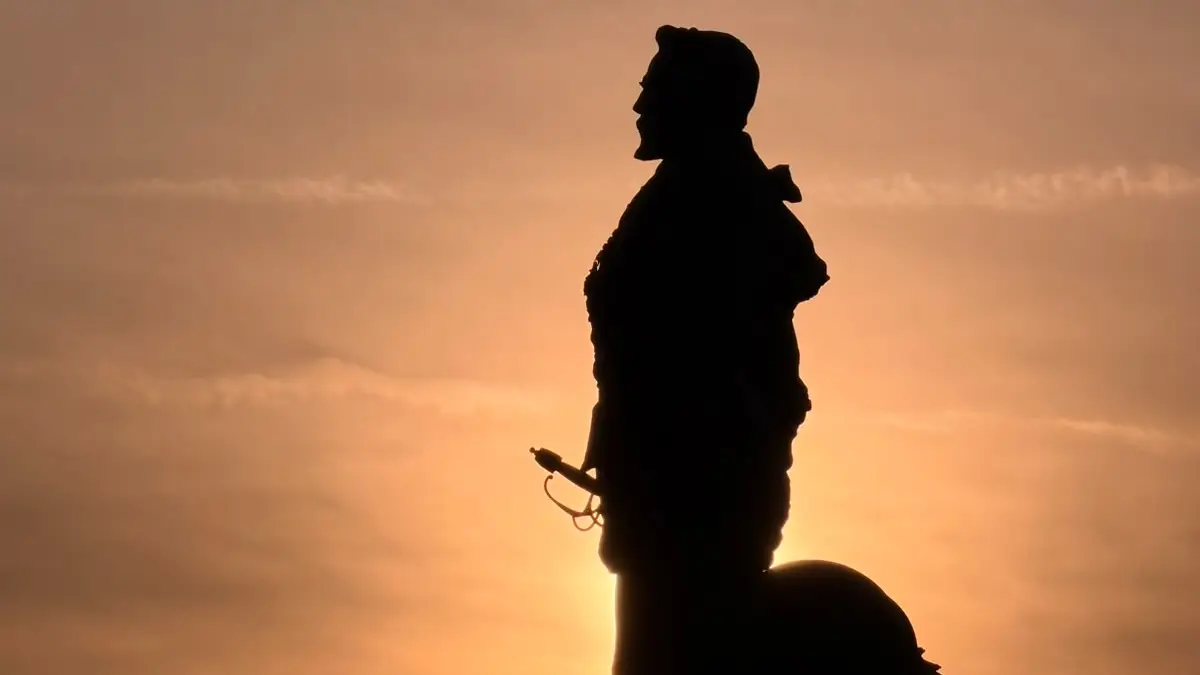
Drake’s drum is rolling, and look at how the modern minnows answer it. The statue on Plymouth Hoe, put up in 1884 for the Armada tercentenary, has acquired a new plaque, added in the BLM years and generally credited with being the reason the bronze is still standing. The commemorations, it explains, “reflected the Victorian view of Drake as a national hero”.
The Victorian view indeed. As against the eternal, disinterested and objectively correct view of a heritage officer with a laminator.
Let Labour screech. Let the Electoral Commission be sicced on us again, let the rules be rewritten in the middle of the innings, let the leader columns discover a sudden passion for the purity of political funding that eluded them entirely during the Sainsbury years.
‘We don’t need another hero’, says the song. Look around us. We plainly do, and in the diffident form of Ben Delo, stood at the edge of somebody else’s party waiting for the clapping to stop, we may have found one.
This article was first published 12 September 2026 on Gawain Towler’s substack Fainting with coils. Photograph by the author.



Comments: 0
Join the debate
Do you agree with this analysis, or is the author wrong? Have your say below.
No comments yet. Be the first to join the discussion.