


THE PARTIES that should be holding the government to account would rather close ranks against Reform.
I expected many challenges when I was elected as an MSP in May 2026. What I hadn’t expected was the behaviour in the debating chamber.
Over two decades, I have occasionally watched debates in the Scottish Parliament from the public gallery. These were generally “members’ debates”, which take place after the day’s voting and are brought forward by an MSP on a specific concern. There is no vote, and the MSPs who bother to stay on usually have a genuine interest. So, although the quality of the debate sometimes left a bit to be desired, facts were brought forward and solutions suggested, or the government asked to take away the points made. Generally, in members’ debates, everyone claps for every other speaker, regardless of party. Well, that was the case before the seventeen Reform MSPs came along this year.
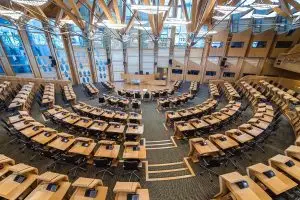
In the chamber, the First Minister can regularly be seen working himself into a faux rage, pointing at the Reform group and saying, “and I will never have anything to do with the Reform racists!” – often specifically naming MSPs. Of course, his 57 followers and the Greens all clap, shout and jeer. The slightly more surprising thing is that Labour, the Lib Dems – and often the Tories in a more muted way – also do this.
I have watched John Swinney reeling on the ropes after questioning by Malcolm Offord about Peter Murrell and SNP finances. Sadly, all it took for Swinney to deflect was to play the “Reform are racists and I won’t have anything to do with them” card, and Labour and the Lib Dems abandoned their next opportunities to question the First Minister in favour of “Reform are racists, Nazis”, etc. Swinney relaxed and must have thought, “I’m so smart… and they’re so dumb”. (That’s a Blazing Saddles reference).
Regularly, in debates – whether in the main session or in a members’ debate – Reform MSPs will make a good speech, with detailed knowledge of the subject and possibly a moving personal story – only to sit down to silence, apart from Reform colleagues. The minister replying to the debate will then make sure they don’t refer to the subject of the member’s speech, but will make a scathing aside about Reform.
no-one should think that some of the opposition MSPs are nice people: they are all first and foremost party hacks who will follow their party line
Another tactic is for a speaker to ignore a Reform MSP when they ask to intervene. The speaker has a perfect right not to take an intervention, but they will normally say “No” or “Not now” or whatever. By acting as if there has been no request, and not looking at the intervening MSP, or the screen showing that MSP, the speaker is continuing the same tactics: ignore, insult and jeer at Reform. The Standing Orders say that MSPs must show respect. So, although the MSP who is speaking has a right not to take an intervention, they should surely have to acknowledge the request and refuse.
These tactics remind me of Lord of the Flies – trying to isolate Piggy (in this case a Reform MSP) while the rest of the “gang” feel pleased to be in with the main players. I’m sure a psychologist would find this an interesting study.
Following one members’ debate, where I sat down to silence, I later challenged a Labour MSP for not applauding the very relevant and moving story I had told. Her response was, “It’s nothing personal. It’s cross-party”. So, no-one should think that some of the opposition MSPs are nice people. They are all first and foremost party hacks who will follow their party line. In this case, getting rid of Reform is uppermost in their minds, regardless of the seriousness of the country’s situation.
I was in the Social Democratic Party and stood in the general election in 1987. It was a crunch election, and there had been a point when it seemed possible that the Labour Party might be wiped out. At my count, I watched Labour’s favourite aristocrat, Tam Dalyell, chatting amiably to the SNP’s Jim Sillars – a surprising duo, but both established politicians in the usual parties. On the other hand, Dalyell had refused to speak to me, or shake my hand. Labour didn’t care that they had lost another general election. All that mattered was that they had survived.
The directional microphones and filming exclude all the bully boys’ nonsense
Their behaviour then was very similar to what we are seeing today. Labour and the Lib Dems have no real prospects in Scotland. They don’t care. Nigel Farage and Reform are “living rent-free in their heads”, to the exclusion of any effort to tackle any of the critical problems facing the country. It is all performance. This allows them not to think about anything else.
And so, Reform MSPs have to sit in the chamber with a barrage of insults coming our way from all sides. Incidentally, those watching online do not hear the full extent of the noise in the chamber. The directional microphones and filming are very good and exclude all the bully boys’ nonsense.
One of the real ironies is that the last session of the Parliament spent endless time on a report about misogyny in Parliament and inventing ways behaviour could be improved. The conclusions have been imposed on the new session. One ridiculous example of their thinking is that it was decided that the subject committees would have to “reflect the gender balance of the Parliament”. Since the parties have to be given their pro-rata allocation of places, achieving supposed gender balance involved gerrymandering.
First, it is very difficult to find out what the “gender balance” is. The Parliament is stumped by the difficulty of one trans woman and one MSP who identifies as “non-binary, a-gender, trans, and queer”. (I identify as “seriously pissed off”).
We urgently need a review of how the Scottish Parliament is performing
Achieving “gender balance” may seem like a classic woke distraction, but it has had a real impact. Reform had allocated one committee to each of most of our MSPs, according to knowledge and interests. However, in the interests of “gender balance”, one of the male Reform MSPs was taken off a committee and is no longer on any committee. One of our women was then put on two committees. So, more work for the women then, and a cosy feeling for those running this madhouse. The Conveners’ Group is not gender balanced for some reason …
However, the committees are where we can hope that actual meaningful work might be done, although they are not given enough authority. Interestingly, Westminster considerably beefed up its select committees in 2010. Most observers agree this has led to an improvement. We urgently need a review of how the Scottish Parliament is performing, to ensure its significant powers are matched by effective means of holding the government to account.
Without a second chamber, even a minority government is likely to get to do as it pleases. Currently, the Greens, Lib Dems and Labour can be seen cosying up to the government to see if they can get some scraps at budget time.
As the convener of the Health, Care and Sport Committee, I have found that committee work does give opportunities. The relevant cabinet secretary and ministers do have to appear fairly often in front of the committee and answer questions. So far, this committee has not shown itself to be obviously partisan and, as is the way with small groups working together on particular issues, the members are polite to each other (face to face anyway). Hopefully, we can get more issues looked at in the light of day, regardless of media bias. The issues are too important to be ignored.
On health, key issues include the drastically speedy reform of the NHS, without consultation with medical and nursing professionals. The proposal that the failing NHS boards will take over social care is an incredibly contentious one. Another issue is the inquiry into NHS Greater Glasgow and Clyde’s Queen Elizabeth University Hospital. The inquiry is nearly concluded and has opened up the real possibility of legal action. Another ongoing inquiry concerns how, under NHS Tayside’s regime, the surgeon Eljamel got away with butchery on hundreds of victims. Sadly, the list goes on.
Nevertheless, there are bright spots where people in public services are working differently and making real improvements in service delivery. We must spread knowledge of these models and influence the development of these and other critical services. Wish us luck.



Comments: 0
Join the debate
Do you agree with this analysis, or is the author wrong? Have your say below.
No comments yet. Be the first to join the discussion.