

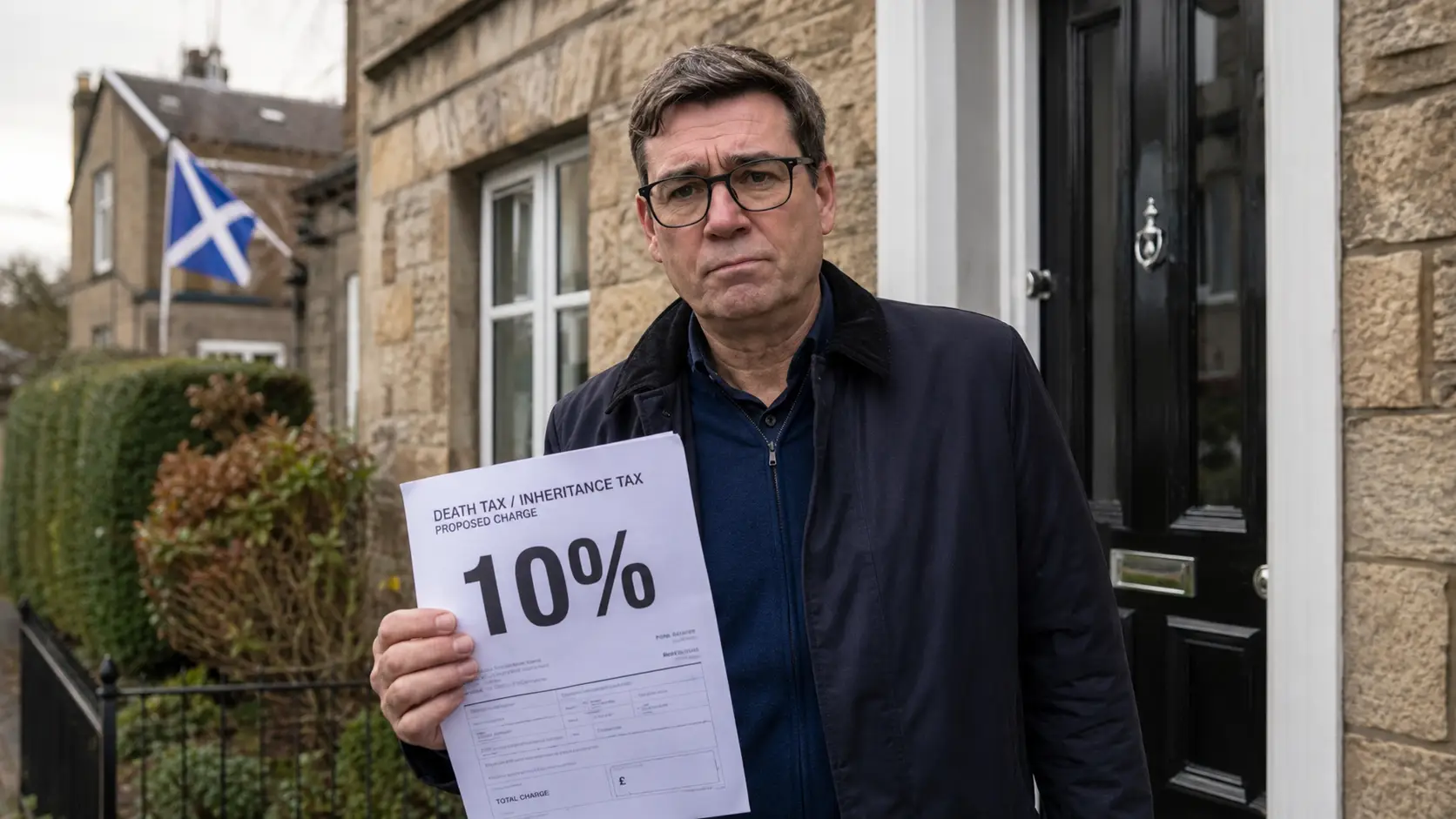
THE PRIME MINISTER has to be very carefully scrutinised and challenged on every vague euphemism that trips from his lips, every kite he flies, every sound bite he passes off as policy. Why? Because there’s every possibility he will simply keep up his “good vibes” routine to inflate the warm glow around him, flutter those eyelashes, and call a general election without ever being held to account for what he really intends to do.
Currently he’s on holiday (of course), but all we’ve had since he stood for the Makerfield by-election (where he shape-shifted on policy as the campaign progressed) is press conferences without questions, chummy videos on baps and barms, and briefings about what his big-picture outcomes might be, such as devolving power to regions and building a national care service.
It’s only when commentators and journalists start to tease out what it all might mean that we begin to see that the soft cashmere hug of Burnham is lacking in any sincerity.
Devolution to Burnham means giving the EU more powers to make our laws and then interpret them in its own courts; it means taking away social care from local authorities and creating a behemoth operating across England and Wales only, but with a national UK-wide tax to fund it.
When he comes back from holiday, Parliament will still be in recess; it then reconvenes for only two weeks before breaking again for the party conference season. It is entirely possible that Burnham will avoid any statements and even Parliamentary Questions (if he can find an international bolt hole summit or pow-wow to disappear to) until he addresses the Labour Party conference in Liverpool (where else!) on 29 September – and, having met His Majesty in advance, calls a general election.
The Tory conference the following week will be thrown into chaos and probably cancelled as the campaigns for an election on Thursday 29 October ensue.
That’s why we must keep scouring his statements, past and present, to try and establish what Burnham really wants to do and what it could mean for every corner of the United Kingdom.
One example of this is the prime minister’s desire to create a particular legacy for the history books. With alarming demographics about an ageing society consuming ever more NHS resources, Burnham believes taking that burden off the health service, local authorities and private providers will define him as the man who saved the NHS. There is at least one big problem: it is very expensive.
Its running costs have to come out of taxes, which means a new tax or raising existing taxes yet again
It will be no easy task to find some £18.7bn annually by 2035 to run a national care service plus a further £18bn of initial set-up costs at a time when ministers like Defence Secretary Wes Streeting will be arguing to expand their own budgets (the Defence Investment Fund has yet to find its £15bn shortfall) and Ed Miliband will be looking to expand foreign aid.
It cannot be funded by borrowing, as it is an annual cost that would force borrowing to rise every year by at least £18.7bn. Its running costs have to come out of taxes, which means a new tax or raising existing taxes yet again.
If placed squarely on income tax the cost would require an increase in the basic rate of almost 3p from 20 per cent to 23 per cent (that’s an increase in tax of £715 on an average salary of £39,000 ) – or 2p across all bands (an increase ranging from £400 for the average salary and £2,300 for someone earning £130,000). The SNP’s six tax bands in Scotland would need to rise by a similar amount. Those 16-17 million UK adults not paying income tax at all (30 per cent of the population) would obviously not be contributing to the costs for a benefit they would be entitled to later in life.
One of the ways to fund this new social care budget that Andy Burnham has suggested in the past is to introduce a flat-rate inheritance tax – known as the Death Tax – of 10 per cent on any estate’s assets, with no tax-free threshold. That would be a radical departure from the current position, where inheritance tax only starts at estates over £325,000 (£500,000 if you leave a home to direct descendants, or up to £1,000,000 for married couples combining allowances). This results in an average of only 31,500 UK estates a year being liable for the Death Tax – around 4.62 per cent of all UK deaths – although those caught can face enormous bills.
the prospect of finding the funds to pay a tax on even a modest single-property estate could become hugely onerous, stressful and highly unpopular
Taxing all estates of those who die – including those without any property – would affect about 646,000 adult deaths in the UK (averaging 58,600 in Scotland) and introduce a revolutionary tax that most bereaved people never thought they would have to prepare for. While the cause of establishing a national care service will undoubtedly be a sweetener for many, the prospect of finding the funds to pay a tax on even a modest single-property estate could become hugely onerous, stressful and highly unpopular.
Those estates valued without property assets, perhaps because the deceased rented their home, would not have the sale of a house to offset paying for any other liabilities such as pensions, leaving the beneficiaries facing a stressful challenge of liquidating most or all of the assets to fund the tax bill. Without a nil-rate band, such as the current £325,000 inheritance tax threshold, every estate would have a liability.
The table below shows that many Labour constituencies – including the most affluent in Scotland – would have significant liabilities, higher even than those in many opposition seats.
Taking the prime minister at his word that any new policy he introduces must pass the “Makerfield Test” – whereby it must work in his own constituency – Reform UK Shadow Chancellor Robert Jenrick calculated the average cost of a 10 per cent Death Tax would be a liability of some £50,000 for an estate of a mortgage-free homeowner in Makerfield, compared with £74,737 for the average mortgage-free homeowner in England.
Writing earlier this week in the Daily Telegraph I highlighted what the likely average death tax liability would be for eleven of the UK’s 650 constituencies. Here I am able to show the full list for Scotland’s 57 constituencies using Scottish data from the Registers of Scotland.
The calculations are based on the median house price per constituency as a reliable proxy of 40 per cent of total wealth (allowing for a further 60 per cent from pensions and other assets). It is possible to estimate the likely annual total constituency liability by multiplying the nominal liability of implied wealth by the Census number of households in the constituency. Anticipated revenue comes from multiplying each constituency’s liability by its own average rate of death (also publicly available). Other variations can also be made for the proportions of age groups that reflecting differing house values and death rates.
everybody’s estate would become liable in the manner of a poll tax payable on death
The average constituency liabilities make for some interesting comparisons – why not look up your constituency to see what its average Death Tax would likely be? What may surprise readers is how many of the highest expected average death taxes would be in Labour and SNP constituencies, a point socialists will have to consider, even if only for three seconds.
Under current rules the Death Tax is highly progressive, with the richest estates paying large sums – which can easily run into millions for the largest landowners – but under a new flat-rate Death Tax it would mean everybody’s estate would become liable in the manner of a poll tax payable on death.
By creating additional taxpayers, those currently paying the most in Death Taxes would experience some savings while everybody else would start contributing. This would be surprising for a Labour Government but then, arguably, the whole population would have access to the new National Care Service.
As well as the financial challenges, there are delivery problems too. Inheritance tax is not a devolved tax, being set and collected uniformly across the whole UK by the Chancellor and HMRC – but health and social care are devolved, with different systems in Scotland, Wales and Northern Ireland. While a new form of inheritance tax can be introduced, the delivery of the service would undoubtedly remain devolved, so it should be expected that the various administrations would have their own slice of the national revenues assigned to them to spend on their own systems as they see fit.
Changing the rates of the Death Tax or radically changing its scope was not included in the Labour manifesto of 2024, so it is fair to say Andy Burnham has no mandate to introduce what is effectively a new tax affecting the beneficiaries of 95 per cent of estates following death. In other words, the vast majority of the public.
The last prime minister who tried to make changes to the financing of care services was Theresa May, with what became known as “The Dementia Tax”. Such was the intense criticism that the idea was quickly abandoned and she went on to lose her commanding lead in the polls and the Tories’ working majority in the election.
For that reason, I expect Burnham to continue to let this particular kite fly, but if he does indeed go ahead with a National Care Service, he will find a more discreet levy that takes more from the wealthiest than it does from the average taxpayer.

Comments: 0
Join the debate
Do you agree with this analysis, or is the author wrong? Have your say below.
No comments yet. Be the first to join the discussion.