

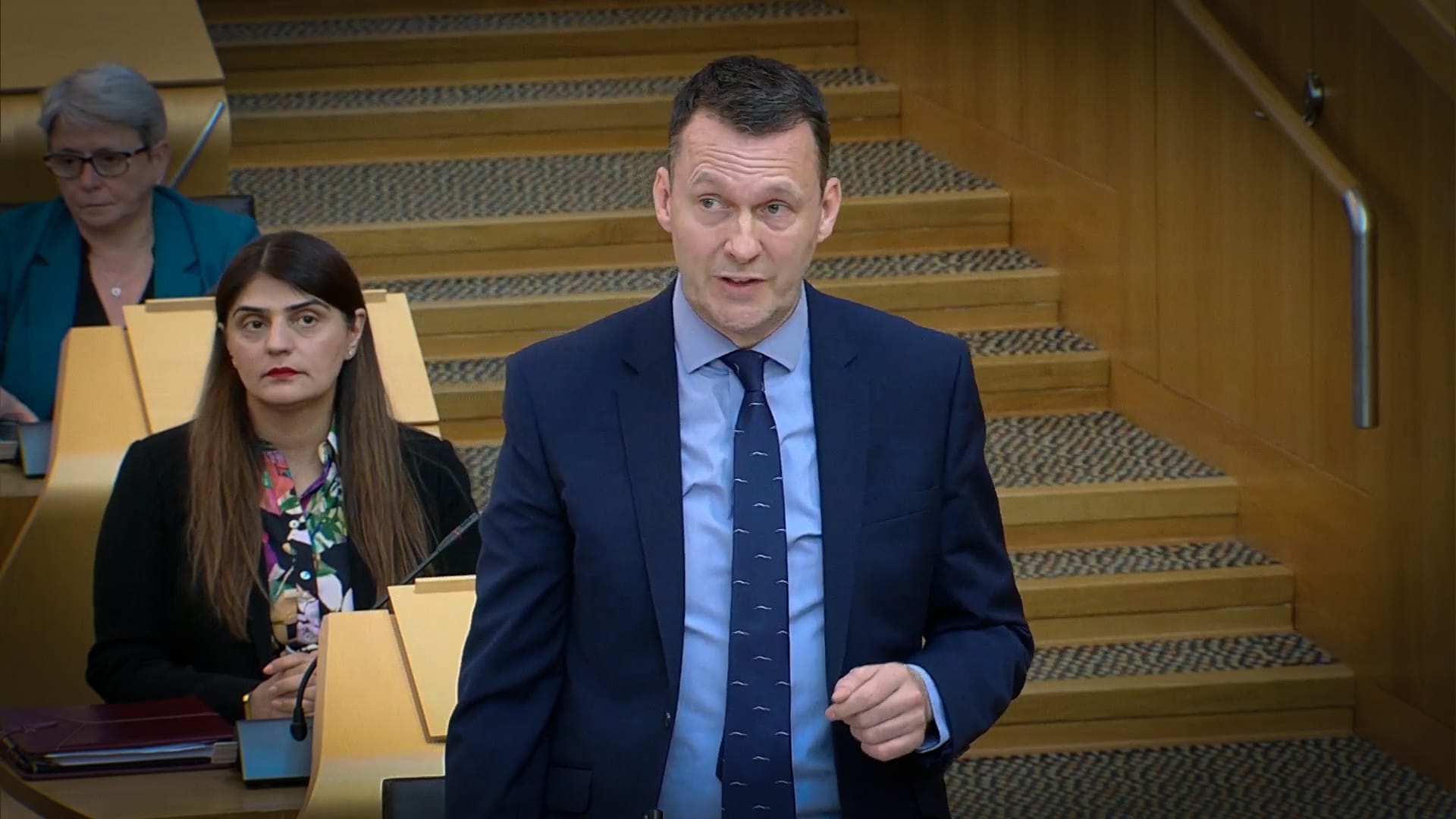
I LIKE RUSSELL FINDLAY, the leader of the Scottish Conservatives. He comes across as amiable and warm, intelligent and with a sense of humour; he’s got a lot of the right ideas and he’s laid more than a few enjoyable punches on John Swinney at First Minister’s Questions. I suspect many on the right in Scotland share my opinion, even if, like me, they no longer vote for his party.
So it was disappointing and disheartening to read Findlay’s cri de coeur in yesterday’s Mail on Sunday about the Tories’ miserable election performance. They lost nineteen MSPs, reducing their tally to twelve – their worst Holyrood result on record. Having been the opposition at Holyrood, they have now slipped behind Reform, Labour and the Greens – only the LibDems have fewer MSPs.
“Sore loser” does not begin to describe Findlay’s desperate response. He blames Reform – which won seventeen seats to become the opposition jointly with Labour – one hundred per cent for the Tory losses, and insists that his “dynamic dozen MSPs are the only real opposition to stop SNP’s drive to break up Britain”. Both these claims are misleading, if not downright false.
No party is entitled to people’s votes. Which is not to say that parties, particularly incumbent ones, don’t end up feeling that they are – it is notoriously what happened to Scottish Labour until they were finally trounced by the SNP in the 2007 Holyrood election. The key, however, is not to reveal that sense of entitlement – nothing is a bigger turn-off – and, more crucially, not revel in it, allowing it to displace the notion that every vote needs to be worked for anew in every election.
Findlay and the Scottish Conservatives fail on both counts. He berates Reform and the people who voted for them for returning the SNP to power – if only they had all voted Tory, everything would be hunky-dory – but completely fails to consider why these voters did not vote Tory and preferred Reform. I would hazard a guess that – going on the records of the Conservatives at Westminster and Findlay’s party at Holyrood – they trusted Reform more than the Scottish Tories to stand up to the SNP and deliver the policies that Scotland needs.
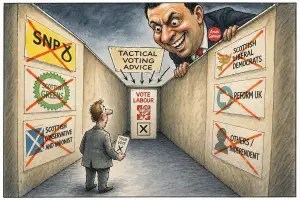
tactical voting manifestly did not work in last week’s election
A central tenet of the Tory election campaign was an argument for a tactical vote to stop the SNP, a fundamentally dishonest tactic (as contributors to this site argued) which manifestly did not work in last week’s election. You might think that would have given the Scottish Tory leader pause for thought, rather than prompting him to double down.
In point of fact, consequential numbers of Reform voters did not come from the Tory ranks, but from other parties, notably the SNP, as Dean Thomson argues in his latest article where he focuses on three constituency case studies. He suggests the “double-out voter … the Eurosceptic independence supporter who backed Yes in 2014 and Leave in 2016” is now finding a new political home in Reform.
the sane response to someone shadow-boxing is to call them out and stop playing
This highlights the second way in which Findlay’s article is wrong-headed and stuck in the past. Like the Japanese soldier who emerged years after VJ day still fighting the Second World War, Findlay has not moved on from 2016 and is still proclaiming the Tory battle-cry, “No to Indyref2”. His defence, of course, is that John Swinney and the SNP haven’t either, but the sane response to someone shadow-boxing is to call them out and stop playing.
Everyone from John Swinney downwards knows his call for a second independence referendum is pure theatre, an empty sop to keep the nationalist faithful on board. He has no legal mandate as the Supreme Court judgement in 2022 made absolutely clear, and his political mandate (in terms of polling for independence and votes for nationalist parties) is weaker now than at any point since 2014. The Labour government at Westminster has also been crystal clear that it will not grant a second referendum, citing its own political mandate in the number of Labour MPs returned from Scotland in the 2024 general election.
Beside all that, since the question of an independence referendum is one for Westminster, not Holyrood, nothing Russell Findlay or his MSPs say or do on the issue will make the slightest difference.
The continued hounding of David Kirkwood, former vice-chairman of Reform in Scotland and now one of its MSPs, is particularly egregious – Findlay uses him to cast aspersions on Reform’s unionist credentials. Like other Reform members and voters, Kirkwood voted Yes in 2014. So what? Polling shows a lot of Yes voters have changed their minds (and there is ample good reason to do so after more than a decade of SNP government), yet ultra unionists treat their Yes vote as an original sin: once a nat, always a nat.
Malcolm Offord, to his great credit, sees that the constitutional debate in Scotland – despite all the shadow-boxing – has lost much of the salience it once had: there are only so many times you can march your army up the hill and down again without depleting its ranks and the faith of those who remain. This, surely, is to be welcomed and encouraged so the full focus of all parties at Holyrood can be on improving its woeful performance on devolved matters.
That was Reform’s election pitch, and it remains disheartening that Findlay is such a sore loser that he needs to demonise the very party whose manifesto is closest to his own instead of finding ways of working with Reform’s new MSPs. To that extent, he is not all that different from John Swinney and his declaration to send Reform to Coventry.


Comments: 0
Join the debate
Do you agree with this analysis, or is the author wrong? Have your say below.
No comments yet. Be the first to join the discussion.