

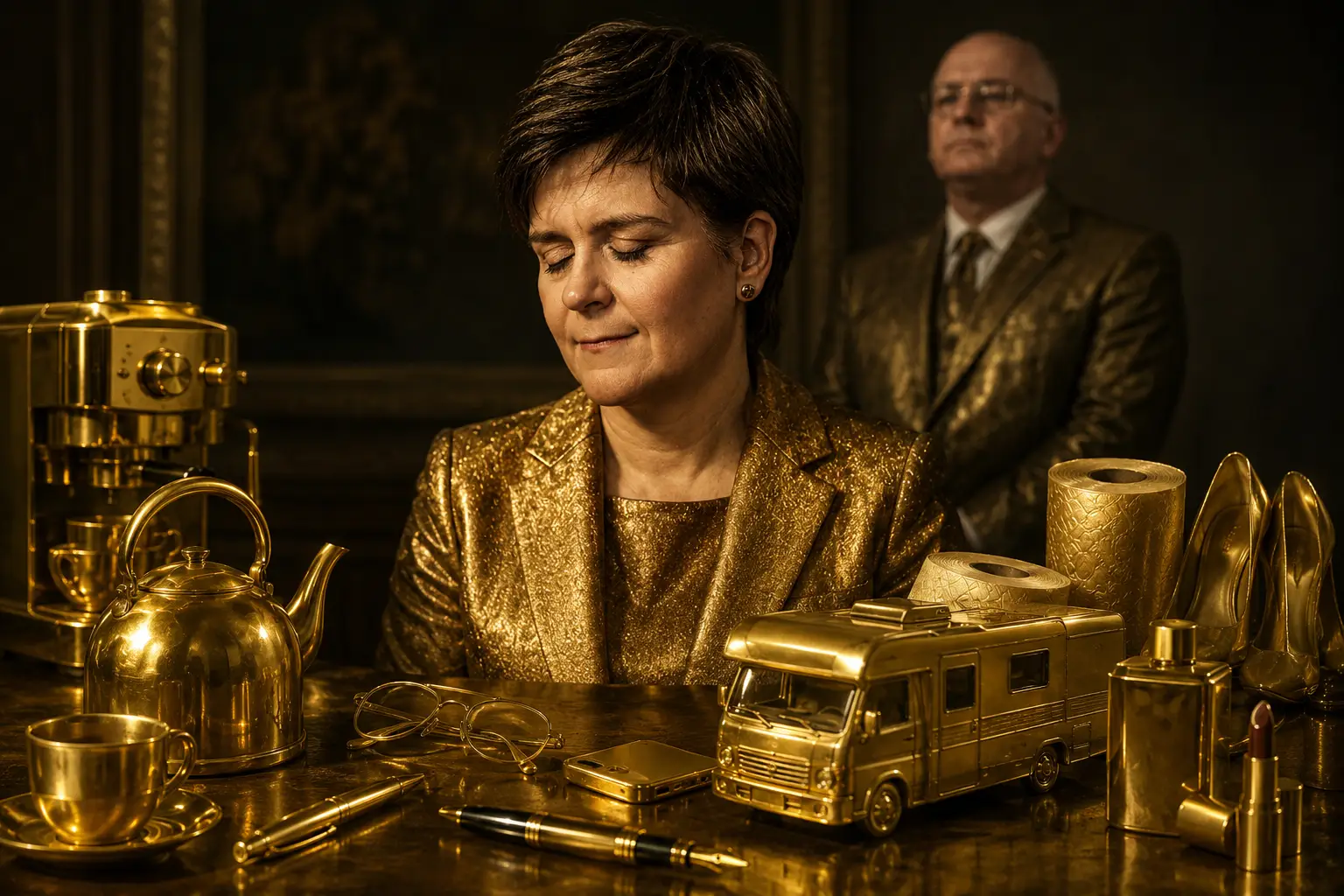
IN THE LAST WEEK OR SO, the Murrells have been the gift that keeps on giving, much as for twelve years party coffers were the gift he couldn’t resist. In these über-grim times, where there is no political or economic respite on the horizon, the list of items pilfered by Peter Murrell has provided the country with welcome merriment.
The tacky £2.6k Lalique salt and pepper grinders; £5k on Montblanc pens; seven kettles in four months; almost £6k on three high-end coffee machines, and of course the world’s most infamous campervan. It’s beginning to sound less like a charge sheet and more like a shopaholic’s version of the Twelve Days of Christmas: Twelve Years of Stealing.
And that’s without the items that didn’t make the charge sheet. Cue more mirth: Murrell stockpiled 108 Andrex toilet rolls just as his wife was warning Scots not to hoard in panic over an impending Covid lockdown. He also spent considerable sums on cosmetics and women’s underwear.
The schadenfreude at the fall from grace of Scotland’s pre-eminent power couple is all the sweeter because throughout her time in office Nicola Sturgeon laid claim to supreme moral virtue. Her political rhetoric dripped with sanctimony, despite the mock humility. She was nobler than other politicians, especially Westminster ones whom she was always ready to denounce, just as the SNP and Scotland more generally were deemed to be morally superior. Nationalists lapped up this mythology, as did much of the media, especially in London, for whom Sturgeon became a Scottish Obama.
What karma, then, that her husband sits in a Scottish prison, facing a lengthy sojourn at His Majesty’s pleasure, while Sturgeon has exiled herself to London, of all places, pleading her innocence via the SNP’s favourite lawyer and appearances at sympathetic book festivals. Her big set-piece interview with Laura Kuenssberg on the BBC on Sunday has been repeatedly compared to Prince Andrew’s ill-starred Newsnight interview with Emily Maitlis.
Like Midas’ gold, Murrell’s bling has proven ultimately destructive
Beyond schadenfreude, there are deeper and older narrative satisfactions to be had in the Murrells’ fate. It is an archetypal morality tale, stretching back at least as far as the Roman poet Ovid’s Metamorphoses, where the gods granted King Midas the wish that everything he touched would turn to gold. It isn’t just that money doesn’t buy happiness. Like Midas’ gold, Murrell’s bling has proven ultimately destructive.
Indeed, like Midas, Murrell’s excess is so extreme – especially in these straitened times when all but the wealthiest are struggling with the cost of living – that there is little scope for public sympathy. And it makes the SNP’s constant harping about poverty sound like Marie Antoinette-level hypocrisy.
But what of Mrs Midas? Scottish poet and former Poet Laureate, Carol Ann Duffy usefully has a poem on the unfortunate spouse in her 1999 collection of poems about the female counterparts of famous men in myth and history. They are written from a feminist point of view, so they should appeal to self-confessed feminist and literature-lover Sturgeon.
Mrs Midas is withering about her husband. She concludes “What gets me now is not the idiocy or greed / but lack of thought for me. Pure selfishness”. I’m sure Sturgeon shares these feelings.
Midas’s dubious gift turns his wife’s life upside down, so much so that she banishes him to “a caravan in the wilds … under cover of dark”. How much Sturgeon might have wished she could have done the same with her husband – had the police not impounded the caravan she claims she didn’t know he’d bought.
But there the parallels stop. Unlike Mrs Murrell, Mrs Midas immediately notices that the twig her husband touches turns gold. When she confronts him, he is “sat in that chair like a king on a burnished throne. / The look on his face was strange, wild, vain”.
Sturgeon was more than happy to lap up the booty her husband delivered
By contrast, Nicola Sturgeon noticed nothing – or so she claims. None of the personal items Murrell bought her and she used (and presumably consulted her about – how else can you buy a woman cosmetics and underwear?), not the £80k Jaguar he drove her about in nor the humongous campervan at her mother-in-law’s. Nor, presumably, did she notice the psychological effect on Murrell of his intensifying kleptomania.
By not noticing, unlike Mrs Midas, Sturgeon colluded – consciously or unconsciously – with her husband and enabled him to continue his criminal activity. Tragically for her, it also meant she was unable to recognise the harm his actions were doing to her and take steps to avoid that harm.
Mrs Midas’s first reaction was to scream with horror, then on realising her husband could kill the cat – or her – if he touched them, she locked the cat in the cellar and barred him from her bedroom. While he is delighted that his wish was granted, his wife knows gold “feeds no one; aurum, soft, untarnishable; slakes no thirst”.
Sturgeon, by contrast, was more than happy to lap up the booty her husband delivered, believing it was from his SNP salary, as no more than her due. To that extent, Murrell’s golden touch has ruined Sturgeon’s reputation – a symbolic killing, if you like.
Mrs Midas may have avoided death at her husband’s hands, but Carol Ann Duffy is clear-eyed in the poem about the terrible cost Mr Midas nevertheless extracted from his wife: intimacy, as symbolised by human touch, her marriage, a possible child.
Doubtless Nicola Sturgeon would identify with Mrs Midas in a feminist analysis that both were done over by their husbands, betrayed by selfish men, and not responsible for their husbands’ initial malfeasance. Of course, Sturgeon denies her own collusion – not just in failing to notice the bling at home, but also as party leader in failing to notice or act on dodgy accounts and in firmly shutting down any awkward questions about those accounts. Despite wearing her heart on her sleeve with Laura Kuenssberg, Sturgeon could not manage the minimal recognition of her agency, in Mrs Midas’s words, as “the woman who married the fool / who wished for gold”.
To hear no evil, see no evil and speak no evil has long been the number one strategy in the SNP playbook
The one new revelation in the Kuenssberg interview was that Sturgeon found out the police investigation had expanded to interviewing individuals about misappropriated party funds just before she suddenly resigned in February 2023 – and shortly before her own arrest. At the time she denied any connection between her resignation and the police investigation, but it now looks like this was her very belated attempt to protect herself from the consequences of Murrell’s crimes.
The other mythic archetype Sturgeon recalls is the three wise monkeys. To hear no evil, see no evil and speak no evil has long been the number one strategy in the SNP playbook when confronted by something the party doesn’t like or that reflects badly on it. It was no surprise, then, that Sturgeon adopted it – and threatened others into adopting it – when confronted by questions about party finances on the party’s National Executive Committee.
It is also the strategy John Swinney is clinging on to as he insists all questions have been answered about the Murrell affair and no parliamentary inquiry is necessary.
The three-monkey strategy is what Sturgeon naturally adopted in her marriage to Murrell, and what she also continues to adopt. The reflex reached its apotheosis last week when her lawyer Aamer Anwar threatened defamation actions against anyone who speculated about what she might have known and when she knew it. His letter to the press has had the opposite effect because Scotland’s Mrs Midas has been well and truly ridiculed.




Comments: 0
Join the debate
Do you agree with this analysis, or is the author wrong? Have your say below.
No comments yet. Be the first to join the discussion.