


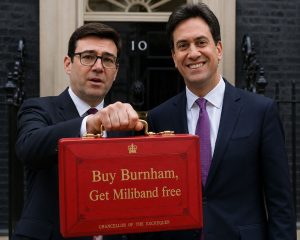
IN HIS FIRST SPEECH Andy Burnham undertook to make politics “more collaborative, more about problem solving than point scoring.” This, he opined, would lead to the creation of a new economy.
That might be possible or it might not, largely depending on who collaborates with whom, and about what. It’s a soundbite, not a policy. Or, perhaps, it’s a smokescreen for what he really intends to do.
Running things efficiently is not really about collaboration. It’s about selecting the best – or sometimes the least bad – policy option and implementing it as efficiently and quickly as possible. Speed is important because circumstances change, and as they do the efficacy of a policy may deteriorate. Developing policy options is the role of the technocrats, as is evaluating them. Picking the one to be adopted is the leader’s task.
There are several ways to approach that decision. One can make it oneself and persuade one’s team that the choice was correct. One might instead be collegiate, working with a sub-group to make the decision. One might delegate the decision to a subgroup, although one should remember that delegating the ultimate responsibility is impossible. Or one might have a debate with colleagues, hoping to argue one’s way to a sound policy.
That debate might be robust, even bruising and the end result might be a vote which one loses. Robust and bruising debates may not be “collaborative”, but they are necessary virtues when strongly held ideas collide with other strongly held ideas.
There is no collaborative solution to many problems. Scottish (and Welsh) independence split communities, as did Brexit. Other topics for which there is no collaborative approach include the death penalty and assisted dying. These issues are fundamental and perhaps abstract, in as much as the evidence basis for the decision is small and questionable.
The economic future of an independent Scotland, or indeed of a UK still in the EU, is a series of assumptions that are unlikely to be completely correct. People can argue about a number on the side of a bus (and many did), or about the implications of sovereignty (and many do) but those are only parts of the whole. Ultimately, people will vote on these matters according to what they feel – their judgement, not solely according to what they know.
High-profile campaigners may distort the discussion, as Esther Rantzen did with the assisted dying debate. They may even influence decisions despite not being in Parliament. What they are not doing is making a government decision more collaborative. Or rather, they’re not unless the government’s inner circle hasn’t already made the decision and now wants to give it a veneer of democratic accountability and due process.
calling a general election now would be recklessly brave
Remember, as leader of the Labour Party Burnham’s mandate is constrained by the Labour manifesto on which the Government was elected. If one of his new ideas is not in the manifesto, he can’t ram it through the House of Lords. Or rather, he can’t unless he appoints another 128 Labour peers to give him a majority of one.
He says he’ll produce a ten-year plan in the autumn, yet he has fewer than three years before he must face the electorate. Producing a plan that will take a decade to deliver is an exercise in deception and hubris, nothing more. With things as they are – Labour relatively weak in the polls and the economy collapsing – calling a general election now would be recklessly brave.
Once his plan is published, he might hope for a bounce in optimism, particularly if he can deliver a budget that puts some money in voters’ pockets without disturbing the bond markets. If that happens, an election might look winnable.
But all elections are also losable. I fear Burnham intends to tinker with the electoral rules to render a win for Labour more likely. Reducing the Westminster voting age to sixteen is one area that might do that, and it’s in the 2024 manifesto. Recent Scottish and Welsh election results won’t be encouraging, though; reducing the voting age to sixteen cost Labour the Caerphilly Senedd by-election and then contributed to its being wiped out in the Senedd elections, where Labour slumped to a distant third place behind Plaid Cymru and Reform.
In the Scottish Parliament elections, where sixteen-year-olds also have the vote, Labour was also hammered into third place by the Scottish Nationalists and Reform. Unless Burnham persuades himself that sixteen-year-olds will fall for his northern charm (I use the phrase loosely), enfranchising them is high risk. Better to tinker with something else.
what Burnham means is the road to a one-party progressive state
Labour has already changed the rules for the forthcoming Manchester mayoral elections, switching the system from first past the post (FPTP) to the supplementary vote (SV) system, under which voters have a first and second choice. If no candidate wins more than fifty per cent of the vote after first preference votes are counted, the top two candidates proceed to a run-off, in which second preference votes from the eliminated candidates are counted. The impact is almost impossible to predict, but Professor Jonathan Tonge of the University of Liverpool suggested Labour could pick up second preference votes from Greens and Lib Dems, whose voters are exceptionally unlikely to vote Reform, Restore or Conservative.
Andy Burnham might call this progressive electoral collaboration, but what he means is the road to a one-party progressive state, with Labour in charge with the Greens and Lib Dems acting as their useful idiots. Given the current composition of the House of Commons, it’s not impossible that the government will bring electoral reform legislation forward, largely to stop Reform.
Certainly Ed Davey is in favour; Lib Dems are more frightened of Reform than they are of any of the Labour factions. Given the failure of FPTP in the last election (as demonstrated by the disparity between Reform and the Lib Dem votes received and seats won), the House of Lords might be less hostile, particularly as the 2024 Labour manifesto also includes aspirations to modernise the House of Lords to make it “more representative” – a chilling term.
It’s not a coincidence that the Burnham camp timed their assault to finish just before the Parliamentary recess. With no Prime Minister’s Questions to answer and most of the Lobby press on holiday, Burnham can avoid scrutiny and consort with his cronies, putting the final touches to their plans. Such media interest as there is will no doubt be deflected by Burnham giving soft interviews to the more pliant journalists rather than giving Andrew Neil the interview he promised.
When Parliament returns at the beginning of September Burnham has to get through a month, and then there’s the Labour Party conference (27-30 September), where he can preach to the choir. Then, and only then, might he and his Chancellor endure some tough questioning in the run-up to the budget. Until then, we’re being taken for fools and treated with contempt by a Cabinet with little experience of making decisions.
And that’s where the Burnham collaboration approach takes a punch in the mouth from reality. Collaboration doesn’t make decisions easier; it often delays them and makes them harder. Early release of prisoners is one simple example; until more prisons come online prisoners must be released early to free up cell space for new convicts. If convicts serve a higher percentage of their sentence, there is no room for newly sentenced criminals. Rather than make this point when the early release of the two toe rags convicted of the manslaughter, not murder, of PC Harper, Burnham avoided a decision and commissioned a review.
If he can’t make that decision, how will he address the problems of funding rearmament and welfare while remaining within the Reeves fiscal rules, as he has pledged to do? What about the £2 trillion or so of unfunded public sector pensions, or the £295 billion of student loans? Surely Burnham considered this in his well-executed ascent to Downing Street.
Burnham rightly bemoans this country being in hock to the bond markets. What he hasn’t done is set out how he will fix that. Instead, he’s espoused the policies of the 1970s and rebranded them “business-friendly socialism” – whatever he thinks that means. It’s the equivalent of Blair’s “Third Way” – an empty phrase that butters no parsnips.
Unless Burnham can balance the Budget, the bond markets will continue to call the tune. Balancing the Budget means eliminating the deficit, which was forecast to be £115 billion in 2026-27 on government spending totalling £1,400 billion. Burnham’s chancellor, John Healey, needs to find either cuts to spending of about ten per cent or a similar increase in the tax take.
In his first speech as Prime Minister Burnham concluded by saying: “Let us make this the moment when Britain starts to believe again.”
Believe in what – the magic money tree?
Enjoy the sunshine while it lasts. Autumn will be brutal.

Comments: 0
Join the debate
Do you agree with this analysis, or is the author wrong? Have your say below.
No comments yet. Be the first to join the discussion.