

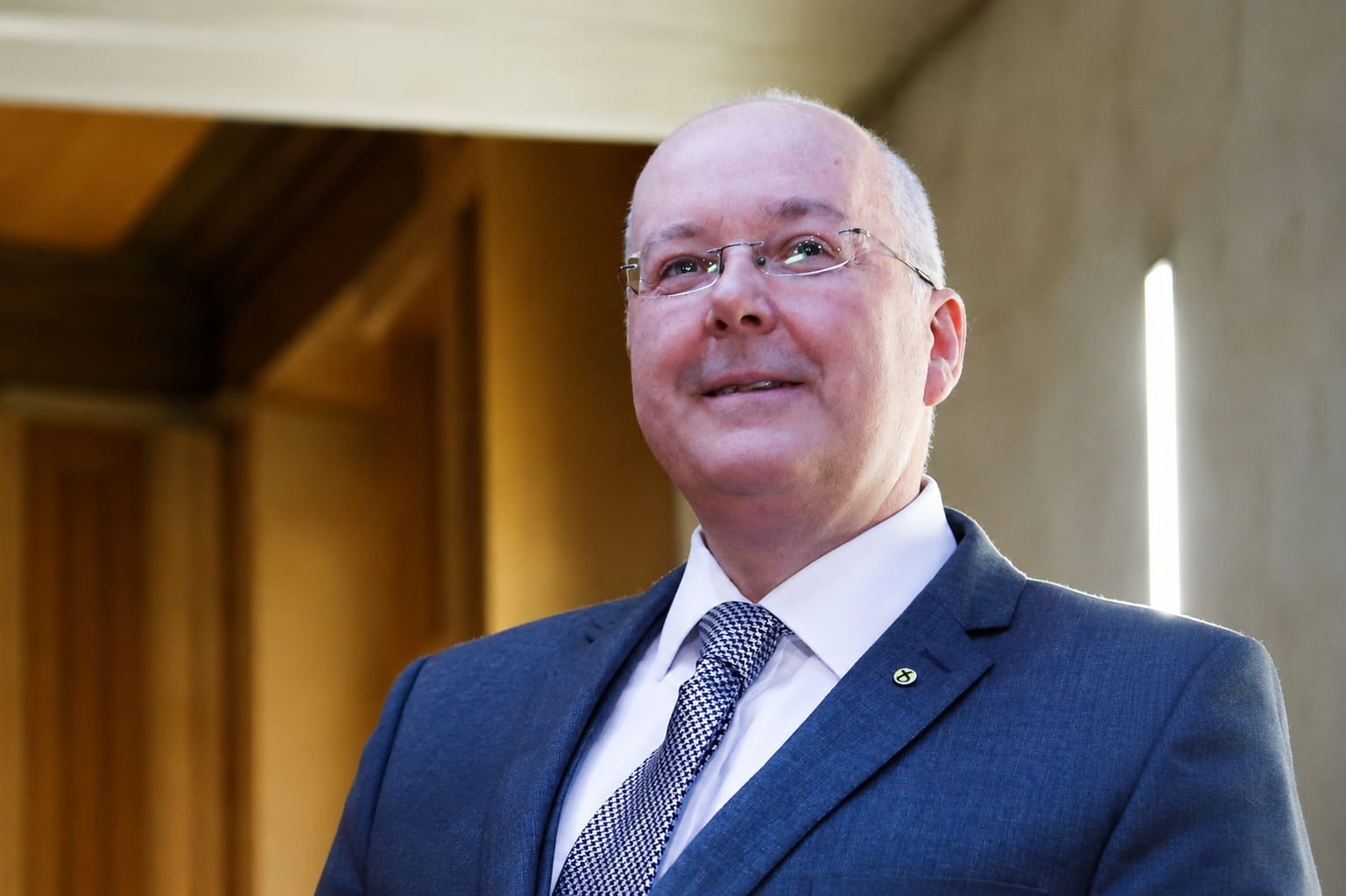
MURRELL’S GUILTY PLEA cannot be the end of the SNP scandal: it must be the start of the audit Scotland needs.
Peter Murrell has now admitted what the SNP spent years hoping would disappear into procedural fog. The former chief executive of the Scottish National Party has pleaded guilty at the High Court in Edinburgh to embezzling £400,310.65 from the party. The money was used for luxury goods, a motorhome and towards two cars. He was handcuffed in court, remanded in custody, and is due to be sentenced on 23 June.
That is not a bookkeeping error, nor an unfortunate misunderstanding, nor some minor internal matter for a political party to tidy away with minimal fuss. It is the former chief executive of Scotland’s governing party admitting that he stole hundreds of thousands of pounds from that party over a period of ten years. And now the SNP wants everyone to move on.
The guilty plea may bring the criminal proceedings against Murrell closer to their conclusion, but it does not close the political scandal – it opens it.
The first question is obvious: why plead guilty now?
No one outside Murrell’s legal team and the prosecution can state his motive. It would be irresponsible to claim as fact that he pleaded guilty to avoid questions about Nicola Sturgeon or other senior SNP figures. But the effect of the plea is plain. There will now be no long public trial, no extended cross-examination and no weeks of witnesses, documents, internal emails and party finance practices being tested in open court.
Nicola Sturgeon has not been charged. Police Scotland confirmed in 2025 that she and former SNP treasurer Colin Beattie were no longer under investigation. Sturgeon has said she had “no knowledge or suspicion whatsoever” that Murrell was using SNP funds for personal purposes.
the Murrell scandal does not sit in isolation
But criminal guilt is not the only standard in public life. The question is not merely whether Nicola Sturgeon, or anyone else, committed a criminal offence. The question is whether the SNP’s senior leadership, its treasurers, its national executive, its auditors, its ministers and its internal watchdogs knew, should have known, or failed to ask the questions any serious organisation would have asked.
How does £400,000 leave a political party without alarms ringing?
How does a party chief executive preside over that kind of financial conduct for years while the party he runs also runs the Scottish Government?
And if the SNP could not properly govern its own finances, why should Scotland trust it to govern billions of pounds of public money?
That is the question Reform should now drive through the middle of Scottish politics.
Operation Branchform began amid concerns about the handling of more than £600,000 raised for an independence campaign. The money came from ordinary people – pensioners, small donors, true believers. People donated their cash because they thought they were funding the cause of Scottish independence, not the lifestyle of the party machine.
Those people deserve answers – but so do taxpayers.
Because the Murrell scandal does not sit in isolation. It lands in a Scotland already familiar with weak accountability, missing paper trails, public money sprayed around under political pressure, and the SNP’s usual response: denial, delay, defensiveness and a demand to be trusted.
Take Covid spending.
Audit Scotland reported that the Scottish Government spent £14.5 billion on its pandemic response, funded mainly by £14.4 billion of Barnett consequentials from UK Government spending. The Scottish Government had budgeted £15.5 billion for Covid measures, with the difference either used elsewhere in Scottish Government spending or carried through the Scotland Reserve.
Audit Scotland also said the Scottish Government had difficulties tracking Covid spending because it was not a standard budgetary or accounting classification.
That does not prove corruption. Nor does it mean every pound was stolen. But it does prove something politically serious: Scotland still does not have the level of clarity it should have over enormous sums of emergency public money.
Audit Scotland’s earlier report was even more direct. It said records of Covid financial decision-making were not collated centrally, that it was hard to see how some decisions were reached, that there had been limited evaluation of the financial response, and that information was not always available or centrally collated. It also warned that using reserves to manage spending between years carried a risk that it would not be clear how Covid funding held in reserves was spent over time.
In plain English: the SNP Government asked for emergency trust, spent emergency money, then failed to provide emergency-grade transparency.
The business support schemes tell the same story. Audit Scotland reported that between March 2020 and October 2021 the Scottish Government made available around £4.4 billion of grants and non-domestic rates reliefs, mostly administered and paid by councils. A further £375 million was announced after Omicron. But Audit Scotland also found that the quality and completeness of data held by the Scottish Government varied, preventing detailed analysis of how funding was distributed or how quickly applicants received it.
Again, this is not proof of fraud, but of weak governance.
Then there are the politically awkward examples. The Stand Comedy Club’s parent company, Salt ’N’ Sauce Promotions, has been reported as receiving substantial Covid-era public support, including reports of a £250,000 grant. The Stage also reported Salt ’N’ Sauce Promotions, which runs The Stand comedy clubs, as one of the larger recipients in a Scottish venues Covid relief round. The Stand was founded by Tommy Sheppard, the former SNP MP for Edinburgh East, who stepped down as chairman in 2026.
the public is entitled to see the paperwork
Was that unlawful? I am not saying that. Was the business entitled to apply? Possibly. Was the grant justified? Perhaps.
But in a small country, where political, cultural, public funding and nationalist networks often overlap, the public is entitled to see the paperwork. Who applied? Who assessed it? What criteria were used? Were conflicts declared? Were political connections considered irrelevant, or merely assumed to be irrelevant? Were outcomes measured? Was the money necessary, proportionate and fairly awarded compared with other businesses left to drown?
These are not conspiracy questions, but audit questions. The SNP hates audit questions.
Then look at Ferguson Marine. Audit Scotland reported in 2022 that the two ferries for the Clyde and Hebrides were originally expected in May and July 2018, but were almost four years late at that point. The project was then estimated to cost at least £240 million, around 2.5 times the original vessels’ budget. The original fixed-price contract was £97 million. Audit Scotland also found insufficient documentary evidence to explain why Scottish ministers accepted significant financial and procurement risks and approved the contract award in October 2015.
By 2023, Audit Scotland said the two vessels were estimated to cost £293 million, were already five years late, and that concerns had been raised over £87,000 of performance bonuses paid to senior Ferguson Marine managers without proper governance or Scottish Government approval.
By 2024, Audit Scotland was still warning that the future of the publicly owned Ferguson Marine shipyard was uncertain, with no more work secured beyond completion of MV Glen Rosa and multiple risks to the continuing cost of completing it. Now characterised as a long-running ferry scandal, it is in fact a governance scandal.
the SNP’s answer is always the same: move along, nothing to see here
So let’s join the dots:
A governing party whose chief executive has now admitted embezzling more than £400,000.
A party finance scandal that avoided a full public trial because of a guilty plea.
Covid money that Audit Scotland says was difficult to track, not always centrally collated, and not properly evaluated.
Business support schemes where data gaps prevented detailed analysis.
Public grants going into politically connected cultural spaces, which may have been perfectly lawful but still require transparent justification.
A ferry procurement disaster where costs exploded and Audit Scotland found insufficient documentary evidence to explain why ministers accepted major risks.
At what point does Scotland stop treating these things as separate accidents?
The SNP will say Murrell’s crime was a party matter. That is not good enough. He was not the treasurer of a bowling club. He was the chief executive of the party of government. The SNP was not some private association operating in a cupboard. It was, and remains, the dominant machine in Scottish public life. The culture of that machine matters.
The SNP has spent years telling Scots to trust it with more powers, more tax, more regulation, more control and ultimately the powers of a separate state. Yet when asked to explain its own finances, its Covid spending, its ferry contracts or its internal governance, the answer is always the same: move along, nothing to see here.
Reform should now lead the charge, but it must do it properly.
This should not be a loose campaign of online innuendo. It should not claim that Nicola Sturgeon has been convicted of something she has not. It should not overstate what is known. The strongest case is the cleanest case: Scotland needs a forensic audit of SNP-era financial governance and a public inquiry into the stewardship of public money.
The demand should begin at Holyrood. Public money spent by the Scottish Government is a Scottish matter. Scottish Ministers have the power to establish a public inquiry into matters causing public concern, and Scottish Government guidance recognises that inquiries can be held jointly with the UK Government where reserved and devolved issues overlap.
That gives Reform a clear position.
First, call for an independent public inquiry into Scottish Government financial governance during the SNP years. The remit should include Covid spending, business support, culture grants, ferry procurement, ministerial directions, conflict-of-interest procedures, record-keeping, arms-length bodies and the role of politically connected networks in public funding decisions.
Second, call for a forensic Audit Scotland-led review of Covid-era spending. That should include a published register of major grants, award criteria, scoring records, conflict declarations, monitoring reports, fraud and error recovery, and measurable outcomes.
Third, call for Westminster scrutiny where UK-origin money is involved. Barnett consequentials are generated by UK Government spending. If Holyrood refuses to mark its own homework, Westminster’s Scottish Affairs Committee and Public Accounts Committee should examine whether the current devolved accountability system is strong enough to protect taxpayers.
The SNP’s central myth has always been that it is uniquely virtuous because it claims to speak for Scotland. Murrell’s guilty plea should kill that myth stone dead. The SNP is not Scotland. It is a political machine. And like every political machine, it requires scrutiny, audit, opposition and restraint.
For too long, hard questions have been brushed aside as anti-Scottish. That trick must end. There is nothing patriotic about weak financial controls. There is nothing progressive about public money disappearing into fog. There is nothing democratic about telling taxpayers they have no right to follow their own money.
Murrell has admitted embezzlement. Now Scotland needs to know how deep the culture of financial carelessness goes. The public paid the bill and the public deserves the books.



Comments: 1
Join the debate
Do you agree with this analysis, or is the author wrong? Have your say below.
Excellent as James Glen’s article is and with respect to him we all knew that the SNP is a thoroughly dishonest organisation and that its MP’s and MSP’s are vagabonds and thieves stealing from and cheating the very people they pretend to be working for. How much have they taken from us via the public purse is anyone’s guess but one thing is certain, it’s gone, forever.