


THE RISE OF REFORM UK has triggered a kind of moral panic inside Britain’s political and media class. Instead of asking why millions of people, including large numbers of former Labour voters, are abandoning the established parties, much of the reaction has been to denounce those voters as dangerous, ignorant, manipulated, or somehow morally defective. That response is not merely contemptuous: it is politically self-destructive.
The results speak for themselves. Reform gained roughly 1,450 council seats across England in the 2026 local elections and took control of more than a dozen councils. Labour lost nearly 1,500 councillors in what many commentators described as one of the party’s worst collapses in modern local election history.
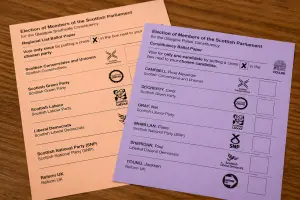
In Scotland, Reform entered Holyrood as a major parliamentary force with 17 MSPs, tying Labour for second place behind the SNP.
That result shattered one of the great myths of Scottish politics. For years the Scottish establishment maintained that Reform-style politics was somehow alien to Scotland, that dissatisfaction with mass immigration, stagnant wages, institutional bloat, and managerial politics was confined to England. The election exposed how shallow that assumption really was.
most Reform voters are not revolutionaries
The easiest response for the political class has been to reach for the language of extremism. John Swinney’s decision to exclude Reform from cross-party talks on the basis that the party is allegedly “far right” sends a remarkable message to hundreds of thousands of Scottish voters. It says their votes are legitimate only when cast for approved parties.
That is a dangerous habit in any democracy. It is especially reckless at a moment when public trust in institutions is already threadbare.
The BBC’s habit of wheeling out academics and commentators to compare contemporary populist voting patterns with the social conditions surrounding the rise of Hitler illustrates the problem perfectly. Such comparisons are intellectually lazy and historically unserious. They function less as analysis than as moral intimidation. The implication is obvious: vote Reform and you are participating in something dark, irrational, or proto-fascist.
Yet most Reform voters are not revolutionaries. They are ordinary people reacting to material decline and institutional failure.
Many are voters who spent years backing Labour. Many are working people who have watched productivity stagnate while taxation rises. Many are self-employed, small business owners, tradesmen, taxi drivers, warehouse workers, carers, or retired people who increasingly feel that the state extracts from them but no longer represents them.
For decades, Britain has expanded layers of public administration, regulatory bodies, consultancies, quangos, compliance systems, and managerial structures while productive sectors of the economy have struggled under high energy costs, housing pressures, wage stagnation, and declining infrastructure. Scotland exemplifies this tendency.
The growth of the state apparatus has not produced noticeably better public services. Instead, many voters see institutional decay combined with endless bureaucratic expansion.
The result is a growing sense that Britain is governed less by accountable politicians than a permanent administrative culture insulated from democratic pressure.
That is why accusations of “populism” no longer land as they once did. Increasingly, voters hear the term as shorthand for “people the establishment dislikes”.
The irony is that establishment parties themselves helped create Reform’s rise. For years, legitimate concerns about immigration, social cohesion, public spending, housing demand, crime, or the direction of public institutions were treated not as political questions but as evidence of moral deficiency. Debate was narrowed and diissent was pathologised. Voters who objected to prevailing orthodoxies were described as backward, xenophobic, or manipulated by misinformation.
When people are denied normal democratic expression, they do not quietly disappear. They eventually find a political vehicle.
And the more aggressively Reform voters are demonised, the stronger that vehicle is likely to become.
Large numbers of voters feel not merely ignored but actively despised
There is already evidence that Reform’s support is strongest in economically strained communities and among voters detached from the graduate-professional culture dominating Westminster, Holyrood, the media, and much of the public sector.
These are precisely the voters who increasingly believe mainstream politics speaks a language designed to exclude them.
The establishment still does not fully grasp the emotional dimension of this shift. Large numbers of voters feel not merely ignored but actively despised. Every time a commentator compares Reform voters to interwar extremists, every time a public institution treats dissenting opinion as morally suspect, every time democratic representation is denied legitimacy because it is electorally inconvenient, that perception hardens.
The old political consensus is fragmenting because the economic and cultural assumptions underpinning it are fragmenting. Britain is entering a period of political realignment in which class, education, geography, and institutional trust matter more than traditional party loyalties. Reform has emerged not because voters suddenly became extremists, but because millions of people concluded that the existing parties either could not or would not address their concerns.
The establishment response so far has largely been to lecture those voters about why their concerns are illegitimate.
That strategy has already failed. Repeating it more loudly is unlikely to change the outcome.


Comments: 0
Join the debate
Do you agree with this analysis, or is the author wrong? Have your say below.
No comments yet. Be the first to join the discussion.