

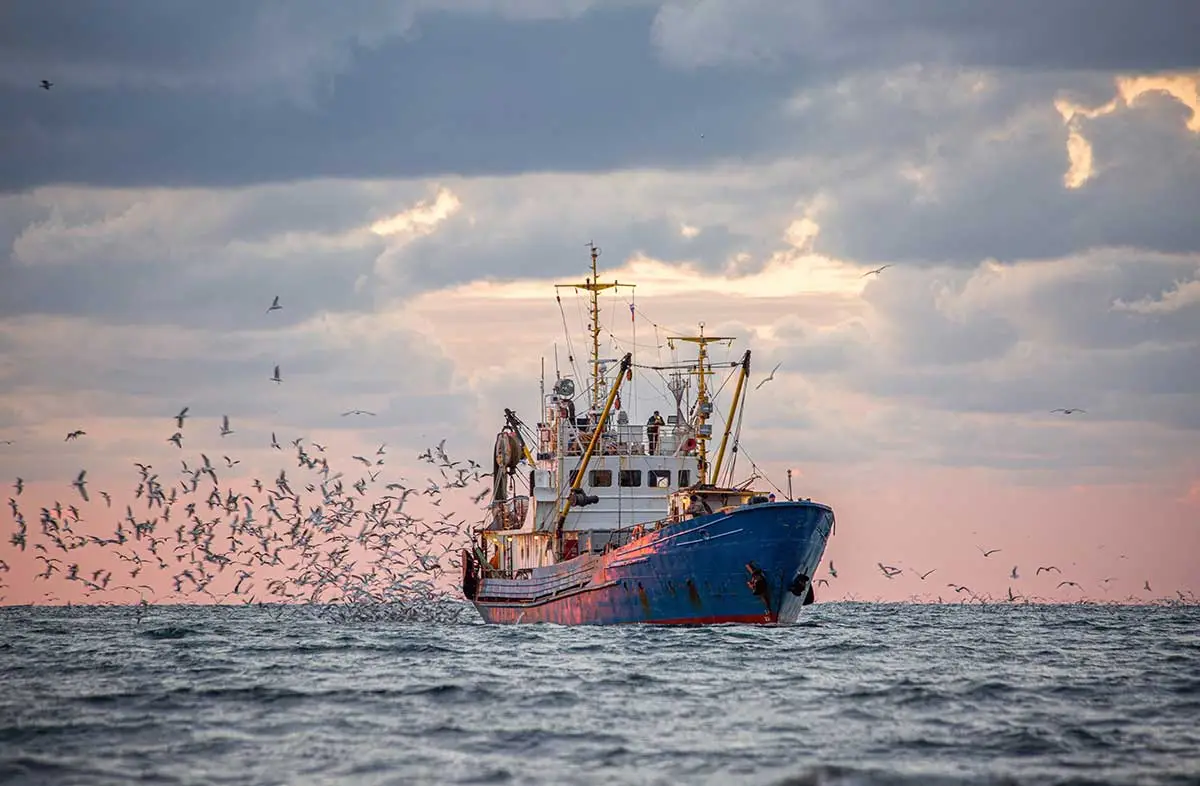
WHEN DAVID BULL visited Scotland during the 2024 general election campaign, Jo Hart took us to meet fishermen in Peterhead, the largest fishing port in the UK.
It would be wrong to say that the Scottish Government hadn’t invested in infrastructure. It funded solar panels on shed roofs, which were soon covered in an inch of seagull droppings, making an already inefficient technology completely useless.
It was only later, after discussions with John Cox, that I realised that the decline in the fishing industry was not one of political neglect but political intent. It was perhaps the first casualty of environmentalism and was finished off by the European Common Fisheries Policy.
From the mid-1970s to the mid-1980s, the Green movement couldn’t use global warming as a threat because there had just been thirty years of global cooling. Enter the Population Bomb myth. Too bad if a billion people starved before the end of the century because we were greedily exploiting the world’s finite resources. Humanity would get its just deserts. But drastic action was necessary to “save the planet”.
Cod stocks were declining and the species was one of many allegedly facing extinction, so the Scottish fishing industry had to be culled. Grants were given for decommissioning the UK fleet. Five hundred Scottish white fish boats were reduced to sixty. Fish markets and thousands of jobs were lost in Buckie, Macduff, Lossiemouth, Arbroath, Aberdeen, Whitehills, Mallaig, Lochinver, Kirkwall and Ayr.
we should ensure all fish from our waters are landed at UK ports
At the same time, Spain was building a new fleet to take advantage of UK waters being opened to it under the European Common Fisheries Policy. Instead of introducing a sensible quota regime for existing boats, the reduced catch was shared with our European “partners”.
Brexit was the chance for a fishing industry renaissance, but Boris Johnson and Keir Starmer used it as a pawn in EU bargaining. Starmer claimed his deal eased access to EU markets for Scottish salmon and shellfish. £350m would be invested in the industry, but the share of this between Scottish and English fishermen favours the latter, being based on the Barnett formula, not recognising that Scotland has over 65 per cent of the sector.
There are still around 4,000 people employed in Scotland’s commercial sea fishing industry, worth £335m in 2022. The industry is vital for remote communities. Sales of farmed salmon were worth £844m in 2024, the UK’s biggest food export. In May 2024, the Scottish Rural Affairs Secretary Mairi Gougeon and 53 other MSPs signed a pledge. “I have Pride in our Seas, and all those who feed us from them.” Worthless words again. Our fishing communities need Reform.
Holyrood is responsible for the development of 21 of the 43 UK Fisheries Management Plans. It is time we took this guardianship seriously in terms of quota policing, fishing standards and marine conservation.
Catches by Scottish vessels are carefully monitored by Marine Scotland, while foreign landings in Scottish ports (413 in 2024) have boxes unlabelled by species or weight and go straight into foreign-owned refrigerated lorries. Weighbridge logging should be introduced. Electronic logbooks would also aid coordination of fish supplies between catching and processing.
Five French trawlers have been fishing Scottish waters for nearly 40 years without checks, their catches not appearing in national statistics. Tax avoidance is also possible. EU countries inform their vessels if they have quotas left to fish, but the UK cannot verify whether these are correct. Overfishing is believed to be commonplace.
It is not just EU craft that fish in our seas. Territorial waters in the Atlantic up to the 200-mile limit are regarded as “international”, allowing Russians and Japanese access. Several non-UK vessels are illegally transhipping at sea without the permission of the North East Atlantic Fisheries Commission, which may include people smuggling, narcotics and weapons trading. This represents a serious national security risk.
At present, we only have three ocean-going protection vessels and crews are not well trained in policing activities. We should attain the same standard as Norway. We must check for licensing, catches, types and condition of gear and nets, health and safety, ‘flagship’ standards, ‘ghost fishing’ (nets left unattended), and possible smuggling. Cameras can be installed on boats to facilitate checks. Flagships are foreign-owned, UK-registered vessels, which should comply with UK standards, including minimum percentages of UK crew.
The industry needs reform to help fisherfolk, both offshore and onshore. Fishing capacity was cut, but quota concessions were not, turning them into tradeable assets. Holders control the industry and profit from leasing them, rather than fishing. Quotas should be time-limited so that fishermen can acquire them, with the business security this brings.
Two hundred and eighteen landings of fish from Scottish waters in 2024 went straight to EU ports. A lack of processing facilities means that many catches are landed in Denmark. The Scottish Government could address this, for example, by underwriting loans for processing automation and robotics. Banks are currently loath to lend due to the precarious nature of the industry. Surely, we should ensure all fish from our waters are landed at UK ports.
The estimated annual loss to the UK economy due to lax policing of our waters, lost landings and lack of onshore services exceeds £1bn.
Our seas are a precious asset which must be managed pragmatically. Too often, criteria for Marine Protected Areas are set by ideological objectives without properly scrutinised scientific evidence, this often being substituted by desktop studies and media-led advocacy. Why is Marine Scotland not based in north-east Scotland to place civil servants closer to the industry they serve?
Gill netting by foreign vessels involves huge monofilament plastic nets that cover vast areas of sea and catch everything in the vicinity, often resulting in the entanglement of sea mammals and birds. The nets are generally discarded in the sea after use. This practice should be banned.
Offshore wind farm infrastructure causes great harm to the seabed and disrupts fishing. Turbines also kill seabirds, species like puffins being unable to fly high enough to avoid them. The Scottish Government could use planning and other powers to thwart net-zero developments.
Let’s think creatively. The dock facilities of north-east shipbuilder Macduff Group cannot handle larger vessels. Could Ferguson Marine’s Port Glasgow works meet this demand and a private sector operator like Macduff advise on how to turn its fortunes around? A government contribution to privatise this yard might be good value, ending a failing nationalised venture, and make it capable of subcontracting Navy work on the Clyde.
We must not ignore issues around fish farming. A 2020 report by the Salmon Interactions Working Group had 42 recommendations, only one of which has been implemented. This sector needs certainty, not indecision.
If Reform is about getting our country back, let’s also regain control of our territorial waters.




Comments: 0
Join the debate
Do you agree with this analysis, or is the author wrong? Have your say below.
No comments yet. Be the first to join the discussion.