

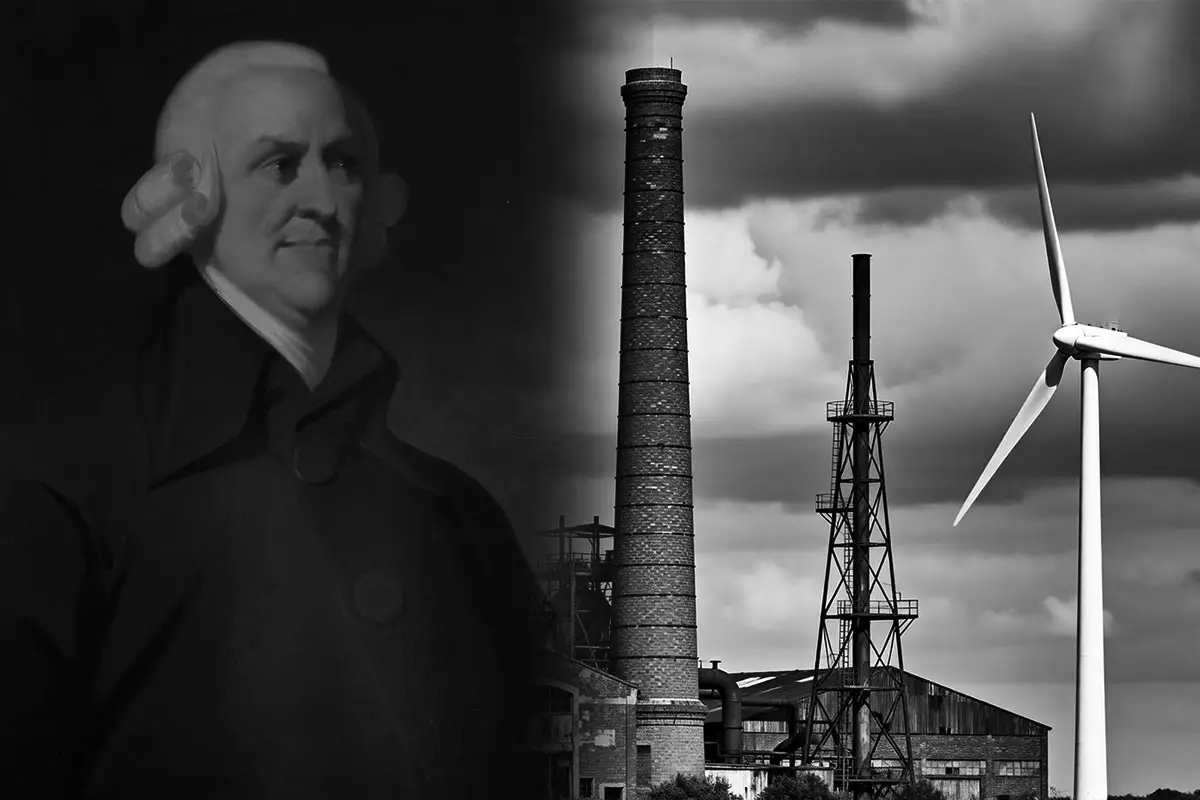
MARCH 9th marked the 250th anniversary of the publication of Adam Smith’s The Wealth of Nations. To commemorate it, the Library of Mistakes organised an event as part of a five-evening series.
Tucked away down a back lane, the library contains every book about economics it can muster, with the aim of helping people learn how not to make mistakes in financial and business matters. Judging by current policy, these mistakes seem to be the norm rather than the exception. Rachel Reeves, take note.
On each of five evenings, four “experts” tried to set the philosophy of Smith in a modern context, but it was just an opportunity to present their own world views.
An Adam Smith Institute representative was asked whether, if Smith were alive today, he would sue the Institute for misrepresentation? Some “real world” people were platformed, like a representative of Aberdeen Investments (who alone stood up for Trump’s disruption of the pervading broken system), but there were too many “think tanky” people for my liking. My concentration wandered as they pontificated.
these people have been advising governments in Holyrood and Westminster, which explains the mess the country is in
It is often said that The Wealth of Nations is, like the Bible, often quoted but seldom read. I have read both from cover to cover although it is difficult to understand the historical context in which they were written and project the ideas forward to how they might apply today. However, Smith’s quotes are marvellous.
“It is not from the benevolence of the butcher, or the baker, that we expect our dinner, but from their regard to their own interest.”
“Little else is requisite to carry a state to the highest degree of opulence from the lowest barbarism but peace, easy taxes, and a tolerable administration of justice.”
“People of the same trade seldom meet together, even for merriment and diversion, but the conversation ends in a conspiracy against the public, or in some contrivance to raise prices.”
“The natural effort of every individual to better his own condition is so powerful a principle that it is not only capable of carrying on society to wealth and prosperity, but of surmounting a hundred impertinent obstructions with which the folly of human laws too often encumbers its operation.”
There was at least one platform speaker each night who promoted environmental collapse and inequality dogma. Some of these people have been advising governments in Holyrood and Westminster, which explains the mess the country is in. They will seek to thwart Reform UK policies if this party attains power.
I got the chance to make comments in the audience discussion section during the evenings.
I pointed out that I had been told for the last sixty years that there was always only twelve years left to save the planet. In the 1960s I was told that songbirds would become extinct in the next few decades because of intensive agriculture. By 1980, a billion people would starve because the planet had insufficient resources. In the 1990s, I was told that Arctic ice would be gone by 2015 and that by 2025 the world’s supplies of oil and gas would be almost exhausted.
The speaker had no answer when I challenged her. This is the main flaw of environmentalists. They avoid scrutiny by saying unscientific things like “the science is settled”, and if you contest their ideology they accuse you of being “a climate change denier”. Being they are rarely unchallenged, their premises are weak and they have no credible arguments when put on the spot with facts.
No political party before Reform seems to have done this. They have just acquiesced.
I pointed out that the consequence of flawed ideology was the adoption of wind power, one of the most inefficient ways to generate electricity. It has given us the highest commercial energy prices in the developed world and placed a million Scottish households in fuel poverty. Regulating every aspect of our lives and adopting tax-and-spend policies – that is, socialism – always wrecks an economy and hurts the poorest in society most.
Some speakers advocated hammering the ultra-rich to make the world a “fairer” place. Jordan Peterson could have told them that equality of opportunity is noble (though arguably utopian, because we all start off from a different place), but equality of outcome is a very bad idea. It is essential to challenge people to do their best and this inevitably leads to inequality. Anyone in business knows that life is unfair, but we just need to get on with it as best we can, not dream about utopian alternatives.
The societies which came closest to equality were the ones ruled by Stalin and Pol Pot, where people who survived were reduced to a lowest common denominator level of poverty.
There was a good debate about the difference between Smith’s self-interest driver and greed, his The Theory of Moral Sentiments condemning the latter. Socialists, powered by resentment and hatred of the privileged and successful, cannot tell the difference between the two. They preach authoritarianism rather than trusting Smith’s “invisible hand”, where self-interest is mutually and socially beneficial.
Lefties don’t understand Enlightenment values. Since Ancient Greece there have been two competing strands of thought: moral philosophy and natural philosophy.
In moral philosophy, the intelligentsia subjectively determines what is good and bad, and therefore who is good or bad. There are no shades of grey. It leads to witch hunts, either literally in the past or metaphorically through the identity politics of today. There must be no challenge to the status quo.
Natural philosophy is what we now call science, where we objectively work out what is true and false, based on observations of the natural world. Having established the truth, we can advance a course of action that will have a good chance of working and, if things go wrong, we are aware and humble enough to amend our model of how the world works until we get things right.
Socialism, globalism and environmentalism are in the unscientific, moral philosophy camp, and are the biggest threats to the Western Enlightenment we currently have. As Adam Smith wrote, “Science is the great antidote to the poison of enthusiasm and superstition”.
Smith proposed adopting ideas and systems which have been proved to work. He was a pragmatist. Situations and circumstances change. We must adapt and evolve, not follow the failed political dogma of the last twenty years. Doing the same thing and expecting a different result is the definition of insanity.




Comments: 1
Join the debate
Do you agree with this analysis, or is the author wrong? Have your say below.
It is such a pity that for decades the Scottish Education system has passed off moral philosophy as science, is it any wonder our universities are filled with leftist ideologues.