

TWENTY YEARS AGO, with the Scottish Parliament newly established, a group of economists wrote about what it should do with its new powers.
In this series on rebooting devolution, I have been dusting down the short paper written by the Harvard economist Edward Glaeser called Four challenges for Scotland’s cities.
Glaeser’s central insight was that, in a global economy where business and skilled professionals are highly mobile, we have to create an environment that is attractive to both. For Scotland to prosper, talented people should want to live here. Businesses will then seek them out.
A crucial determinant in deciding where to live is the built and natural environment on offer. Scotland’s prosperity therefore depends on the availability of well-designed, affordable housing in an attractive setting.
Yet the importance of planning and housing policy goes further than just attracting skilled workers. Glaeser’s research shows that the pattern of housing is a vital component in deciding the life chances of the poorest.
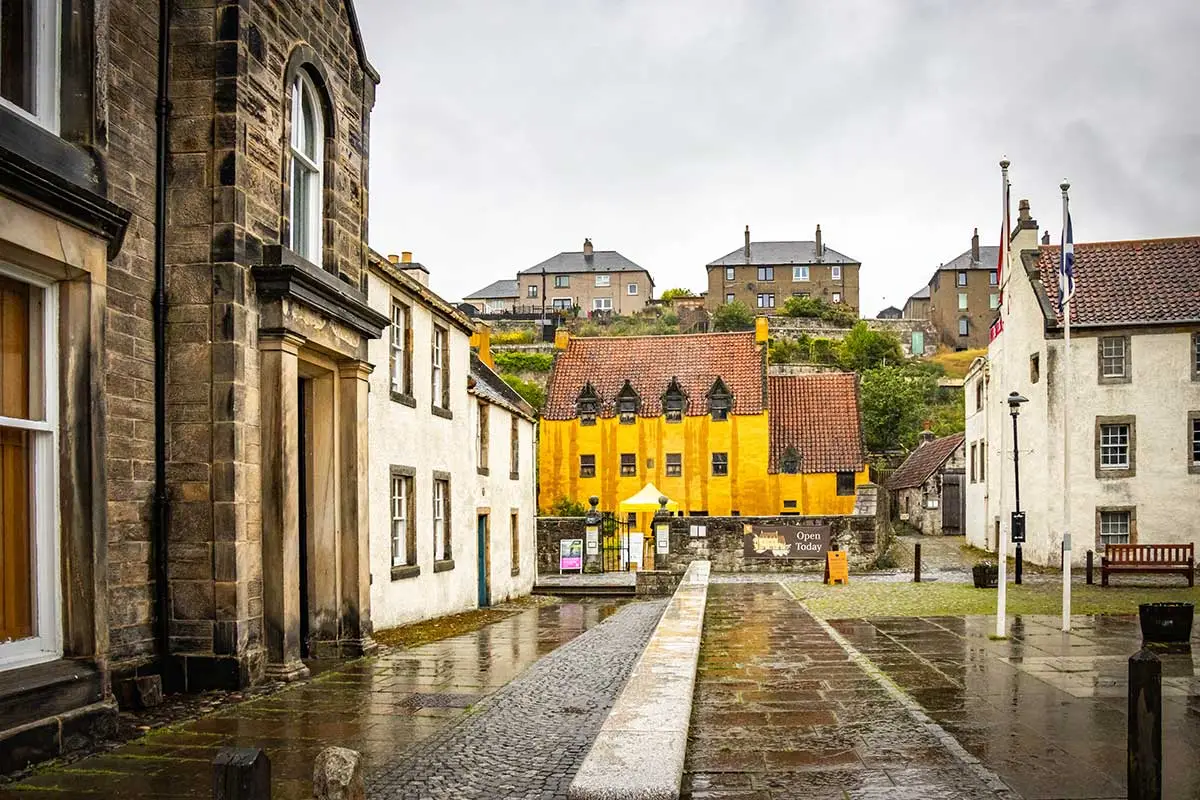
The good news is that Scotland has inherited many advantages when it comes to its environment. We are fortunate to live in a beautiful, rugged and sea-girt country famous for its natural scenery. And over the centuries we have developed a distinctive and charismatic architectural tradition. From late medieval townscapes such as Falkland, Culross and the Edinburgh Old Town, to the planned Georgian streets that adorn many of our city and town centres, and to Victorian houses and proud civic buildings, often overlayed on intricate medieval layouts.
it seems astonishing that these days we build such dross
Sometimes it is hard to define beauty, but when it comes to architecture, we know it when we see it. That’s why we legislate to preserve it through conservation orders, listings and government protection of historic buildings. Meanwhile the market tells its own story. The most valuable properties in Scotland tend to be old.
Given that we know what a beautiful building and an attractive street layout look like, it seems astonishing that these days we build such dross. Most modern housing developments fail to follow the successful patterns of their forebears. Instead, they tend to be bland, soulless and cheaply built.
Before going further into the aesthetics of modern housing, it’s worth considering the economics of it because the two are closely related. Elsewhere in these pages Ewen Stewart explained how the market had become distorted by a combination of loose monetary policy and stalled incomes, which has led to asset inflation, including in the housing market, making good houses less affordable.
I would add a supply problem to this mix. In spite of some changes since devolution, Scotland has in essence retained the UK model of planning and development. This is highly restrictive and designed to control the spread of housing and industrial development in a densely populated landscape. The problem is that Scotland is not densely populated. We have about 180 people per square mile compared to England’s 1,160. It is true that in the Central Belt densities are higher, and the overall picture is skewed by very sparse populations in the Highlands and southern Scotland. But you could fit a city the size of London easily in the Central Belt, trebling Scotland’s housing stock without impinging on its spectacular Highland and rural landscapes.
Economists often criticise the UK’s planning systems as unduly restrictive, and so they are, particularly here. But it’s important to bear in mind that they reflect public priorities too. Many people in Britain are very fond of the character of the countryside and hostile to its ruination. In fact, insensitive development runs counter to exactly the premise that Glaeser explains, which is that an attractive environment attracts people and investment.
How do we square this circle? For some years I chaired a local planning committee, and I noticed that public hostility to development was rooted in the well-founded assumption that the quality of its architecture and design would be low. Meanwhile builders would tell me that the lack of development land inflated its price, so the only way to make houses affordable was to pack them into cramped sites and keep the costs down with cheap, identikit designs.
To break this vicious circle requires an insistence on much higher quality in design as a quid pro quo for releasing more land for development. There are some good (if rare) examples of what can be achieved, usually on small sites in the historic parts of cities, but also on planned estates such as Tornagrain near Nairn, where the landowner has insisted on high architectural standards.
Too often we see the opposite. Where demand for housing is high in expanding cities like Inverness or Edinburgh, the new suburban developments seem to pay no heed to the extraordinary landscape setting and architectural heritage that are the foundations of these two cities’ modern success. The endless suburban estates being built east of the Highland capital (“Tesco town” as it’s known) or around the Edinburgh bypass are an affront to ambition and good taste. We should be designing and building beautiful new metropolises in these locations.
Poor people have no taste, so we can get away with building ugly homes
At the root of our planning malaise is a contradiction. We know what works because we preserve it. Yet planners and builders seem unwilling to follow the examples of their predecessors, particularly at the lower end of the market. This is the worst form of snobbery – the snobbery of low expectations. Poor people have no taste, so we can get away with building ugly homes.
Good quality housing is essential to attract and retain a skilled workforce. But it is particularly important for the least fortunate. Successive governments have sought to tackle the problem of housing for the poorest by building and renting out cheap accommodation specifically for those who can’t access the mainstream housing market. “Council housing” or “social housing” is well intentioned but fundamentally misconceived. Housing costs are kept below market prices which inevitably leads to underinvestment. What is worse, it leads to segregation. The poorer members of our society are corralled into certain areas of our towns and cities.
Edward Glaeser’s work on the economics of urban environments shows that children from poor backgrounds have their life chances considerably improved if they move to a mixed income area rather than staying in a poor one.
Increasing the availability of development land by insisting on higher standards will allow the market to provide more affordable housing. Deregulating the rental sector, which has seen major restrictions on landlords in recent years, would do the same.
But local and national government should also revisit their approach to providing subsidised housing. Glaeser suggested a voucher system which would allow the poorest to access housing in the mainstream market, improving the quality of accommodation while escaping segregation.
Reversing the cycle of poor development and public hostility to it requires imaginative new approaches. Some economists advocate a system where developers pay local communities for development rights, incentivising them to build attractive new housing that augments the landscape rather than ruining it. Others advocate much tighter design rules imposed when development rights are granted. There is space in Scotland to experiment with different planning rules to attract new ideas and see what works best.




Comments: 0
Join the debate
Do you agree with this analysis, or is the author wrong? Have your say below.
No comments yet. Be the first to join the discussion.