

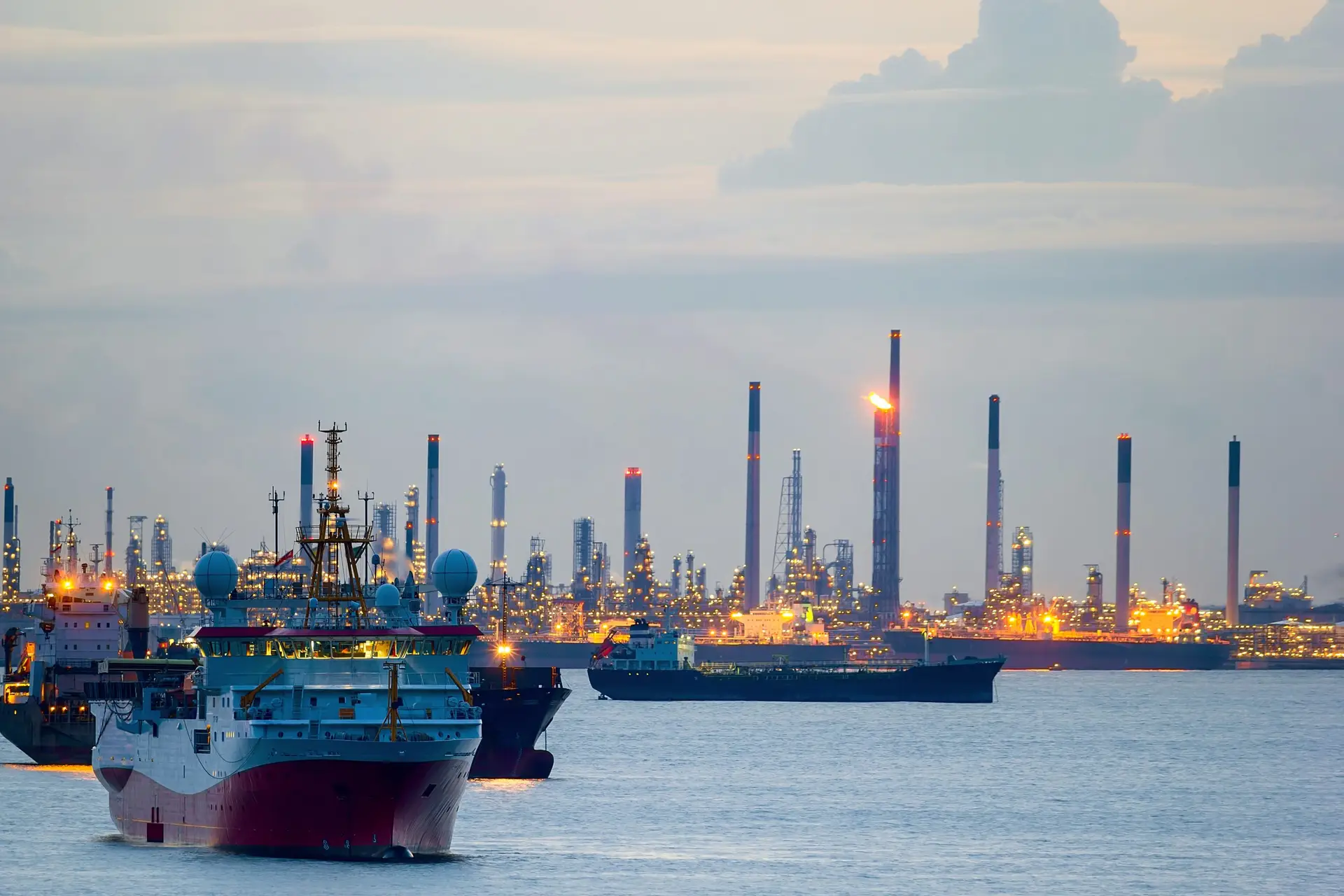
AS THE GRANGEMOUTH REFINERY edges toward closure, the UK faces a pivotal moment in energy, industry, and geopolitics. For decades, Grangemouth stood as a cornerstone of Scotland’s oil refining sector, supplying domestic fuel and petrochemicals while symbolizing Britain’s industrial prowess. Now, with its decline, the opportuity presents itself not to replace it modestly, but to think bigger — to reimagine the UK’s energy future on a bold, Global Britain scale with the Kraken refinery in the North Sea.
The concept is ambitious: a 400,000 barrel-per-day refinery at Sullom Voe, Shetland, capable of processing North Sea crude and delivering both domestic supply and a dedicated NATO allocation of 80,000 barrels per day. On paper, this is enormous for Europe – roughly 20 million tonnes annually – putting Kraken on par with Singapore’s largest refineries in regional influence. Unlike Grangemouth, which primarily served domestic markets, Kraken would signal Britain’s return to strategic energy leadership. It is the kind of long-term, state-aligned industrial thinking Lee Kuan Yew deployed to transform Singapore into a global refining hub.
The North Sea still produces around 1.5–2 million barrels per day of crude between the UK and Norway, meaning Kraken could be fully sustained by local production, dramatically reducing reliance on imports from the Middle East or Russia. More than just a refinery, Kraken becomes a sovereign energy asset: a facility where Britain can ensure NATO allies have guaranteed access to refined fuel, even in times of geopolitical tension. A twenty per cent MOD golden stake in the refinery secures the NATO allocation, allowing the Ministry of Defence to directly oversee 80,000 barrels per day while leaving over eighty per cent of operations in private hands for efficiency and market flexibility.
This hybrid model is the key innovation. By combining MOD oversight with private operation — potentially through BP or Shell — the UK gains the best of both worlds: strategic security and industrial competence. NATO allies, and indeed the world, would see the UK not merely as a participant in energy markets, but as a trusted guarantor of supply for Europe’s defence infrastructure.
The Kraken refinery would create a permanent operational workforce of 1,000–1,500, with the added flexibility of offshore-style rotations. Staff could live on Shetland for two-month stints, mirroring North Sea oil operations, minimizing local housing pressures while ensuring highly skilled personnel are onsite. Temporary construction jobs could number 5,000–10,000, giving the Shetland economy a substantial short-term boost.
Moreover, the refinery could generate significant employment across Scotland. Support hubs in Dundee, Aberdeen, and even Glasgow could handle logistics, maintenance planning, engineering, and administration, spreading economic benefits beyond Shetland. This model turns Kraken into a national economic engine, creating jobs while sustaining the UK’s industrial skill base.
The refinery also reinforces Britain’s energy independence. By converting North Sea crude into refined products locally, the UK minimizes supply chain vulnerability, stabilizes domestic fuel costs, and strengthens leverage in global energy markets. Politically, this is a compelling narrative for Global Britain: a nation taking control of its energy destiny while supporting NATO commitments.
Naming the facility “Kraken” adds symbolic weight. These mythic names evoke strength, scale, and dominance — precisely the attributes of a project designed to reposition Britain as a regional energy and stretegic power. For a party like Reform UK, Kraken becomes a political wedge: bold, unionist, pro-NATO, and easy for opponents to attack. Left-wing critics will focus on the carbon-tax exemption and fossil fuel expansion, creating a perfect lightning rod. Every criticism reinforces Kraken’s narrative: Britain acting decisively on energy and defence, while others hesitate.
The project highlights Tory caution. Conservatives might see Kraken as risky politically or environmentally. Forty years after Thatcher rightly shifted away from traditional docking to back Felixstowe — now handling 40% of UK container shipping — the same choice presents itself again. Act boldly, or fall behind.
The refinery would operate as both a strategic and political instrument, energizing voters who value sovereignty, energy security, and NATO reliability.
Globally, Kraken signals that the UK remains a serious energy player. While 400,000 barrels per day is mid-sized on a global scale, it is massive for Europe, dwarfing other regional refineries and approaching Singapore-scale influence. NATO allies would benefit from the dedicated allocation, while Russia and other competitors would see a renewed UK presence in European energy markets.
From a PR perspective, MOD involvement adds credibility. NATO allies would know the 80,000 barrels per day are guaranteed, while BP or Shell operating the refinery ensures world-class efficiency and safety. Kraken is not just infrastructure; it is signalling. The Kraken refinery is not just about fuel — it’s a statement of Global Britain’s industrial, military, and political clout.
The closure of Grangemouth is a chance to redefine Britain’s energy future. By building the Kraken refinery right in the North Sea, the UK can secure domestic and NATO fuel supply, create thousands of jobs, and signal Global Britain’s return to strategic energy prominence. Offshore rotations, MOD/NATO involvement, and mainland support hubs turn it into a national network of employment, security, and industry.
At present, refining costs sit at roughly £100 per barrel — comparable to Rotterdam. A carbon free zone could reduce this to around £35 per barrel, bringing the UK into line with global competitors such as Houston and Jurong. A carbon freezone takes this down to around £35 a barrel, in line with global competitors such as Houston and Jurong in Singapore. It ditches the absurdity of the “producer pays” principle which has simply offshored our industry to those who won’t pay.
Kraken is not simply a refinery — it is a symbol, a lever, and a statement. It is Britain acting decisively, boldly, and strategically, taking its place once more as a major North Sea power. If the UK is to truly go big in energy, NATO support, and industrial revival, Kraken is the vessel to do it.
Release the Kraken!

Comments: 0
Join the debate
Do you agree with this analysis, or is the author wrong? Have your say below.
No comments yet. Be the first to join the discussion.