
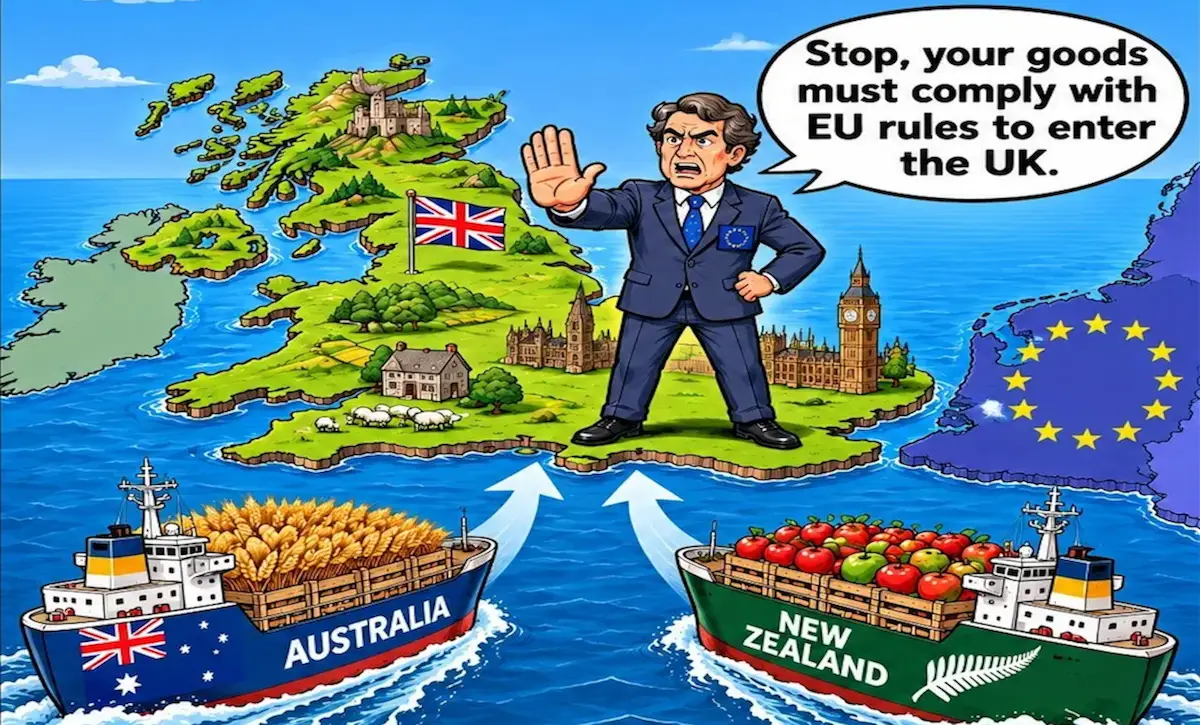
Andy Burnham’s EU-UK SPS Agreement will allow the EU to control UK food imports from non-EU countries.
THE SPS DEAL in the EU-UK “reset” will force all UK food manufacturers and farmers to follow EU regulations at all times and change those regulations the moment the EU changes its regulations. We will have no time to scrutinise EU regulations, and no power to make even small changes.
The EU has changed many of its rules since the UK left. These govern the types and quantities of pesticides farmers can use, the plants they can grow, the ingredients and colourings manufacturers can use, and the materials that can come into contact with food, from mixing bowls to retail packaging.
The SPS agreement will also force the UK to pay the EU for making our food and agricultural rules. But most importantly, the SPS Agreement will allow the EU to control UK food imports from non-EU countries.
The truth about customs unions
The EU is a customs union. It is designed to discourage imports from outside the union and encourage members to import goods exclusively from within the union. This never suited the UK. It was the only EU member that traded more with non-EU countries than with EU countries. That is one reason we left. However, under the SPS agreement with the EU, the UK will be forced to block non-EU food imports that do not comply with EU rules.
Britain has not restricted food imports from the EU since Brexit, primarily because we rely on imported food. The UK imports 40 per cent of the food it consumes each year, and even for foods that could be produced in the UK, only 72 per cent is supplied by UK food producers; the rest is imported.
This is because the UK population has increased by about 10 million people since 2000. Meanwhile, UK farmland used to produce food has been reduced by urban development, biomass crop production, solar panel coverage, or conversion of farmland to environmental schemes such as wildflowers and tree planting.[1]
During the Brexit negotiations, the UK still relied on EU food and lacked trade deals with some of the world’s largest food producers. That left it little room to retaliate when the EU subjected UK food exports to onerous paperwork and veterinary checks. That has all changed.All CPTPP countries are large food exporters, except Japan and Brunei. The UK also now has a trade agreement with India, the world’s largest rice exporter and fifth-largest beef exporter, which also supplies tea, cashews, mangoes and other tropical fruits and nuts.
But this may be why the EU now wants to force the UK to obey its trade rules – so they can limit UK food imports from non-EU countries.
The EU restricts trade in three ways:
1. High food and agricultural tariffs
2. Low food and agricultural import quotas
3. Restrictive regulations and food standards that prevent some imports
Although the UK has a tariff- and quota-free trade deal with the EU, the EU has restricted UK food exports using point 3: Restrictive regulations. And now those restrictive regulations will be focused on the UK’s other trading partners.
How will this affect the UK’s new trade agreements?
The UK put very long lead times on its tariff reductions for food imports in its new trade agreements, even though the countries on the other side of those agreements mostly gave the UK immediate tariff-free and quota-free access to their markets. But those time-limited quotas are beginning to expire.
2027 will be “Year 5” for the Australian and New Zealand trade deals. By then, the quota limits on Australian wheat, barley, and broken rice imports will have expired, while imports of Australian dairy products still have to wait until 2028, sugar imports until 2030, and beef imports until 2032 (although the UK will still have quantity limits known as “safeguards” applied to Australian beef until 2037).
Similarly, New Zealand apple imports are now quota-free, although New Zealand butter and cheese imports will have to wait until 2028, and New Zealand beef until 2032 and New Zealand lamb until 2038.
Even so, the EU will be worried about losing its captured food market; the UK’s tariff-free import quotas on non-EU food are increasing, while the EU has been imposing more and more environmental restrictions on its own farmers, pushing up food prices in domestic EU markets.
How to bring down food prices
If Andy Burnham really wanted to lower UK food prices, he would allow more food imports from outside the EU. According to the Irish Food Board’s website, Irish R3 steer beef averaged €6.72 per kg wholesale in 2026 (excluding VAT). The Australian equivalent was €4.86 per kg, about 28 per cent cheaper. The Irish beef industry desperately wants to hold on to its position in the UK market. With more than 50 per cent of the UK’s meat processors in Irish ownership, it probably will.
But there are signs that food supply chains are beginning to shift. Before Brexit, the EU supplied between 28 per cent and 30 per cent of the beef the UK consumed each year, while non-EU beef imports accounted for just 1 per cent. In 2025, EU beef imports fell to 23 per cent of UK supply, while non-EU imports rose to 6 per cent. These numbers are from Defra’s Agriculture in the UK, and they are in tonnes to avoid inflationary effects.
This is probably why the EU is eager to “reset”its tariff-free and quota-free trade deal with the UK – to give it control over UK imports and retain its captured market.
This explainer was first published on 23 November on Catherine McBride’s substack.
[1] Defra estimates that 2.3 per cent of the UK’s arable land is used for bioenergy crops and that ground-mounted solar panels cover 21,000 hectares. It also puts 6.1 million hectares under agri-environment schemes, some of which allow continued food production. That is still a substantial share of the UK’s 16.8 to 17 million hectares of utilised agricultural area.


Comments: 0
Join the debate
Do you agree with this analysis, or is the author wrong? Have your say below.
No comments yet. Be the first to join the discussion.