

OVER MANY YEARS I’ve watched how the SNP handles its public finance responsibilities when in power in Scotland. It would be hard not to observe that when it comes to public accountability, obfuscation, evasion and bluster have been the order of the day.
Since entering Parliament in May I’ve seen this played out in full, from important statements made on which only one question is allowed, to delays in producing statements in line with precedent, to budgets being moved between portfolios with no pertinent explanations. While I’m assured there has been an improvement in transparency relating to public finance procedures, most agree MSPs have only 70 per cent of the information needed to write an opposition budget.
This is staggering, considering the SNP’s worship of all things European, when parliamentarians in many European countries have sufficient information to prepare an opposition budget capable of being put before their parliament, and the right to do so is enshrined in legislation.
In recent weeks, the pre-budget scrutiny process has been rolling out in committee. The SNP has launched an ambitious “Programme for Government”, but with a structural deficit already acknowledged, questions abound about cuts, reform of services and new taxes. Yet the crucial medium-term financial strategy has not yet been presented, apparently due to the situation in the Middle East and a delayed OBR forecast.
How did we cope before the creation of the OBR, or during the Second Gulf War, in which we were directly involved, I wonder?
There is a structural budget deficit of £5 billion looming by 2029, and in addition a tax deficit of £720 million this year.
The recent round of experts appearing before the finance committee has endorsed commentators’ summation of the general malaise. There is a structural budget deficit of £5 billion looming by 2029, and a further tax deficit of £720 million this year. To compound this, there is no prospect of economic growth, very few opportunities to grow the tax base that are likely to be realised, as well as little hope of early savings from the public services reform agenda. Quite the reverse, in fact.
Let’s start with the deficit. The Scottish Parliament acquired new powers following the Smith Commission in respect of taxation and benefits. In recent years a suite of new benefits has been created, with more and more people receiving disability benefits and Universal Credit. The number of young people on disability benefits with conditions such as ADHD has gone up significantly.
We have a skills shortage in Scotland. Our PISA results are poor compared with other countries. We have long known that we are not producing enough young people with good qualifications in STEM subjects. Given that situation, it might be reasonable to assume that these young people could more easily access a university place in engineering or biochemistry – two coveted degrees. However, with Scottish universities experiencing funding gaps, a significant number of places on these courses go to fee-paying foreign students.
In Glasgow, these are predominantly Chinese students. When Scots students fail to get a free place in Scotland in their chosen subject, they go south. Rarely do they return to Scotland to pay tax here.
Economic growth
In 2022 Kate Forbes, then Finance Secretary, produced a paper on transforming Scotland in ten years with the inherent ambition of economic growth across Scotland. She cited five key indicators, but a recent assessment found that progress in the last five years has been little and sporadic. While there have been regional pockets of growth, the overall outlook has been unimpressive, with economic growth of around 1 per cent.
By contrast, the economy of a comparable country such as Israel is expected to grow by** 3.5 per cent this year, despite fighting a war with many workers diverted to the military. So, clearly little to be excited about in Scotland’s case.
This isn’t the only flagship announcement we’ve seen from the SNP, but the problem appears to be that these initiatives fizzle out like a damp squib, with no report on what the spending has achieved. While the corporate world has strategic and operational plans, as well as risk registers, we might be forgiven for thinking some of the SNP initiatives are thrown in a drawer to await the appointment of yet another cabinet secretary to spin the narrative. And so it goes on.
Expectations of Scotland’s heritage
In Scotland, our heritage is one of our pioneering accomplishments across science and technology, creating the basic industries and infrastructure on which we rely. Yet we know that many investors feel that Scotland is not a place where they can invest and allow ideas to grow and flourish. While much innovation is born in Scotland, it grows and bears fruit elsewhere.
It is therefore disappointing that the Scottish National Investment Bank was created with such a narrow focus on green start-ups with long lead times to growth. If the remit of the bank had been wider, we might have experienced more successes, rather than the heavy losses the Scottish taxpayer has had to absorb.
Against this backdrop of nothing much to write home about, there are the ever-growing cries for public funding, whether for health, education, the third sector, councils, skills, or justice. The list is endless and growing. I know this first hand sitting on the finance committee with the current budget scrutiny process underway.
This Government is simply not delivering enough for the money it is taking in
Without exception, we are being told that more money is being saved, more services provided, and more opportunities created than ever before, but these claims are not translating into sufficient results. This Government is simply not delivering enough for the money it is taking in, and this can only be due to poor management.
If this article has been somewhat depressing, I’m not going to change tack now. The outlook is bleak. All agree that there will be little progress in this session. No economic growth, more debt, and likely no growth in the tax base. Indeed, our only hope seems to rest with Ivan McKee’s public services reform and Jenny Gilruth’s reform of local government, the latter having played no part in the SNP election manifesto.
Regrettably, what I’m hearing from councils is that in the short term Gilruth’s project is likely to need more money, not less. All this comes against a backdrop of a squeezed capital budget, a possible bond issue to raise funds, capped reserves and ScotWind revenues likely to be drained.
I often look to international comparators to see what other countries have been able to achieve, some with similar resources to our own. Norway is an example I keep coming back to, and the more I consider its approach to wind energy, the more I despair for Scotland. The promise of using Crown Estate revenues to create a nest egg for Scotland’s future may yet come to little.
If that is allowed to happen, it will be another tragedy in the story of Scotland, but not one that can be blamed on the UK Government.
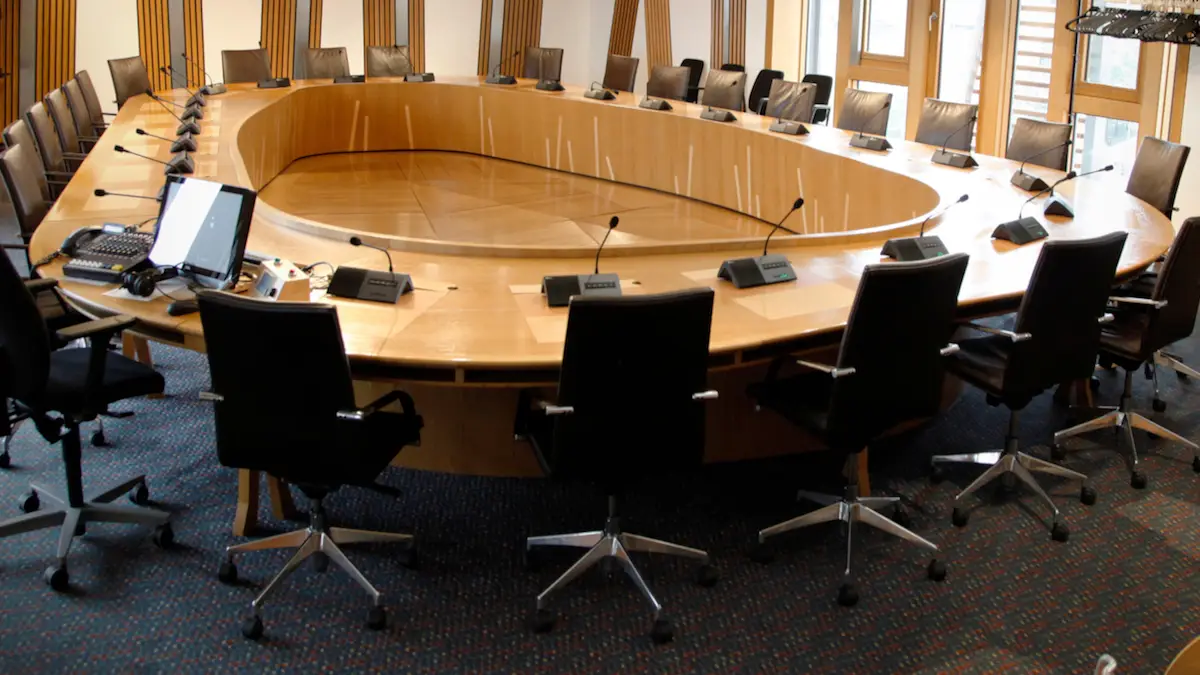
Image of Holyrood Committee Room courtesy of the Scottish Parliament


Comments: 1
Join the debate
Do you agree with this analysis, or is the author wrong? Have your say below.
Kim Schmulian says, “Our PISA stats are poor compared with other countries.” Readers may like to watch this video which examines possible reasons for the decline. It is a talk by “Britain’s strictest headmistress”, Kathrine Birbalsingh, headteacher of England’s most successful school (measured in the most valid way).
https://www.youtube.com/watch?v=07vbBoRcmjI&t=2350s
I was a secondary teacher in Scotland and can vouchsafe for much of was Ms Birbalsingh says, especially about the downgrading of knowledge. We had a relatively new Maths teacher come into the school. She ran a course of some kind for other teachers but made it very clear that those teachers in favour of rote learning were most definitely not welcome to attend.