

THERE IS A SCENE in the television adaptation of Amor Towles’ wonderful book A Gentleman in Moscow in which two ill-disciplined wolfhounds run amok in the Hotel Metropole’s restaurant. Tables are overturned, fine tableware smashed, and diners terrified. The dogs belong to a working-class film star who apologises for their “lack of breeding”. The unrepentant aristocrat, Count Rostov, calmly corrects her: the dogs appear perfectly bred; the fault lies in their handling. With one firm command the animals are brought to heel.
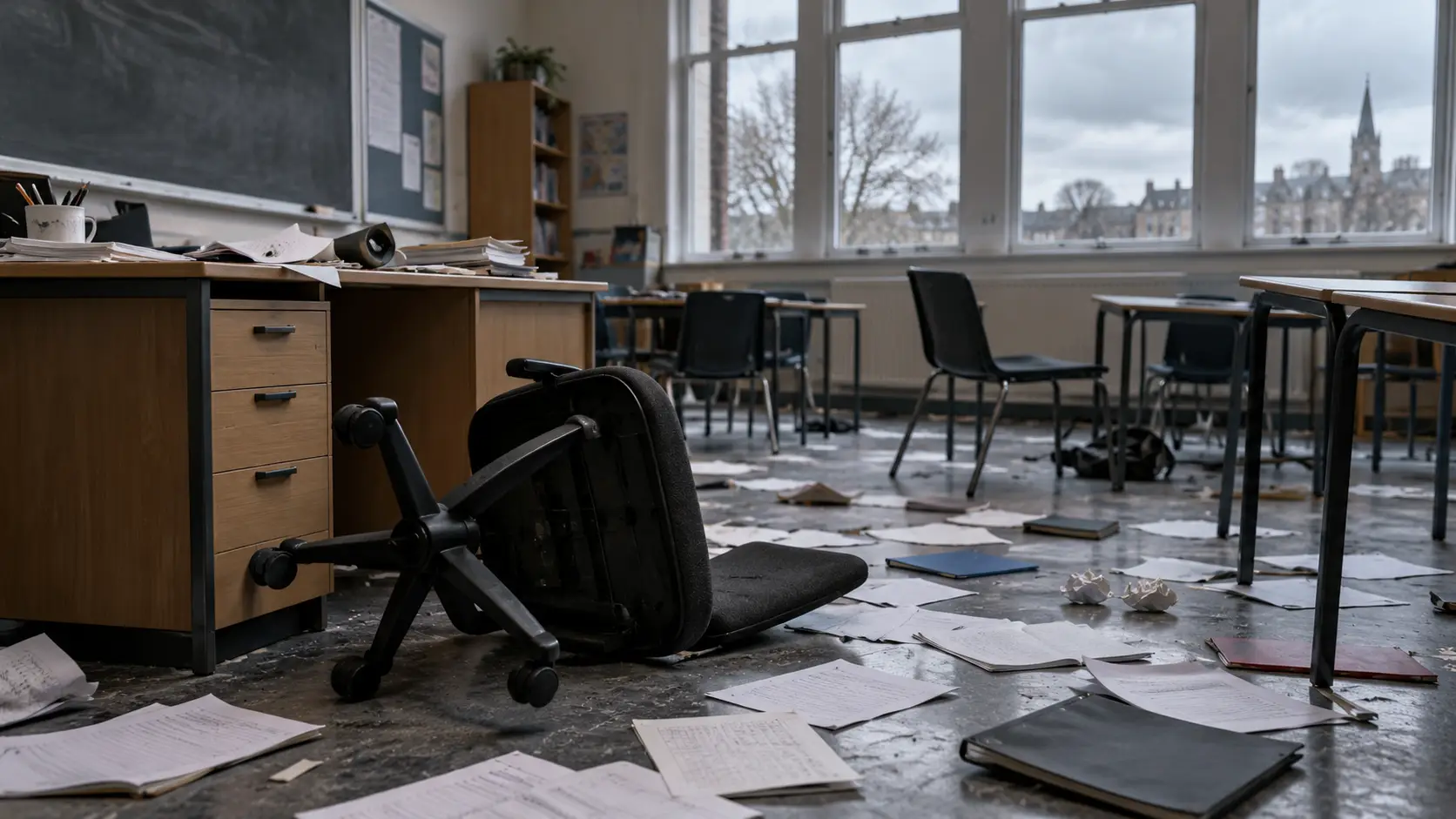
The metaphor is instructive, and it is the handling of the animals, not the animals themselves, that concerns me. Watching the scene brought to mind a recent story in The Herald which reported that physical attacks on secondary teachers in Edinburgh have more than doubled in four years, a rise of 115 per cent.
Edinburgh, sadly, is not an outlier. Figures obtained by the Liberal Democrats, and reported in The Scotsman, showed that there were more than 44,000 violent incidents recorded in Scottish schools last year. With schools open for roughly 190 days each academic year, that equates to over 200 reported incidents every single school day. Nor is the problem unique to our cities. Fife recorded 5,664 incidents in 2025–26, the highest of any local authority and a quadrupling since 2018. The vast majority of Fife’s incidents were in primary schools. When you consider the amount of time that must be spent dealing with the disorder behind these figures, it is hard to believe that this does not contribute to Scotland’s poor performance in PISA.
In any other workplace, these figures would be regarded as intolerable. Which raises an obvious question: why are they tolerated in our teachers’ workplace?
Successive Scottish Governments share responsibility for the decline in standards and the erosion of classroom order. The SNP’s long period in charge of education is a significant factor, but the previous Labour–Lib Dem coalition and local authorities also bear their share of responsibility. The Scottish Conservatives have never had, and still do not have, a coherent, conservative education philosophy. Their failure in opposition also bears some responsibility for the current crisis.
But deeper causes lie beyond simplistic political finger-pointing. The pedagogical assumptions that have shaped teacher training, the Curriculum for Excellence (its architects cannot simply blame faults in its implementation), and the activist guidance issued by Education Scotland have for years undermined the teacher’s traditional didactic authority. Together they have promoted approaches that have allowed the wolfhounds to run wild.
What is required is a decisive turn away from a permissive culture that has transformed too many classrooms into battlefields
Consistently enforced behaviour policies in every school would be a necessary first step. But policies alone will not suffice whilst the prevailing culture prioritises mediocrity over merit, empathy over expectation, and management over authority. I know of one teacher who was praised by their head teacher for not enforcing school rules.
In these appalling working conditions, teachers should reasonably expect support from their trade union. The EIS remains the dominant professional voice in Scottish education, but it is a union that has long defended the pedagogical settlement that prioritises process, relationships and holistic outcomes over knowledge, structure and adult authority. Consider its general secretary’s message on X, on 17 October: “We need sound, holistic education for peace and prosperity, not for performativity and PISA scores”. In the very week that brought news of a doubling of attacks on Edinburgh’s teachers, the union’s public emphasis was on “education for peace”. The irony is excruciating.
None of the above is an argument for the return of “the belt”: the dogs in the Hotel Metropole are not beaten; they are commanded, and they respond to authority because they have been trained. What is required is a decisive turn away from a permissive culture that has transformed too many classrooms into battlefields. Restoring the teacher’s right and duty to set and maintain firm boundaries would be a good place to begin.
This piece began life as a letter in The Herald. It is always nice to see a letter published, but nicer still when it draws a reply. In this case the reply came from David Miller of Milngavie, who wrote that my letter took him back to his lessons at Hillhead High School, where his excellent English teacher would enter a class of noisy pupils with the loudly spoken command:
“Sit down, sit up and shut up.”
It was alliterative and effective, he recalled, with “rapt attention and no inattention ensuing”.
Count Rostov would have approved. This is what we have lost.


Comments: 2
Join the debate
Do you agree with this analysis, or is the author wrong? Have your say below.
No comments yet. Be the first to join the discussion.