

THE FIRST EPISODE OF DAVID OLUSOGA’S FINDING BRITAIN’S SLAVE TRADER airs today (21 September) on BBC Two. It features the research of William A Pettigrew, “who has led a landmark project identifying some 13,000 investors connected to the trafficking of 3.2 million enslaved African people”.
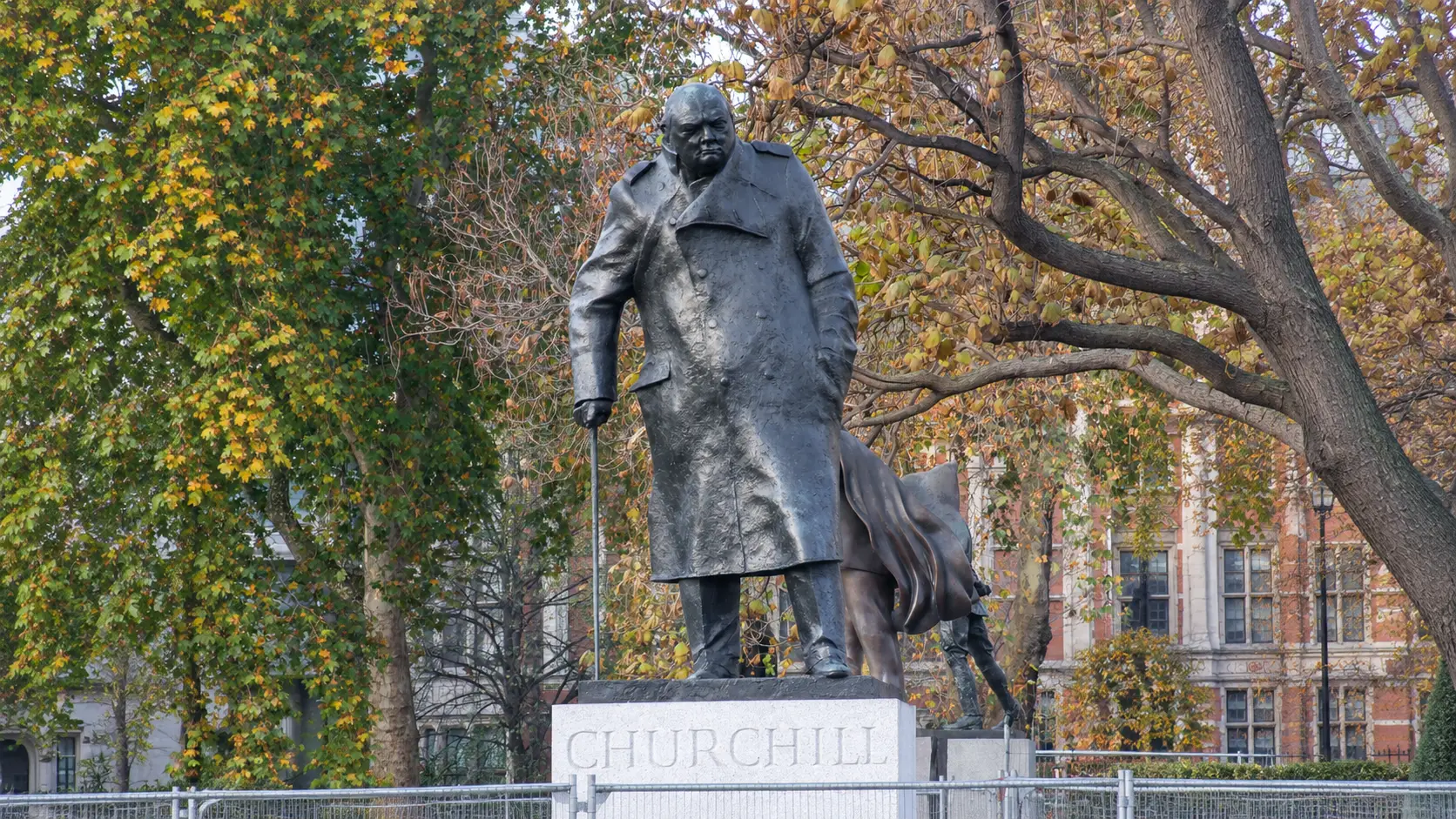
Pettigrew refers to the irony of “far right, fascist” defenders of Churchill’s statue in Parliament Square protecting it from people protesting against his imperialist views, given that Churchill fought fascism. William, they are not far-right fascists but patriots.
Once again, lefties cannot help splitting us into victims and perpetrators, goodies and baddies. They brand those they dislike as fascist but are blind to the distortion of history to suit their agenda. They judge 18th-century people by their own self-defined 21st-century morality. The word “enslaved” emphasises the exploitation, so woe betides anyone like me who describes them as mere “slaves”. I must be a fascist.
Britain did not invent slavery so it could pursue the Industrial Revolution. It already existed in West Africa and in every pre-industrial society, if one includes serfs who had no freedom. Only people naive enough to believe we control our own destiny, and do so in a selfish way, would say such a thing. Our ancestors, as individuals, played the hand they were dealt in the survival game that is life, using the knowledge they had inherited. The future is always unknown and scary, and our fears lead to mistakes that we later regret.
The capitalism and industrialisation that the left now abhors produced the wealth that enabled the abolition of slavery and allowed 90 per cent of humanity to escape extreme poverty. It was far from a perfect process, nor did it happen instantly – but woke leftist ideology now threatens it. In 2014, the World Bank prioritised climate action over eradicating extreme poverty by 2030. This was an achievable target, unlike net zero, but one that will now not be met, with the world’s poorest denied electricity because they cannot invest in coal-fired power stations.
Apartheid and slavery were therefore regarded as morally correct because God sanctioned them
To understand the historical context, we must recognise that the vast majority of 18th-century inventors, industrialists and investors were devout Christians. This was virtually a prerequisite of the respectable social norms of the time. What God said in the Bible was gospel.
Genesis chapters 9 and 10 tell us that God destroyed all the evil people in the world in a flood, leaving Noah and his family. Everyone in the world was said to have descended from his three sons. One of the sons was destined to be the slave of the other two, as were his descendants. So, when Christians came across new peoples who were not Jews or Christians, especially if they had dark skin, they were assumed to be from this stock. Apartheid and slavery were therefore regarded as morally correct because God sanctioned them.
The Renaissance had renewed admiration for the Roman Empire, which couldn’t have functioned without slavery. Most slaves were not like Spartacus but formed an inferior part of the family, perhaps taken in as orphans. The same word was used for “servant” and “slave” because why would anyone pay them when they didn’t have to? Board and food were rewards enough, such that a master could send a slave to another city on an errand and know he would return, because the alternative was destitution.
The Old Testament gives rules for slavery, while Paul in the New Testament tells slaves to obey their masters, although he urges masters not to beat them. Paul was probably a slave owner. He tells us his eyesight was poor so he had scribes to write his letters who would have been slaves. His household contained Onesimus and Tertius, the literal meaning in ancient Greek being “Useful” and “Third”, suggesting that he had at least three slaves.
British businesspeople in the 18th century could deny the cruelty in Africa and America until some of them experienced it themselves. John Newton was an English slave-ship captain who later became a clergyman, renounced the slave trade and wrote Amazing Grace in 1772, the year it was confirmed that slavery had no foundation in English common law and that a previously enslaved person could not be deported from the UK.
Yet in 1776, most of the authors of the US Declaration of Independence owned slaves, with the economies of the thirteen colonies underwritten by taxes on slave imports. It is doubtful that the USA could have sustained its independence without the wealth from slavery, and many historians believe that Abraham Lincoln ended slavery in 1865 partly to gain British support for the North in the Civil War.
In the days before a social security safety net in Britain, the difference for many prominent people between a big mansion and the gutter might have been the proceeds of the slave trade, so it took until 1807 for the slave trade to be abolished and until 1834 for slavery itself to end in the British Empire.
Christian and Islamic texts were written by many people with different perspectives, so, among the contradictions, one can find justification for various courses of action. St Paul’s “faith, hope and love” won out, and slavery ended, at great cost to Britain.
Should we charge those countries on which we bestowed democracy to redeem this? Should we bill all countries for the benefits of the Industrial Revolution? Should we seek reparations from the Danes and Norwegians for Viking slavery, or from the Italians for slaves taken to Rome by Caesar? Should we charge India for abolishing the caste system with its untouchables, for stopping the burning of widows on funeral pyres, for building its rail network and for founding its civil service?
We must reject globalist nonsense when we find it and, if necessary, withdraw from organisations that promote it
Instead, we are expected to pay reparations for the “crimes” of our forefathers. The Caribbean Community (CARICOM) is considering bringing a case against the UK at the International Court of Justice. It cannot pursue the crime of slavery because issues before 1987 are exempt. But it can accuse us of historic racism under the UN International Convention on the Elimination of All Forms of Racial Discrimination, to which the UK is a signatory.
The UN Committee on the Elimination of Racial Discrimination stated in August 2026 that the Convention should cover “reparation for acts of racial discrimination linked to the continuing consequences of historic injustices”. Defining these “consequences” requires a particularly leftist historical construct.
The UN failed in its role as the peacekeeper it was set up to be, so this confection of democracies, autocracies and failed states now interferes in social issues. Some of its activities, like emergency aid following disasters, have merit, but many initiatives, like climate change alarmism, are very harmful to Western society. We must reject globalist nonsense when we find it and, if necessary, withdraw from organisations that promote it.
When will the lefties grow up, stop simplifying and distorting history to suit themselves, and accept the realities of life? We are where we are. Let’s sort out today’s problems, liberated from a blame culture, especially one applied retrospectively.



Comments: 0
Join the debate
Do you agree with this analysis, or is the author wrong? Have your say below.
No comments yet. Be the first to join the discussion.