

ACROSS THIS ELECTION the result could not be clearer. British people do not like Labour and the Tories anymore. They have voted for anyone but them. Nigel Farage, Zach Polanski, Rupert Lowe and John Swinney have one thing in common: they are very different. The governing uniparty is almost everywhere on less than half the vote.
Thirty years of Blairism of many colours is over.
Since 2000, Britain has become a low-growth asset society governed by an increasingly managerial political culture, and voters have finally begun rejecting the legitimacy of that settlement.
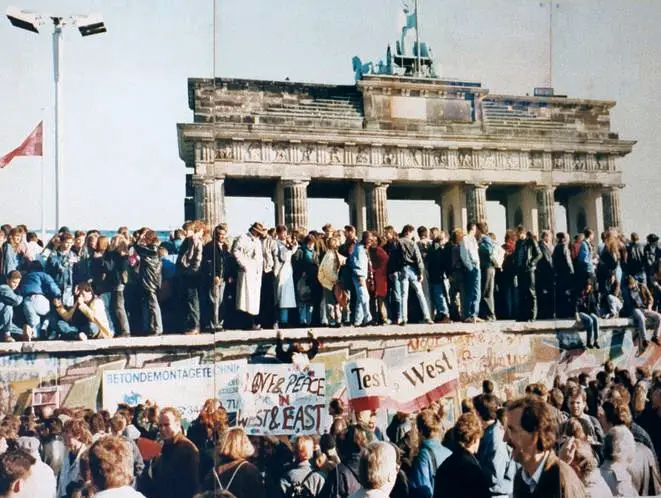
The last time we saw this scale of peaceful rejection was in East Germany after the fall of the Berlin Wall. There, when people had a choice, the old Socialist Unity Party collapsed. There was no coup. In East Germany uniparty rule ended with a general election, not a general strike.
Britain’s Berlin Wall has fallen, at least for now.
The reasons are pretty clear. Tax is too high, we have been at war for a quarter of a century, migration has soared far beyond the elastic limit of public opinion, there has been virtually no meaningful economic growth since 2007 and the rubberband has not twanged – it has snapped.
It makes me think of some of the words of Bertolt Brecht, that famous East German who saw the fall of the Kaiser, the Weimar era, the Third Reich and finally the rush of vigour of a new socialist government that turned bureaucratic and heartless.
The people have been called greedy, bigoted, intolerant, racist, sexist, uninformed, addicted to fossil fuels and in need only of being nudged, steered and lied to until they are brought up to speed. Then and only then, apparently, will they accept marginal rates of tax of seventy per cent, rents double the German average, seven million more people to be housed in three million homes built largely on paper, and energy prices triple those of Finland.
Would it not be easier in that case for the government to dissolve the people
and elect another
Brecht would have seen this coming and advised the leaders Honecker and Ulbricht of some home truths. Brecht wrote a poem about the 1953 riots against the GDR. It’s perfect for today.
“After the uprising of the 17th June
The Secretary of the Writers Union
Had leaflets distributed in the Stalinallee
Stating that the people
Had forfeited the confidence of the government
And could win it back only
By redoubled efforts.
Would it not be easier
In that case for the government
To dissolve the people
And elect another?”
Britain has taken a different direction. We have dissolved the parties of government.
Personally, I chart the decline of the UK to the People’s Budget of the old Liberal Party. Elections come in cycles but parties come in centuries, almost like seeing Haley’s Comet return every eighty or so years.
Since 1660 our civil war plays out every five years in elections and every eighty to hundred years one side reboots … almost like the AI programme in The Matrix. British politics continually replays the same deep constitutional and class conflicts through elections, but roughly every century the entire party system and governing settlement resets itself into a new form.
Fundamentally, the UK has a party of haves and have-nots: those who own land and property and those who do not. The have-nots could only catch up through wealth creation. Between roughly 1830 and 1910 – our finest age – Britain became the workshop of the world and, arguably, the most successful society in human history. The Liberals were the party of this more than the landed Tory gentry.
But the Liberals switched sides. The have-nots would increasingly focus on slicing the pie rather than growing it. This fails. It always fails.
The Liberals rebooted into Labour when they failed. The Tories also switched sides to embrace capitalism further. Macmillan boosted physical capital by a huge housebuilding programme. Thatcher unleashed the service economy, though unequally. Even Blair’s era was “perfectly relaxed about people getting filthy rich”.
The something changed.
Cameron and Miliband snapped back towards managerial status quo politics: higher taxes on work and consumption, softness on taxes on wealth, and the turbocharging of welfare-state managerialism. The gap between work and reward, risk and security, widened dramatically. The premium against prosperity has rarely been higher.
Here the story changes again.
The Greens and Nationalists expanded the blame game beyond class into nationality, identity and culture – in what is truly a post-global view of the have-nots. No longer imperial, no longer European, the identity crisis of the have-nots has been fully reshored and takes the politics of envy and malice that bit lower – more fragmented and more bitter.
Reform is not yet a party that appeals to have-nots in the way Labour or the Liberals once did
Reform, however, has pointed in a different, though very mixed, direction. It is the first major party of the have-nots to openly champion the growing pains of economic reform as the price of upward mobility.
Cutting rises to bills, rents, taxes and long-term unemployment are no accidental slurry. This is clear triangulation aimed at lifting those at the bottom without simply punishing those already successful.
Meanwhile its rhetoric on migration, bureaucracy and national identity feels decisively European in tone. Dare I say it: Dutch, even Belgian?
The European flavour of the Eurosceptics has also been reshored, and while it clearly has appeal in parts, Reform is not yet a party that appeals to have-nots in the way Labour or the Liberals once did.
The Berlin Wall has fallen and I would personally be delighted if Britain became the new West Germany: economic growth and pragmatism balanced by a genuine safety net and a sense of national solidarity comfortable within a wider Europe and world where social conservatism was polite and content because it has space within a wider democracy.
Britain may, however, need to pass through a more rebellious stage to force open political space for those not so inclined to the Butskillism and identity whack-a-mole social justice we have been treated to of late.
We are, after all, as a people socially conservative but quiet about it. We pay taxes up to a point and no further. We cherish home ownership and, yes, even housebuilding. We do not like big bills and we do not like big liars.
We could probably afford another 25 years of without endlessly vanguarding the next war, and the occasional nod to future industries moving here would not go amiss either.
Perhaps the new politics should take its advice not from Brecht but from Kipling:
“Be polite but not too friendly to Bishops and be good to all poor parish priests.
Say ‘we’, ‘us’ and ‘ours’ when you’re talking, instead of ‘you fellows’ and ‘I’.
Don’t raise our taxes, keep your temper, and never you tell us a lie.”



Comments: 0
Join the debate
Do you agree with this analysis, or is the author wrong? Have your say below.
No comments yet. Be the first to join the discussion.