

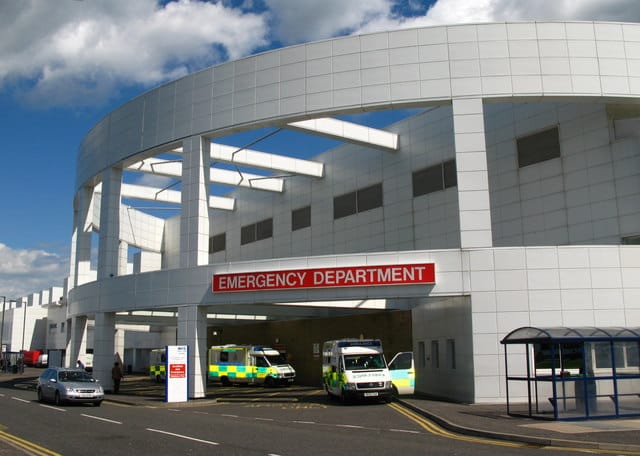
SCOTLAND’S DECISION TO INVEST in GP walk-in centres is driven by a perfectly reasonable ambition: to improve access to urgent primary care. Few would argue that patients are satisfied with the current system. Difficulty obtaining timely GP appointments remains one of the public’s biggest frustrations, while emergency departments continue to operate under relentless pressure.
The diagnosis is correct; the prescription may not be.
This argument comes from my experience working in emergency departments across all four nations of the UK, where the same pattern repeatedly emerges. Every few years the NHS introduces a new initiative designed to reduce pressure on A&E. The names change, the branding changes and the structures change, but the underlying assumption remains remarkably constant: create another service outside the emergency department and demand will fall.
It rarely does.
The reason is simple. Almost every initiative designed to divert patients away from A&E still relies upon A&E as the NHS’s ultimate clinical risk sink. When uncertainty remains, when diagnostics are required or when observation becomes necessary, patients are referred back to the one part of the system designed to manage all three.
England tested GP walk-in centres on a far larger scale than Scotland is proposing today. They undoubtedly improved convenience, but they did not consistently deliver the system-wide reductions in emergency department pressure that policymakers hoped for. Scotland should be careful not to repeat that mistake.
the bigger question is whether the traditional divide between primary and secondary care still makes sense in 2026
The same is true of telephone triage. NHS 24 and NHS 111 perform an important role, but remote assessment inevitably errs on the side of caution. Faced with uncertainty, the system escalates patients towards A&E because that is where uncertainty can ultimately be resolved.
Perhaps the bigger question is whether the traditional divide between primary and secondary care still makes sense in 2026. Patients care far less about organisational boundaries than they do about receiving the right care, in the right place, the first time. The distinction between urgent and elective care is increasingly more important than which side of an administrative boundary a clinician happens to work.
That brings us back to the purpose of GP walk-in centres.
The debate has largely focused on how patients enter the NHS. In reality, the greatest weakness in urgent care is often what happens after they have already entered it.
GP walk-in centres are the right hub for the wrong problem.
Used as unrestricted walk-in services, they risk becoming another funnel that attracts additional demand into an already stretched system. Used differently, they could become something the NHS currently lacks: an effective off-ramp from emergency departments, allowing patients to continue their care without repeatedly returning to A&E.
Healthcare follows the same principles as any other queue. Make one queue shorter or easier to access and people will naturally join it. Some of that demand represents patients who genuinely require earlier assessment. Some represents people who would otherwise have waited, self-managed or attended their own GP. Patients are behaving entirely rationally.
The NHS is simply responding exactly as queuing theory predicts.
This is why attendance figures tell us so little. A busy walk-in centre may simply demonstrate that a new queue has become popular rather than proving that pressure has been removed elsewhere.
many patients return to A&E because their journey was never properly completed
The more important question is whether patients are completing their journey through the NHS more effectively.
Every emergency clinician recognises the patient who returns within 24, 48 or 72 hours. Sometimes that return is entirely appropriate. Illness evolves. Diagnoses become clearer. Treatment plans change. But many patients return because their journey was never properly completed. They need a wound review, a medication adjustment, a repeat examination or simply reassurance that recovery is progressing as expected. With no obvious alternative, they return to the one part of the NHS they know will always be open.
These patients “boomerang” back into A&E.
Reducing such unnecessary returns should be one of the central objectives of urgent care reform.
This is where GP walk-in centres could make their greatest contribution—not as unrestricted walk-in facilities, but as “Click and Check-In” Urgent Care Hubs. Patients should not have to navigate urgent care alone. The NHS should guide them.
Following assessment by NHS 24, patients requiring urgent but non-emergency review could be booked directly into the next available appointment. General practitioners could refer patients requiring same-day assessment. Ambulance clinicians could divert suitable patients where appropriate.
Most importantly, emergency departments themselves should be able to book patients directly into review appointments within the following 24 to 72 hours. Instead of discharging patients back into uncertainty, clinicians would discharge them into a defined pathway. Instead of another front door into the NHS, these centres would become a structured exit from emergency care.
However, the challenge is not simply to create premises. Every new service requires clinicians. Scotland must be careful not to create parallel structures that compete with general practice, emergency medicine and community services for the same limited workforce.
A successful urgent care hub cannot simply add another layer to the system. It must replace duplication, improve flow and use existing clinical expertise more effectively.
That changes the purpose of the service completely. Traditional walk-in centres treat episodes whereas “Click and Check-In” Urgent Care Hubs manage journeys.
Success should therefore not be measured by how many patients attend. It should be measured by how many patients do not need to return unnecessarily to A&E within 72 hours, how many duplicate assessments are avoided, how many ambulance transfers are prevented and whether patients reach definitive care without bouncing between different parts of the NHS.
Scotland undoubtedly needs to improve access to urgent care. But the larger prize is not creating another place where patients can join a queue. It is creating a system where patients complete their journey safely, efficiently and without repeatedly falling back into emergency departments.
GP walk-in centres are not a bad idea. They are simply the right hub for the wrong problem. Used as another walk-in service, they risk becoming another funnel into an already crowded NHS.
Used as “Click and Check-In” Urgent Care Hubs, they could become the off-ramp from A&E that Scotland’s urgent care pathway has been missing.




Comments: 0
Join the debate
Do you agree with this analysis, or is the author wrong? Have your say below.
No comments yet. Be the first to join the discussion.