

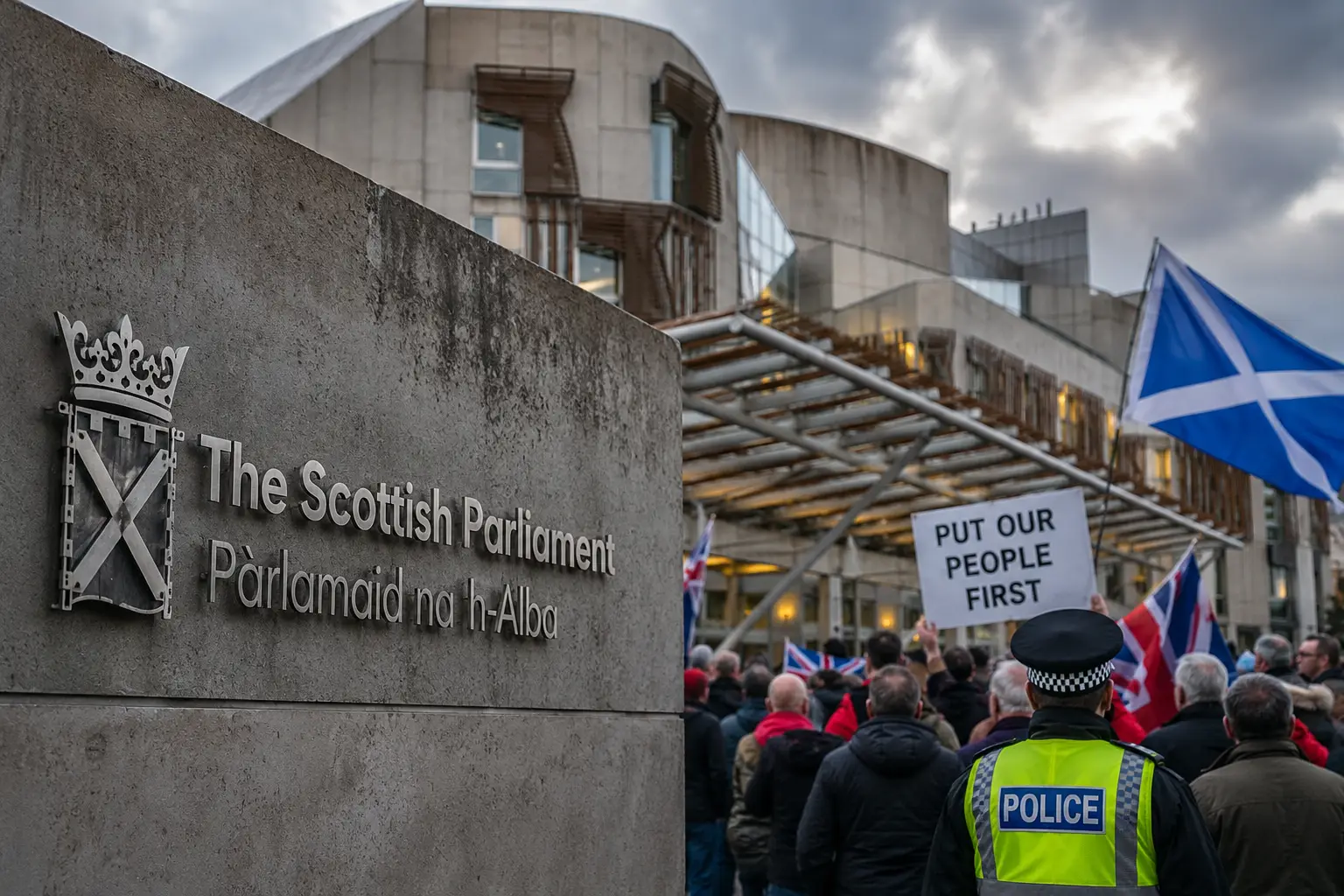
ABOVE ALL ELSE, Reform UK is a party that has focused on exposing and remedying the problems of uncontrolled immigration, and its electoral success has been driven in no small part by this policy stance.
Yet in Scotland the issue has been far less prominent, despite polling showing it among voters’ top three concerns before the Holyrood election. While a few migrant hotels have become flashpoints for protests and media attention , Glasgow hosts more asylum seekers than any other local authority in the UK.
The reason immigration has not risen to the top of the political agenda in Scotland is simple: there is an unspoken cross-party consensus not to discuss the problems it is causing. The official line is that Scotland is a welcoming, inclusive country that needs more, not less, immigration.
Unlike Kemi Badenoch’s Conservatives in England who have been forced to address the issue, Russel Findlay’s Scottish Tories have kept schtum. Thomas Kerr told me the leadership had explicitly instructed him not to raise the issue when he was a Conservative councillor in Glasgow.
Scottish Labour is no different. When Councillor Audrey Dempsey wanted the Labour group on Glasgow Council to approve a question for a council meeting about the prevalence of attacks on white pupils by black pupils, she was blocked, and advised privately that the question would be acceptable if she changed the wording to make the victims black. The details were subsequently leaked to the press in such a way that she left Labour.
The issue of immigration finally exploded at Holyrood last week, thanks to Malcolm Offord at First Ministers’ Questions (FMQs). The pretext was the protests in Belfast, as well as in Glasgow and Greenock, following the attempted beheading of Stephen Ogilvie, a Scotsman from Livingston living in Belfast, by a Sudanese man who had claimed asylum in Northern Ireland in 2023.
protest is a valid mechanism to make one’s views heard when in frustration
Belfast has around two-thirds of all supported asylum seekers in Northern Ireland, about 0.5 per cent of the population while Glasgow’s proportion is 0.65 per cent. The protests in Belfast escalated into violence, with immigrants’ homes and businesses targeted, reflecting in part the province’s tendency to violent street action seen during the Troubles, but also its continuing sectarianism and failure to integrate Protestants and Catholics since the Good Friday Agreement.
It is hardly surprising, therefore, that Northern Ireland has experienced more difficulty accepting immigrants than other parts of the UK. Given Glasgow’s sectarianism and many connections to Ireland, it is hardly surprising that protesters there also took to the streets after the Belfast stabbing. Both Glasgow and Greenock saw violent incidents, with police and civilians injured and arrests made, although without the level of sustained rioting, arson and property destruction seen in Belfast.
All the party leaders at FMQs performed the customary genuflection to the Belfast stabbing and condemnation of the subsequent “violence, racism and disorder on our streets”, including Malcolm Offord, who did so twice.
Before the Scottish Reform leader could complete his first question, he was interrupted by the Presiding Officer and reminded that “immigration is a reserved matter and does not come under the First Minister’s remit”.
Nevertheless Malcolm Offord persevered with “a specific Scottish matter … in relation to immigration”. He then homed in repeatedly on a simple practical remedy to Glasgow’s worsening immigration problems – reinstate the local connection rule, which Reform had announced in its election manifesto. In contrast to England, the lifting of this rule gives asylum seekers with leave to remain who present as homeless priority over local people on social housing lists. It has made Glasgow a magnet for illegal immigrants from across the UK and made its self-declared housing emergency more acute.
John Swinney simply refused to engage with Offord’s question. Instead he accused Offord of “trying to pursue an issue on immigration at the same time as his party is associated with the stirring up of hatred within our society”. He then referred to his pre-election statements that he “would not co-operate with Reform in this Parliament because of the way in which it pursues this issue, which incites racial hatred in our society” and expressed his determination to sustain this stance during this session of the Parliament.
Offord’s response was to argue that while everyone can agree that “violent protest is not the answer”, this stance should not obscure:
“the very real problem with immigration, which was created by the Tories and is now being exacerbated by Labour. Weak politicians have created this unrest in our society. If we, the politicians, do not fix it democratically, other, less savoury actors will fill that vacuum.”
The First Minister then attacked Reform MSP Thomas Kerr for saying people “should get out and protest” when he, the First Minister, had said that “in the current context, nobody—although they have democratic rights—should be out protesting last night, given the climate that we are in”.
Offord defended Kerr, who had also repeatedly disavowed violence, on the grounds that “protest is a valid mechanism to make one’s views heard when in frustration”. He pointed to the twenty refugees a week coming to Glasgow, “the vast majority … fighting-age men of undisclosed nationality” as “unsustainable”. Contrasting this with Swinney advocating “open borders” while wearing a T-shirt saying “I welcome refugees”, Offord insisted that “there are consequences” and repeated his call to reapply local connection rules “to rebalance the system, once again, to put our own people first”.
In reply Swinney pounced on Offord’s use of language, such as “strangers” (which he did not use in this exchange although Thomas Kerr repeatedly has previously) “to create division between people who walk the same streets of our country”. He then explicitly blamed the racial violence in Glasgow on Offord, Kerr and other Reform MSPs for “inciting racial division in our society”.
This exchange illustrates, in a nutshell, why there are violent protests about immigration and why there will be more.
the First Minister has effectively told a substantial tranche ot Scots to shut up and go away because they are racists
The First Minister’s approach is to vilify Reform, in an attempt to silence it; when that fails, he refuses to engage and vilifies them further, all the while occupying the highest of moral high grounds. (It is curiously similar to the approach Nicola Sturgeon adopted towards Joanne Cherry and others who questioned SNP finances – an approach which also manifestly did not succeed in the longer term.)
This approach to Reform, which is after all merely voicing the grievances of many protestors, extends, of course to the protestors and to everyone concerned about immigration: if you do not keep shtum, you are accused of inciting racial hatred and branded a racist. The 745,419 votes cast for Reform in the recent Scottish Parliament election do not signify individual voters, but they do represent a substantial tranche of Scots whom the First Minister has effectively told to shut up and go away because they are racists.
The purpose of Swinney’s approach is obvious: if immigration cannot be discussed, then no problem need be acknowledged.
It amounts to political gaslighting. Audrey Dempsey’s eloquent article on this site was a cri de coeur against precisely this phenomenon. It gives voice to the lived experience of ordinary working-class Glaswegians living alongside foreigners – yes “strangers” – who have not integrated.
The contradiction is glaring.
Swinney and his ilk preach inclusivity while practising exclusivity by refusing to engage with those who have concerns about immigration. They warn against “othering” immigrants while “othering” anyone concerned about excessive immigration as “far right”. In condemning in the stoking of division, the stirring up of hate and the inflaming of racial tension, they only deepen the anger and antipathy between those concerned about immigration and those who deny there is a problem.
Problems that cannot be discussed cannot be solved
The Reform MSP Helen McDade raised a point of order at the end of FMQs, referencing rule 7.3 of standing orders, which states that members “shall not conduct themselves in a manner which would constitute a criminal offence”. This was her complaint:
“The First Minister believes that saying the word “strangers” incites violence. What does he think the word “racist”, aimed at me, does to my risk? I think that it increases the risk to me as a public figure. I ask the Presiding Officer to rule on the use of the word “racist” in this Parliament, or to ask the First Minister, who has known me for twenty years, to say to my face that he thinks that I am a racist.”
The Presiding Officer argued that the First Minister did not address his comments “specifically to any individual” and dismissed her point of order as “a point of argument”.
While it is true that Swinney did not directly call Offord or McDade a racist, he certainly accused him, Thomas Kerr and other unnamed Reform MSPs of “inflaming racial division”. Following Offord’s exchange with Swinney at FMQs, there was a love-in between the Green leader Gillian Mackay and the First Minister, in which she called for “our Parliament” to “stand together to condemn racists and fascists who seek to divide our communities”.
McDade appeared on BBCRadio 4’s Any Questions? the next day where she disclosed that she and some other members of Reform had had to increase their security in the wake of attacks against them. Again, the irony is on stilts: Swinney and his allies decry the risk to immigrant communities while increasing the palpable risks faced by politicians such as McDade. (The irony is heightened by the SNP’s frequent condemnation of the abuse directed at women in politics).
The Any Questions? episode also illustrated the role of class in the immigration debate. The BBC was in Crail, an affluent and very picturesque village in the East Neuk of Fife, beloved of retirees (who dominated the audience), second-home owners and tourists. The Green MSP Lorna Slater was also on the panel, and the mood in the room was overwhelmingly pro-immigration, with critics often regarded as ignorant and bigoted – akin to the stereotypical “gammon” Brexit voter.
Yet the mood was also – in response to a question about the proliferation of second homes and Airbnbs in the area – overwhelmingly hostile to such incomers. This was despite many of the audience enjoying substantial gains in property wealth due to these markets and benefitting from the lovely shops, restaurants and other amenities which they supported. No one in the room recognised the parallel with working-class communities in Glasgow struggling with the influx of immigrants, who far from contributing to rising property values or improved amenities, have increased pressure on public services such as housing, health and education services.
For all the gaslighting, the strategy pursued by Swinney, Slater and much of the Scottish political class is doomed. Problems that cannot be discussed cannot be solved. If immigration-related pressures continue to grow while politicians insist there is nothing to debate, public frustration will grow with them. Eventually, denial becomes impossible.


Comments: 0
Join the debate
Do you agree with this analysis, or is the author wrong? Have your say below.
No comments yet. Be the first to join the discussion.