

IN DEBATES ABOUT SCOTTISH INDEPENDENCE and full fiscal autonomy, many unionists make a category error. They assume they are arguing within a normal democratic framework where voters behave primarily as economic actors: weighing tax rates, deficits, productivity, public services, and competence. From that assumption comes the comforting belief that if the Scottish National Party were ever given full fiscal autonomy and governed badly enough, the public would eventually recoil and abandon the nationalist project.
I do not believe that follows at all.
I call this misunderstanding the “Prisoner’s Monolemma”.
Human beings frequently organise politically around singular objectives that survive enormous internal contradiction. Religious sects, revolutionary movements, national liberation struggles, ideological parties, and even states themselves can remain coherent in one overriding direction while incoherent in dozens of subsidiary beliefs.
The principle is simple: even a deeply irrational or incoherent group can still unite around one shared rational objective. Prisoners may distrust one another, hate one another, or possess wildly distorted worldviews, but if the cell door opens they move in the same direction. The same applies in asylums. A delusional man may believe himself Napoleon, Christ, or a radio receiver for Venusian frequencies, but he still understands confinement and still wishes to leave.
Years ago I had a psychiatric patient who illustrated this perfectly. He could converse lucidly for long stretches, but there were serious concerns about his mental state. At one point he demanded discharge. I explained carefully that he could not leave.
He replied:
“Doctor I understand you, but remember I am the First Apple because I know what is good and what is evil, which is why everyone wants me and why I must leave.”
Now, re-read the script:
“Unionists I understand you, but remember I am the First Minister because I know what is right and wrong for Scotland, which is why Scotland voted for me and why we need independence.”
The sentence structure is almost identical. In both cases the speaker establishes himself as the unique possessor of moral legitimacy, claims democratic or metaphysical validation for that authority, and concludes therefore that confinement itself is illegitimate.
The sentence from my patient was madness and logic fused together. His cosmology was irrational, but his objective was not. He wanted freedom. Everything else in his thinking bent itself around that single imperative.
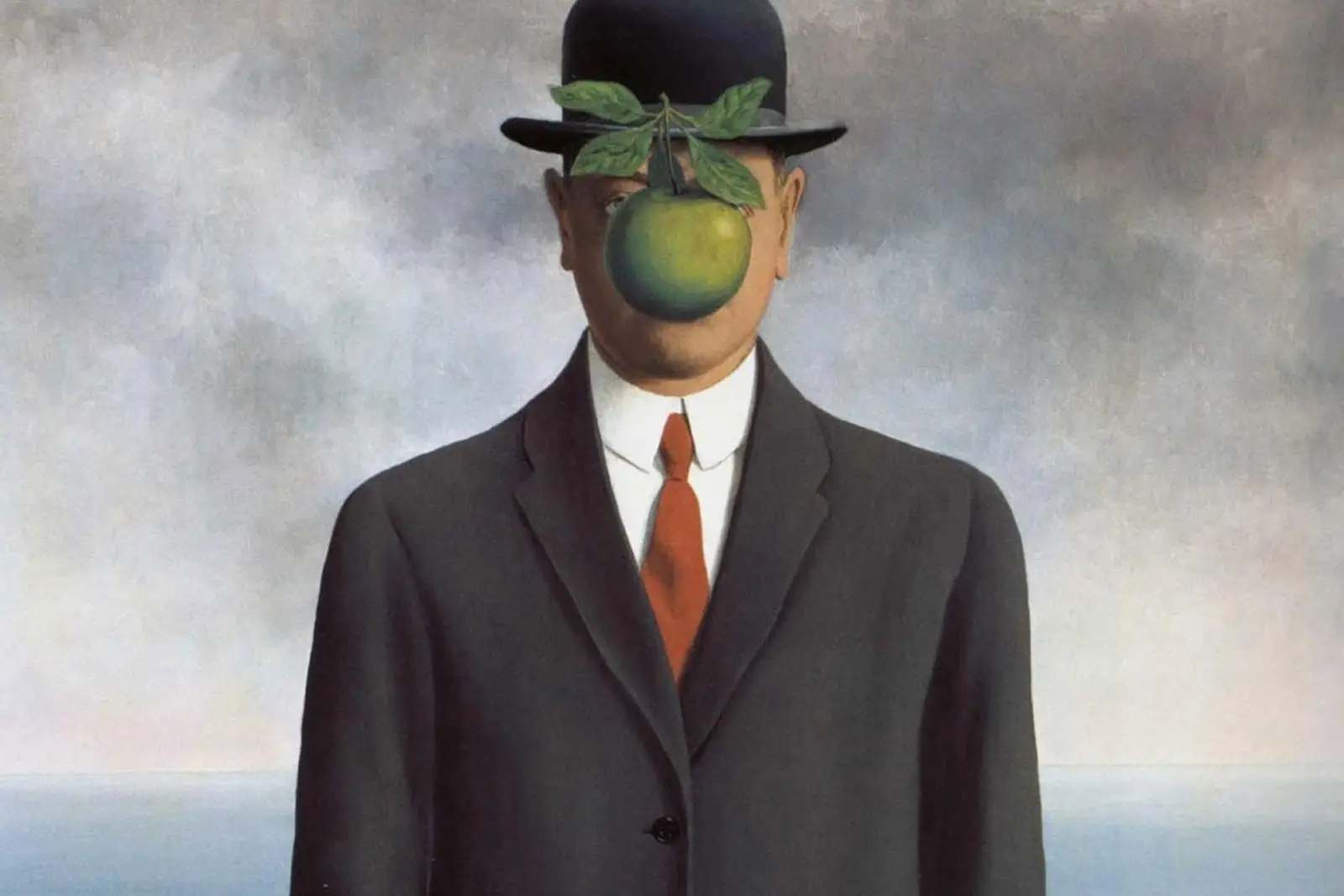
The image of the “First Apple” always reminded me of The Son of Man by René Magritte – the anonymous suited figure whose face is obscured by a hovering green apple. It could easily be John Swinney himself. The painting is absurd yet strangely theological, as though some hidden revelation sits just beyond ordinary comprehension. My patient seemed to imagine himself as a living avatar of that image: a man who believed he possessed forbidden knowledge and therefore could not legitimately be restrained by ordinary men.
Against the First Apple I possessed only one defence: that within the hospital the majority holding power agreed with me and not with him.
That was the entire basis of authority.
Not omniscience. Not divine certainty. Consensus.
I could not ultimately reason him out of his worldview because I am not God. I am only a doctor. My authority existed because the institution around me still accepted a shared definition of reality and still trusted me with the keys.
But imagine gradually handing more keys to the patients themselves. Imagine empowering them with greater security responsibilities while simultaneously hoping to preserve the institutional order that depended upon containing them. The process would not strengthen my ability to reason with the First Apple. It would weaken it. Before long I would likely find myself locked in his cell rather than him in mine.
In truth, however, the Scottish case is even more difficult than that metaphor suggests, because these people are neither criminals nor insane. They are neither in prison nor an asylum (even if nationalists sometimes like to claim hey are prisoners of nasty colonialists).
Their views and actions are simply mutually incompatible with our own. They possess the same democratic legitimacy as we do. They vote, organise, persuade, and campaign exactly as we do. The conflict is therefore not between sanity and madness, virtue and evil, but between two populations with increasingly incompatible constitutional instincts.
Then what is fair? What is reasonable?
Only this: that if we are the majority, we had better start acting like it electorally.
That, in essence, is why I believe many unionists fundamentally misunderstand Scottish nationalism.
We already live in a Scotland saturated with contradictions that large numbers of people tolerate without abandoning the broader constitutional project. We live in a country where biological definitions can become politically negotiable; where we are told simultaneously that Scotland is a net contributor to the United Kingdom and also too poor to survive without it; where mythical oil fortunes appear and disappear according to constitutional necessity; where ferries arrive with painted-on windows; where taxes rise above English levels while productivity stagnates; and where politicians rage against refinery closures while opposing the extraction industries that sustain those refineries in the first place.
Yet despite all this, roughly forty per cent of the country still wishes to leave the Union.
That forty per cent does not need to be coherent in every respect. It merely needs to remain coherent in one respect.
Escape.
That is the Monolemma.
The mistake many unionists make is believing that contradiction automatically dissolves political commitment. They imagine that exposing fiscal gaps, industrial failures, unrealistic projections, or administrative incompetence must eventually collapse nationalist sentiment under the weight of reality.
But identity-driven movements do not function like spreadsheet calculations.
A prisoner does not abandon escape because his accomplice is incompetent. He does not suddenly decide the prison is legitimate because the tunnel walls are unstable. If anything, hardship often deepens solidarity because suffering becomes incorporated into the moral narrative of captivity itself.
This is why full fiscal autonomy would not necessarily operate as a stable constitutional compromise. It could just as easily function as a lockpick. Every transfer of competence becomes evidence that further transfer is possible. Every new institution becomes proof of latent sovereignty. Failures themselves are reinterpreted not as evidence against the project, but as proof that liberation remains incomplete.
In fact, the truly irrational actor may not be the nationalist at all.
The most irrational one of all is the man who fully recognises that another person is motivated by identity, myth, emotion, and existential desire – and still attempts to reason him out of it using Treasury forecasts and marginal tax analysis.
There is something almost comic in trying to persuade an escape movement with actuarial tables. It resembles arguing about interest rates with a prisoner halfway through digging a tunnel beneath the wall.
The nationalist may indeed be contradictory. He may believe six impossible things before breakfast. But if his primary psychological orientation is toward escape, then conventional political rationalism loses predictive power.
The patient who called himself the First Apple was not governed by coherence. He was governed by direction.
And direction, when shared by enough people, is often more politically powerful than reason itself.



Comments: 0
Join the debate
Do you agree with this analysis, or is the author wrong? Have your say below.
No comments yet. Be the first to join the discussion.