

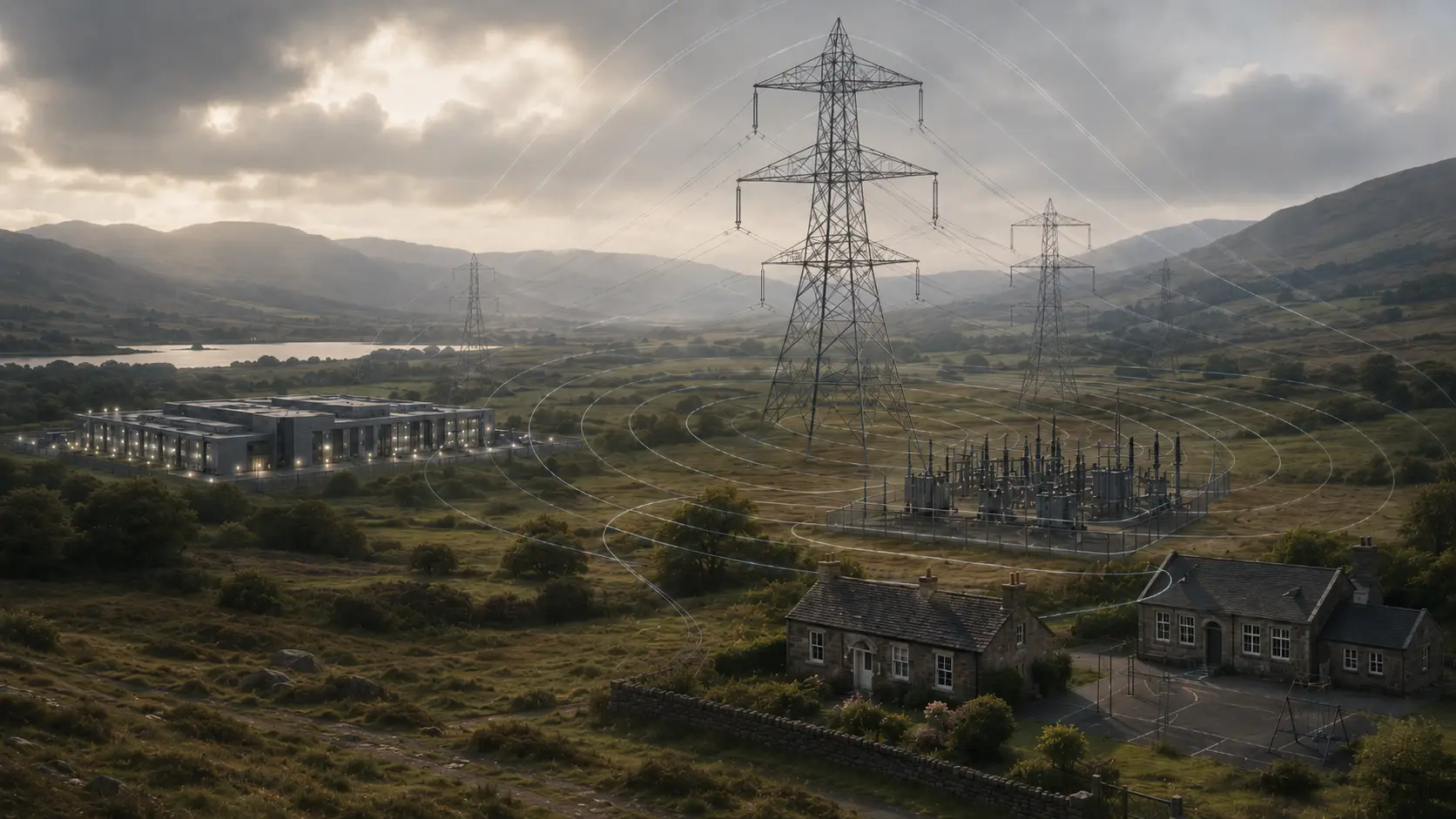
THERE IS A STRUCTURE that will accompany every large data centre built in Scotland, and it does not appear prominently in any planning application. It is not discussed at community consultations. It does not feature in the economic impact assessments that developers commission to support their applications. It is, for most practical purposes, invisible in the planning process — despite being physically enormous, permanently installed, and carrying documented health implications that have been the subject of formal scientific assessment for two decades.
It is the grid connection infrastructure.
A 500 megawatt data centre requires a connection to the high-voltage transmission network. That connection is delivered by 275 kilovolt or 400 kilovolt overhead lines, carried on steel lattice towers standing approximately 56 metres tall – seventeen storeys – spaced at roughly 370-metre intervals along the connection route. The on-site substation required to step voltage down to usable levels occupies between two and six hectares of land. This is not a cable buried underground and forgotten. It is a permanent, visible, substantial alteration of the landscape through which it passes and beside which people live.
What the science says
The International Agency for Research on Cancer – the IARC, a body of the World Health Organisation – classifies extremely low frequency magnetic fields as Group 2B: possibly carcinogenic to humans. That classification, set out in IARC Monograph 80 published in 2002, is based on epidemiological studies showing a statistical association between long-term residential exposure above 0.3 to 0.4 microtesla and elevated rates of childhood leukaemia.
The classification does not establish causation. Group 2B means the evidence is sufficient to warrant concern and continued research, not that exposure at these levels will cause cancer. What it does establish is a threshold: 0.3 to 0.4 microtesla is the field level at which long-term residential exposure is associated with increased risk. That threshold is the relevant benchmark for assessing whether homes beside 400 kilovolt infrastructure are within a zone of documented concern.
The distances that matter
Published field decay measurements for 400 kilovolt overhead lines – available from the emfs.info database maintained by the electricity networks, and from the German Federal Office for Radiation Protection – show that magnetic field levels directly beneath the conductor reach 5 to 10 microtesla at typical operating loads. At 120 metres from the conductor, fields fall to approximately 0.2 microtesla. At 150 metres, background levels are reached.
The IARC threshold of 0.3 to 0.4 microtesla is exceeded, on published field decay data, out to approximately 60 to 80 metres from the conductor at typical operating loads. That is the distance at which long-term residential exposure moves into the range associated with elevated childhood leukaemia risk.
At 100 metres, published measurements consistently show fields at or approaching background levels. At 100 metres, the documented concern ends.
The Scottish Energy Compact proposes a 100-metre planning setback from any new 275 kilovolt or 400 kilovolt overhead transmission conductor or substation perimeter fence to the nearest residential property, school, or hospital. This is not a health regulation. It is a planning protection grounded in published field decay data, requiring that new grid infrastructure is not placed within the zone where the IARC threshold is exceeded.
The 2009 decision that does not resolve this
There is a standard response to the 100-metre setback proposal, and it deserves a direct answer.
In October 2009, the UK Government issued a Written Ministerial Statement declining to impose mandatory buffer zones around high-voltage power lines. The decision followed the SAGE – Stakeholder Advisory Group on ELF EMFs – process, which produced two interim assessments before the Government responded. The 2009 statement concluded that the cost-benefit case for mandatory buffer zones had not been made.
That decision concerned the existing transmission network – tens of thousands of kilometres of overhead lines already in place, beside homes already built. The cost of imposing a buffer zone on that existing network would have involved either compulsory purchase of residential properties or operational constraints on infrastructure whose removal would have been practically impossible. It was a GB-wide cost-benefit judgement about infrastructure already in the ground.
It does not bind Scotland’s planning framework for new infrastructure seeking new consent. When a developer applies for permission for grid connection infrastructure that has not yet been built, beside homes whose proximity can be assessed before a single pylon is erected, the cost-benefit calculation is entirely different. The cost of a 100-metre setback is a routing choice, not a demolition programme.
The SAGE Second Interim Assessment of 2010 separately concluded that reasonably practicable steps should be taken to site new substations away from residential properties. That principle has never been applied as a condition of planning consent in the data centre process. The Compact applies it.
The cumulative gap
No data centre planning application in Scotland has been required to submit a cumulative EMF assessment covering all grid connection infrastructure associated with the facility – the connection route, tower heights, substation footprint, and modelled field contours at 50, 100, and 200 metres from the nearest residential properties.
This information is not technically difficult to produce. Field decay can be modelled from published parameters with straightforward software. Both the data and the methodology exist. What is missing is a requirement to produce and disclose it as part of the planning process.
The Scottish Energy Compact requires every applicant above 50 megawatts to publish a grid connection statement before their application is determined, identifying all above-ground infrastructure, substation footprints, and modelled field contours at the specified distances from the nearest homes, schools, and hospitals. These are not onerous requirements. They are the minimum information that communities living beside this infrastructure deserve to have before the decision that will affect them for decades is made in their name.




Comments: 0
Join the debate
Do you agree with this analysis, or is the author wrong? Have your say below.
No comments yet. Be the first to join the discussion.