

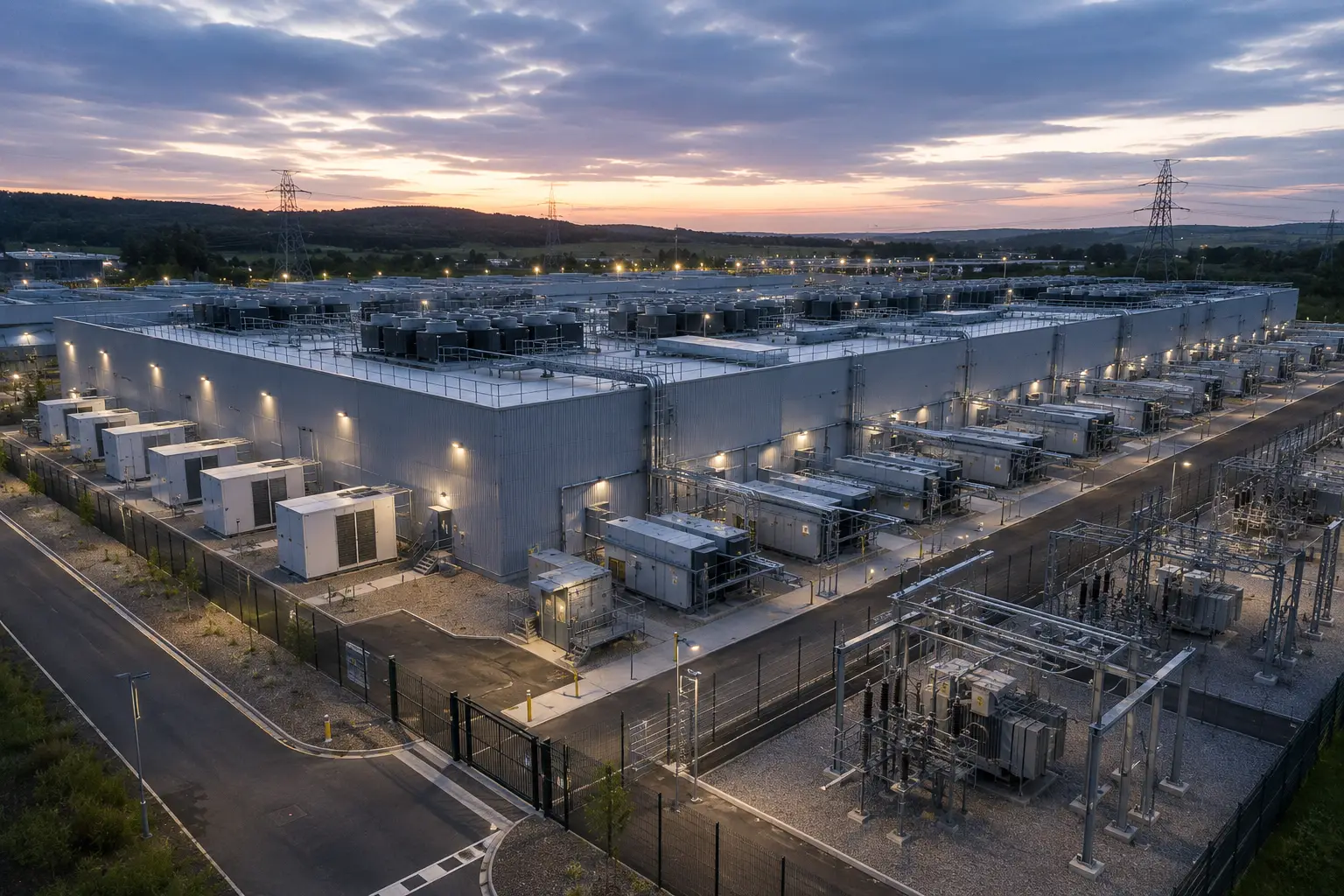
TWENTY HYPERSCALE DATA CENTRES are currently working their way through Scotland’s planning system. If they are all built, their combined electricity demand will exceed Scotland’s entire winter peak consumption. Every watt that keeps Scottish homes warm, hospitals running, and trains moving in the coldest weeks of the year – matched, and then surpassed, by server farms processing artificial intelligence workloads for corporations whose combined market capitalisation exceeds five trillion dollars.
This is not a prediction. Nor is it a campaign claim. It is arithmetic derived from the developers’ own planning submissions, cross-referenced against National Grid ESO capacity data. The pipeline is real, it is large, and it is moving faster than the institutions designed to scrutinise it.
No Scottish voter was asked whether this was the country they wanted to build. No parliament debated the cumulative scale before the first consent was granted. No minister published an assessment of what it would cost households, what it would do to water supplies, or what it would place in the fields beside people’s homes. The planning system processed each application individually, in isolation, as if the others did not exist.
That is the central failure this series will document – and the fix it will propose.
What is a hyperscale data centre?
A hyperscale data centre is not a server room. Nor is it a small office building humming quietly on an industrial estate. A 500 megawatt facility – the standard unit of the current Scottish pipeline – consumes as much electricity as a city of 400,000 people. It requires grid connection infrastructure on the scale of a small power station: 56-metre steel lattice towers carrying 400 kilovolt overhead transmission lines, and an on-site substation occupying between two and six hectares of land.
These are industrial facilities. The electricity they consume must be generated somewhere, transmitted through infrastructure that someone must pay for, and delivered at pressures and voltages that require significant civil engineering to achieve. The water they use to cool their servers – in the evaporative cooling systems that most current designs rely upon – must be drawn from somewhere, at volumes that would strain any Scottish water supply system.
None of this is secret. It is all in the planning submissions. What is missing is any requirement that it be assessed in aggregate, disclosed to the communities that will live beside it, or subjected to conditions that reflect the documented environmental risks.
How did we get here?
The answer lies in a decision that seemed reasonable at the time. Scotland’s National Planning Framework 4, which sets the national planning context within which all local decisions are made, designates certain categories of development as “national developments”. This designation streamlines the consent process. It signals that facilities of this type are, in principle, in the national interest, and instructs planning authorities to treat them accordingly.
Green and AI data centres are on that list. The designation was introduced when the pipeline was a fraction of its current size, when the facilities being proposed were smaller, and when no cumulative assessment existed because there was nothing cumulative to assess. The framework was not designed for twenty simultaneous applications totalling 8,700 megawatts.
National development status does not remove the need for planning consent. It does not override local objections or bypass environmental assessment. But it creates a presumption in favour of approval that colours every decision made downstream – by planners, by reporters, by councillors weighing objections from residents against a national policy framework that tells them these facilities are wanted.
The framework has not been updated to reflect the scale of what is now being proposed. The presumption in favour remains. The cumulative assessment does not exist.
The numbers that should have triggered a pause
Scotland’s total electricity demand at winter peak is approximately 5,500 megawatts. The current data centre pipeline, if consented and built, would add 8,700 megawatts of new demand. Even accounting for the fact that not all facilities will operate at full capacity simultaneously, the scale of the demand signal is unprecedented in Scottish energy history.
For comparison, the entire offshore wind capacity currently connected to the Scottish grid generates approximately 4,500 megawatts at maximum output – and generates nothing when the wind is not blowing. The data centres will run at approximately 80 per cent utilisation, 24 hours a day, 365 days a year. They are a constant, massive, non-negotiable baseload demand that must be met at all times.
The estimated household exposure from grid reinforcement costs is between £145 and £225 per year in additional network charges once the pipeline is fully operational. That figure has not been published by the Scottish Government. It has not been disclosed to the communities hosting the facilities. It appears in no planning document submitted by any developer.
Ireland’s warning
Scotland is not the first country to face this question. Ireland was. In 2021, the Irish Government imposed a moratorium on new data centre connections in the Dublin area after modelling showed that the pipeline, if built, would consume 70 per cent of Ireland’s electricity generation capacity by 2030. The moratorium was not permanent. It was merely a pause: twelve months to carry out the cumulative assessment that should have been done before the first consent was granted.
The Netherlands followed. Singapore followed. Each country reached a point at which the aggregate demand signal became impossible to ignore, and each chose to pause and assess before proceeding. None of them abandoned data centre development. They conditioned it – setting requirements for renewable energy, water use, community benefit, and infrastructure contribution that reflected the actual scale of what was being built.
Scotland has not paused. Nor has it assessed. Scotland is still processing applications individually, in isolation, as if the cumulative picture does not exist.
What this series will cover
This is the first of five articles examining Scotland’s data centre planning failure and proposing a specific, legally grounded remedy – the Scottish Energy Compact, a framework of four conditions of consent that can be applied immediately using existing devolved powers, without new primary legislation.
Part 2 examines who pays the bill. Part 3 examines the water supply crisis. Part 4 examines the electromagnetic field infrastructure. Part 5 sets out the Compact in full – what it requires, why it is legally sound, and what the Scottish Government can do this parliamentary session to begin applying it.
The evidence is documented and the powers exist. The question is whether the government that claims to act in Scotland’s interest will use them.




Comments: 1
Join the debate
Do you agree with this analysis, or is the author wrong? Have your say below.
Very interesting. The Rationals Forum has done a similar analysis on a UK-wide basis, also exposing the lack of transparency in what is going on. They say the UK pipeline of AI data centres will need a supply of 50 GW, a figure that already exceeds the UK’s current peak electricity demand: https://rationals.substack.com/p/britains-ai-superpower-a-sermon-in.
Their latest post exposes that these data centres are nearly all American owned, many linked to the US military and as such obvious targets for military enemies: https://rationals.substack.com/p/the-kill-chain-on-your-energy-bill.
They say these centres will be in part paid for unknowingly by the UK general public via their energy bills. Our establishment oppressors seem to think they can get away with murder.