

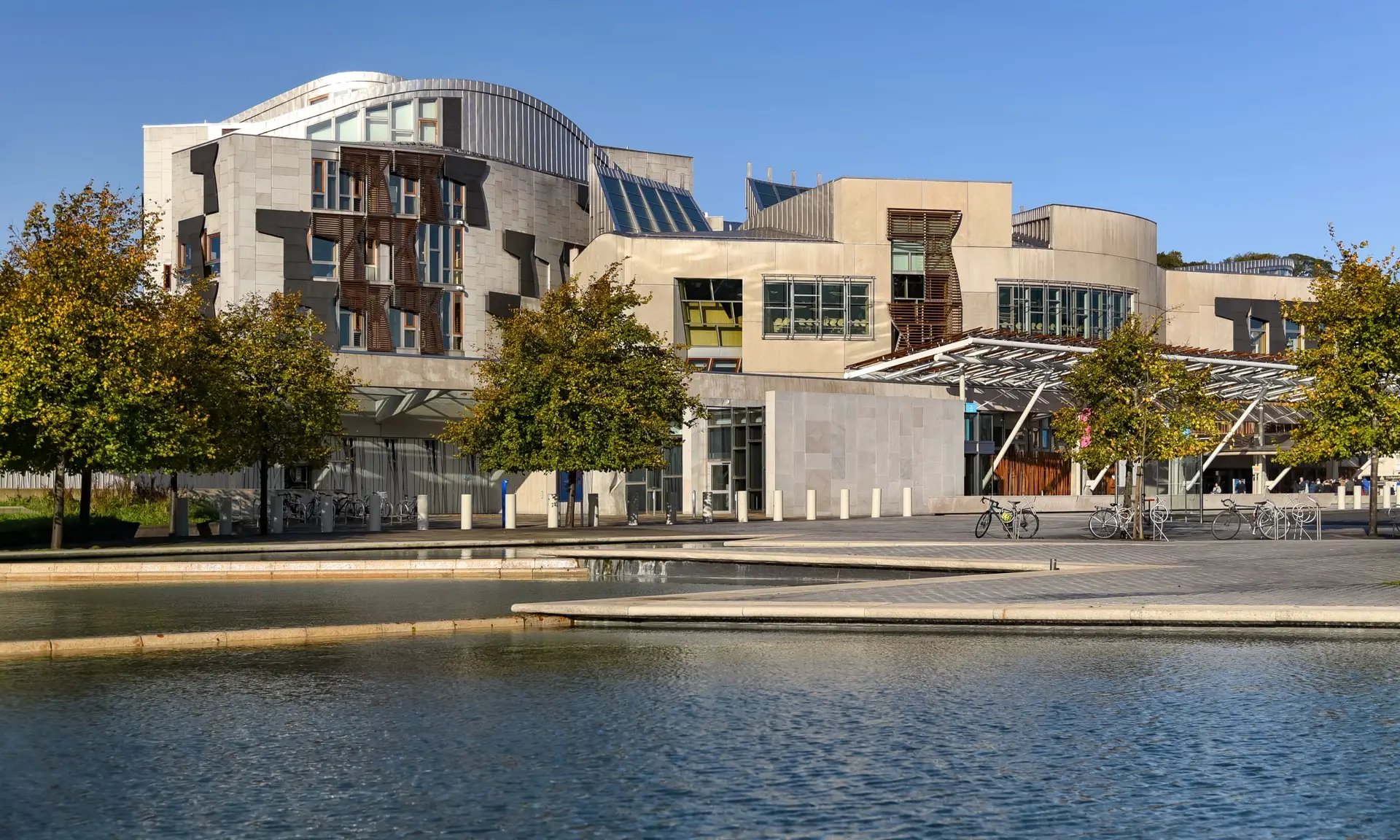
FOR WHAT IT’S WORTH, after first campaigning in Scottish elections since 1976 – some fifty years ago – and having lived through the rise and fall of the SNP (and then its rise again), the phenomenon that was the SDP, serving two terms in the Scottish Parliament and later the European Parliament, I believe the arrival of Reform at Holyrood is a defining moment.
Simply put, the Reform result is astounding. There is no other way to express it. Some may be a tad disappointed because much of the polling suggested Reform could burst through into 20-25 MSPs and possibly win one or more constituencies (the media speculated openly about Banffshire, Ayr, and seats in the borders). So missing out in Banffshire by 324 votes and being held to seventeen list MSPs may appear to be an underperformance – but I shall have none of it.
Everyone, be it political opponents, practically all of the Scottish media, or the ever-so-disgusted establishment class, were keen that Reform failed – and, where possible, did their level best to belittle and marginalise the party (in some cases that’s putting it politely).
Had the SNP offshoot, Alba, produced a result of seventeen MSPs elected from the lists, you would not be hearing the end of it and there would be protest marches springing up demanding a referendum be held later this year.
Had there been another left-of-centre party, a Corbynite faction, a Tommy Sheridan remake of the SSP, or other such splinter group elected with seventeen list MSPs, it would be all over the broadcast news, including the London-centric channels.
Neither of those scenarios happened, but Reform has spoken up for not only those disenchanted supporters of the mainstream parties – it has given a voice to those who did not like the existing choices or politicians more generally. Reform raises the issues the other parties would rather not reach. Now, with a platform of seventeen MSPs, mostly newbies without the inhibitions of established parties or ingrained political backgrounds, Holyrood will hopefully be confronted by difficult questions that it has previously refused to face up to.
The only way, surely, is up for Reform in Scotland – with next year’s council elections the first yardstick of the impact it might make.
Worst ever Labour result
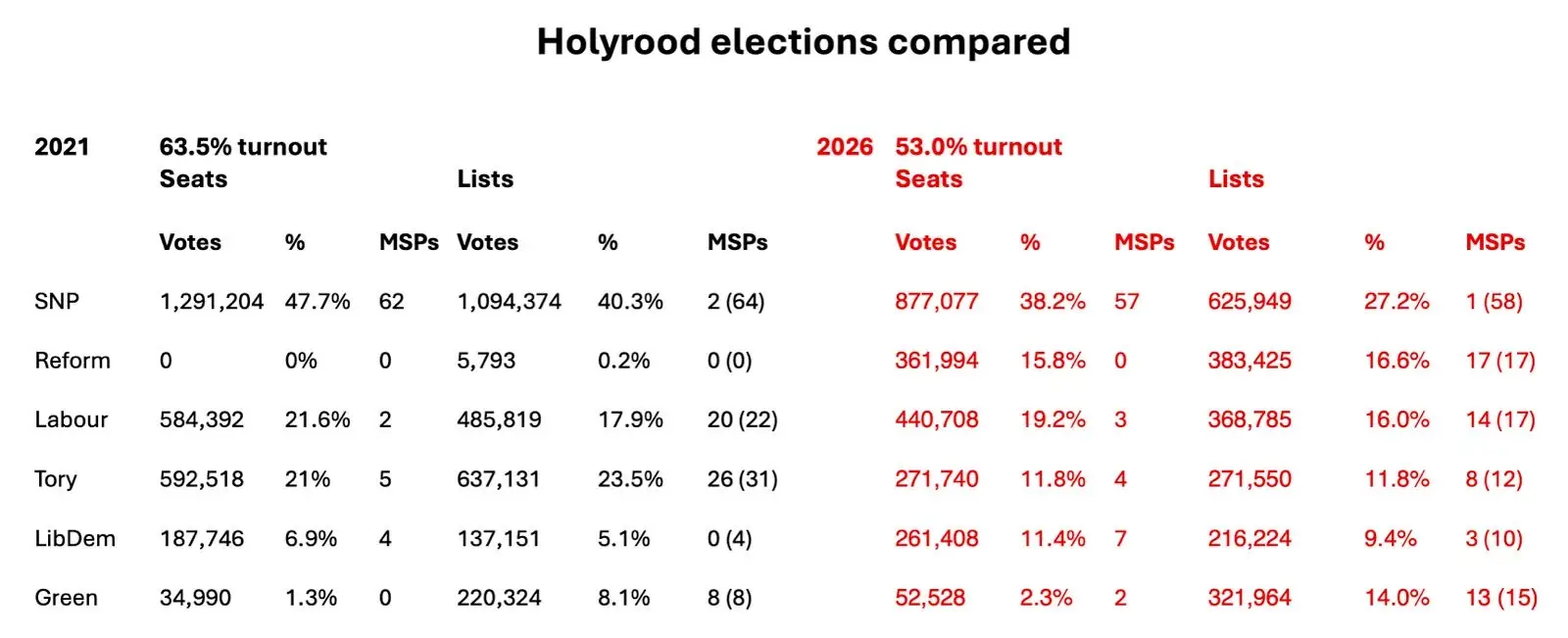
For Labour the result was dire, but not quite as bad as the polls often predicted. The worst Labour result in a Scottish Parliament election, votes down, share down, MSPs down – and yet still managing to share second place with Reform – and, crucially, holding two constituencies and winning another off the SNP – the Western Isles.
Why did Labour not fall further? My take is simple; it still has, in the areas where it is strong, a decent ground war operation and it has data that informs its teams who has voted Labour in the past. Add this together with a reputed £400k-plus air war campaign and it was able to get the vote out (or at least what is left of it). This is what won it the Hamilton by-election (which has returned to the SNP this time round) and I reckon it saved Anas Sarwar from an even more embarrassing outcome where Labour could have fallen behind the Greens.
Still, Labour’s chances of revival are not yet obvious until it refreshes its leadership offering. Expect movement on that within the next year – if someone wants to take on the job before next May’s council elections (leadership candidates might prefer to take on the task after more bad news rather than before it).
Worst ever Conservative result
The Conservative result was, like Labour’s, its worst ever since devolution, beating even the dismal showing of Annabel Goldie’s campaign in 2011 (achieving 11.8 per cent against 12.4 per cent back then). It too managed to hold four of its five constituency seats but lost a whopping eighteen list members.
I shan’t dwell on the Conservative performance so much here. Linda Holt has covered it well already, but for all Russell Findlay is able, the Tories shall also probably need a leadership refresh if they are to register on the public’s consciousness. Without something changing they are likely to become an irrelevance. Relying electorally on a Badenoch bounce, if there might be such a thing, will simply not cut it.
Greens
The Greens undoubtedly benefitted from a transfer of second votes of SNP voters that took them well beyond normal expectations. The voting system was gamed in the manner that Alba once thought it could game the 2021 election. Tom Miers has written about it but there is probably more to the Greens’ relative success than just the electoral system being exploited, so I shall return to the party’s prospects in a future article.
SNP and a second referendum?
The SNP achieving the position of largest party was the minimum that Swinney’s campaign had to achieve, and it managed that convincingly. The not-so-secret weapon of Keir Starmer was undoubtedly a huge factor. Without such a catastrophic and unpopular prime minister there should be little doubt that the SNP could have come behind Labour, which until Starmer was elected was looking well placed to be the largest party.
It’s not as if Swinney was full of new ideas – free school bags about summed up his masterfully dull campaigning approach.
The loss of six constituencies (five net) and one list member told its own story, even though winning the Shetland seat appeared a surprise to most observers. Losing to the Greens would soften the blow in some respects.
The danger for the SNP and Swinney in particular is that with such a soft “victory” he and his party could become unpopular very quickly – especially after some grilling from Malcolm Offord at FMQs. Then there’s also the possibility of Starmer being removed and Labour enjoying a brief honeymoon with a new leader in Downing Street.
In the medium to long term we should be anticipating a change of SNP leader now that Stephen Flynn has been elected to Holyrood. He is clearly very ambitious, is an able communicator and, unlike the long-in-the-tooth Swinney, represents a new generation of SNP activists.
Swinney was first elected to the House of Commons for Tayside North in 1997 – when Stephen Flynn was only eleven! Whatever people might think of Flynn’s arguments or policies, he could bring a new dynamism to the SNP and at face value appear more compelling.
Again, he might want to wait until after May’s council elections when Reform could inflict some losses on the Swinney-led SNP and provide a pretext for a new broom sweeping away the cobwebs of the old guard.
A second referendum?
There will be no second referendum and any talk of having one is nothing other than nationalists in the SNP seeking to speak to their base and deflect the public from their continuing incompetence and waste.
There is no reason for any UK Government, be it under Sir Keir Starmer or anyone who might replace him, to agree to give a Section 30 Order that could allow a referendum to happen.
Any talk of the need for, or a case for, having a referendum is nothing other than SNP and Greens hoping for a rebuttal so they can carry on with their Pavlovian grievance mongering – and should be dismissed as such.
Talk of a mandate for a referendum is not supported by what politicians argued prior to the Holyrood election or its subsequent outcome. The Holyrood election suffered a poor turnout; falling 10.3 per cent – from 63.5 per cent to an embarrassingly low 53.2 per cent. It cannot be argued that such was the concern that a referendum should be held that the Scottish electorate flocked to the polls to demand one by voting SNP.
If anything, it is the other way around. There is reason to believe it was a high turnout in 2021 because Scottish voters were motivated to get out and stop Nicola Sturgeon from having a majority – so she could not claim the mandate she wanted.
there was no clamour and there shall be no referendum
The voters achieved that aim and, with the Supreme Court then ruling that the decision to hold a referendum was reserved to Westminster, the SNP’s gaming of the Holyrood elections has been called out and made irrelevant. That particular SNP bubble has well and truly burst as the numbers show.
Nor can it be argued that such was the clamour for a referendum, the chief protagonists of that cause, the SNP, enjoyed growing support. The result speaks for itself – there was no clamour and there shall be no referendum.
The SNP’s vote share has fallen, the number of people voting SNP has fallen and the numbers of SNP MSPs elected have fallen.
The comparisons are quite clear: SNP constituency vote share in 2021 was 47.7 per cent but fell by 9.5 per cent to 38.2 per cent in 2026. SNP regional vote share in 2021 was 40.4 per cent but fell 13.2 per cent to 27.2 per cent in 2026.
Moreover, John Swinney was explicit in his campaign that the case for a referendum depended on the SNP winning a majority of the 129 seats, but he suffered a reversal, losing six seats, falling from 64 to 58 MSPs.
Swinney also made it explicit that a mandate would only be attached to SNP success, not the joint success of the SNP and Green parties added together (the latter now also being committed to Scottish secession from the UK). It was Swinney himself who ruled out any benefit from gaming the second vote.
It simply does not matter that the total number of SNP and Green MSPs (73) forms a majority that supports a referendum; people vote for parties for many different reasons (in the case of the Greens, especially so) and we cannot tell if having a referendum is a high priority for the Green voters.
Even were it the case, the number of SNP and Green MSPs does not reflect the joint shares of the vote or form a majority of voters. Be it adding constituency vote shares (SNP 38.2 per cent + Green 2.3 per cent = 40.5 per cent) or regional list vote shares (SNP 27.2 per cent + Green 14.0 per cent = 41.2 per cent), the two nationalist parties fell well short of achieving a majority of those choosing to vote.
After the referendum of 2014 the SNP leadership – of which Swinney was Deputy Leader between 2014-2023 – argued that a referendum would require evidence of consistent support for independence over at least six months at a level of sixty per cent of the electorate.
Currently, it remains a minority pursuit and should be ruled out for the foreseeable future. There is simply no need for the UK government to countenance a further referendum.
Forthcoming by-elections
The unsurprising election to Holyrood of SNP MPs, Stephen Flynn in Aberdeen Deeside & North Kincardine and Stephen Gethins in Dundee City East, has required them both to resign their Westminster seats (Aberdeen South and Arbroath & Broughty Ferry, respectively) and cause two parliamentary by-elections in the process.
That will be a big campaigning opportunity for Reform and I understand the writs have already been moved – so they will undoubtedly be on the same day, possibly 11th June.
The by-elections are important not just for ensuring the two constituencies have an MP but because It represents a fresh opportunity for Reform UK to stake its claim to be the main challenger to the SNP.
With Labour very likely to still be in the middle of a UK leadership election and the Conservatives struggling to gain relevance, there is a good opportunity for a Reform candidate to do well.

Comments: 0
Join the debate
Do you agree with this analysis, or is the author wrong? Have your say below.
No comments yet. Be the first to join the discussion.