

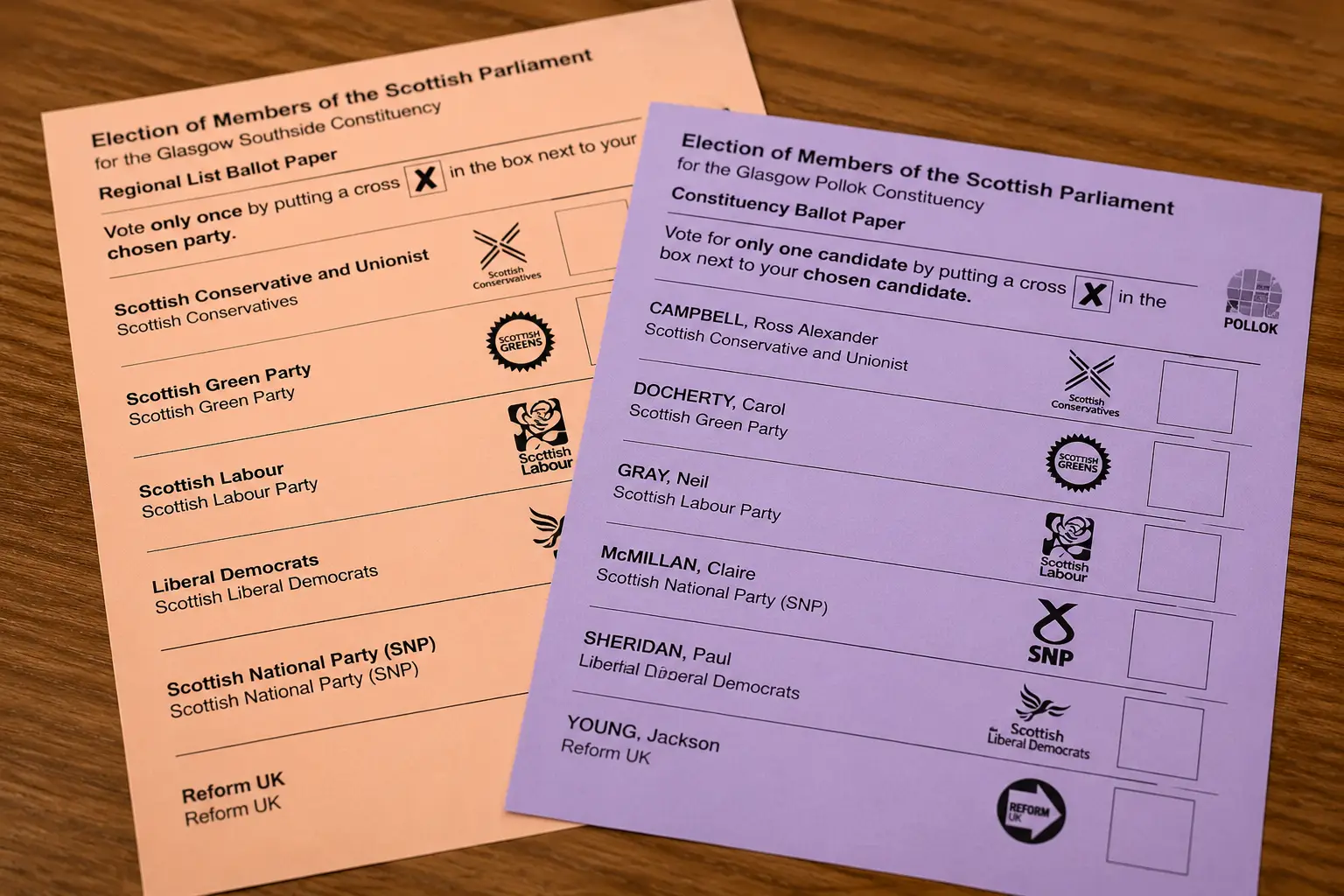
AS PREDICTED, the nationalist vote fell considerably in last week’s Holyrood election. The combined vote of the SNP and Greens fell by 8.5 per cent to 40.5 per cent in the constituency ballot, and by 7.2 per cent to 41.2 per cent in the regional vote.
This seems in large part to reflect SNP voters switching to Reform. As I explained in The Reformer on 13th April, the advent of Reform in Scotland is of huge benefit because the party is able to attract nationalist voters into its camp whose priority is not the constitution. For the first time in years, there is the prospect of Scottish politics not being dominated by endless arguments over another referendum. At the very least, the nationalists’ “mandate” for one has been torpedoed.
Nonetheless, some nationalists are claiming that their seat tally – up one seat to 73, giving the SNP and Greens a majority – reinforces their claims. We all know that the constitution is decided by votes, not Holyrood seats, but it’s still worth considering how their seat tally went up despite their vote falling.
This is not, as some commentators are claiming, because of a split unionist vote. After all, the SNP lost six constituencies. While the SNP may have benefitted from a Tory swing to Reform in a few areas, the party probably lost out from the swing to Reform among its own voters in others.
The real story here is that nationalist voters are gaming the Holyrood election system by abusing the second vote. It needs reform before it loses all credibility – or worse, cons the UK government into believing the “mandate” narrative.
This is how Alex Salmond explicitly aimed to achieve his “supermajority”
For non-electoral obsessives, here is the basic problem. The rules for Holyrood elections allow for a second “party list” vote which is supposed to compensate parties that get lots of votes but few seats in the normal “first past the post” constituency vote.
So, for example, if Labour won twenty per cent of the vote across the board but few or no constituencies, the regional list system would “top up” Labour representation to make it more proportional in the overall parliament.
But you can cheat the system by having two parties with the same agenda, effectively operating as one.
Imagine one party called the “Liberal Socialists” and the other the “Social Liberals”. The former contests constituency seats and the latter stands just on the list. The same voters vote for the Liberal Socialists using their constituency vote and the Social Liberals with their list vote. The Liberal Socialists might then win lots of seats and obviously do not need to be “compensated” by being topped up on the list. If people voted for them using their second vote, it would be wasted. The Social Liberals, however, have not even contested any seats, and so is heavily topped up through the list.
Clever, huh? Same voters. Same political project. Extra seats.
This is how Alex Salmond explicitly aimed to achieve his “supermajority”. The Greens have been benefitting from this dynamic for years, with various nationalist start-up parties attempting the same trick.
they certainly do not have a mandate to break up the country
This cheat works better for them with each election as nationalist voters cotton on. Almost all their voters are SNP voters in the constituency vote – you can tell by the way the SNP second vote is lower by almost exactly the same amount as the Greens is higher.
In this election the SNP vote fell by 9.5 per cent in the constituency vote but by 13.1 per cent in the list vote. In other words, something like 3.5per cent more of the electorate are gaming the system than last time.
As a result, most of the Green regional seats are not “top ups” at all but extra seats for SNP voters who have worked out how to get double representation. Overall, the nationalists have up to a dozen extra seats from this scam.
Their opponents need to call this out and show the Scottish people how the system is being abused to exaggerate nationalist representation.
The SNP and Greens won the election and deserve the right (just) to form another administration. They have a mandate to fix the NHS, the schools and the police. But overall their vote fell and their seats are grossly inflated by the second vote scam, so they certainly do not have a mandate to break up the country.
I’m always bemused that Unionist politicians don’t point out these shenanigans more assertively. It is admittedly hard to explain the mechanics, but exposing this nationalist deceit would allow the pro-UK parties to propose the obvious alternative: the same single vote should be used both for electing the constituency MSPs and topping up with the regional list.
Mathematically there’s no need for a second vote – you can just use the first one for both purposes. Parties underrepresented in constituencies would still receive additional MSPs — but without creating incentives for tactical double representation.
The second vote was introduced when Holyrood was established to encourage independent politicians. The idea was that respected individuals who could never win a single seat might garner enough votes across the region to get a top-up seat without having to field a candidate in each constituency.
But this has rarely happened. The only MSP ever to be elected as an independent on the regional list was Margo MacDonald.
The Holyrood system of two types of MSP has its merits – it allows for reasonable opposition numbers even when one party is dominant. If we just had constituency MSPs, the SNP really would have a supermajority. Reform would have no representation whatsoever and the other parties a bare handful each.
But the current arrangement is now being exploited to manufacture an exaggerated impression of nationalist support.
Two kinds of MSP can work perfectly well.
Two votes no longer do.




Comments: 1
Join the debate
Do you agree with this analysis, or is the author wrong? Have your say below.
No comments yet. Be the first to join the discussion.