

IN THE 1970s AND 80s, I designed a lot of shopping centres. It was the high point of town centre development, a consumer boom enlivening communities after slow economic growth in the two decades after the Second World War. The public sector provided enabling works to allow the private sector to invest billions.
My wife was delighted. When a new centre opened anywhere in the UK, I would visit it to get ideas. In the 1990s, I started designing hospitals. I cut my teeth on the Golden Jubilee in Clydebank, a Scottish Government-enabled, but private sector-driven, project, to redevelop riverside land vacated by the demise of shipbuilding. Gillian was not so keen to visit new hospitals.
Retail was in my blood. My first Saturday job was in my father’s shop on a bustling Rutherglen Main Street when its “wee rid lums still reeked briskly”. It seemed appropriate therefore, when a Westminster by-election was held there in October 2023 that I represent Reform UK. My Conservative opponent was Councillor Thomas Kerr. I got to know Thomas, and his assistant Stuart McLuckie, at hustings and as we trudged the streets.
I digress. After the 2024 General Election, I resolved to visit as many fledgling Reform branches as I could throughout Scotland. It also gave me a chance to see how shopping centres I had designed were faring in the age of online shopping.
First stop was Glasgow. We had struggled to get half-a-dozen people to attend a meeting in the city centre up to the General Election. In September 2024, after Nigel became leader, almost a hundred people packed into a pub on Duke Street, in Glasgow’s east end. Reform organisor Martyn Green couldn’t believe it. Perhaps our party was finally taking off.
Most High Street shops were also boarded up.
Further along Duke Street is Parkhead Forge Shopping Centre. It is on the site of an old steelworks and breathed new life into the area when we built it in the 1980s. It is still functioning but is a shadow of its former glory. I have a confession to make. I designed it with red framed windows, blue-tinted glass and white cladding panels, just across the road from Celtic Park.
Then to Paisley where an enthusiastic group of Reformers gathered. The enclosed shopping centre we designed was still open but only about twenty per cent of the units were occupied. Most High Street shops were also boarded up. The more recently built Braehead Centre five miles away (not designed by us), with its thousands of parking spaces, had sucked the life out of Paisley town centre.
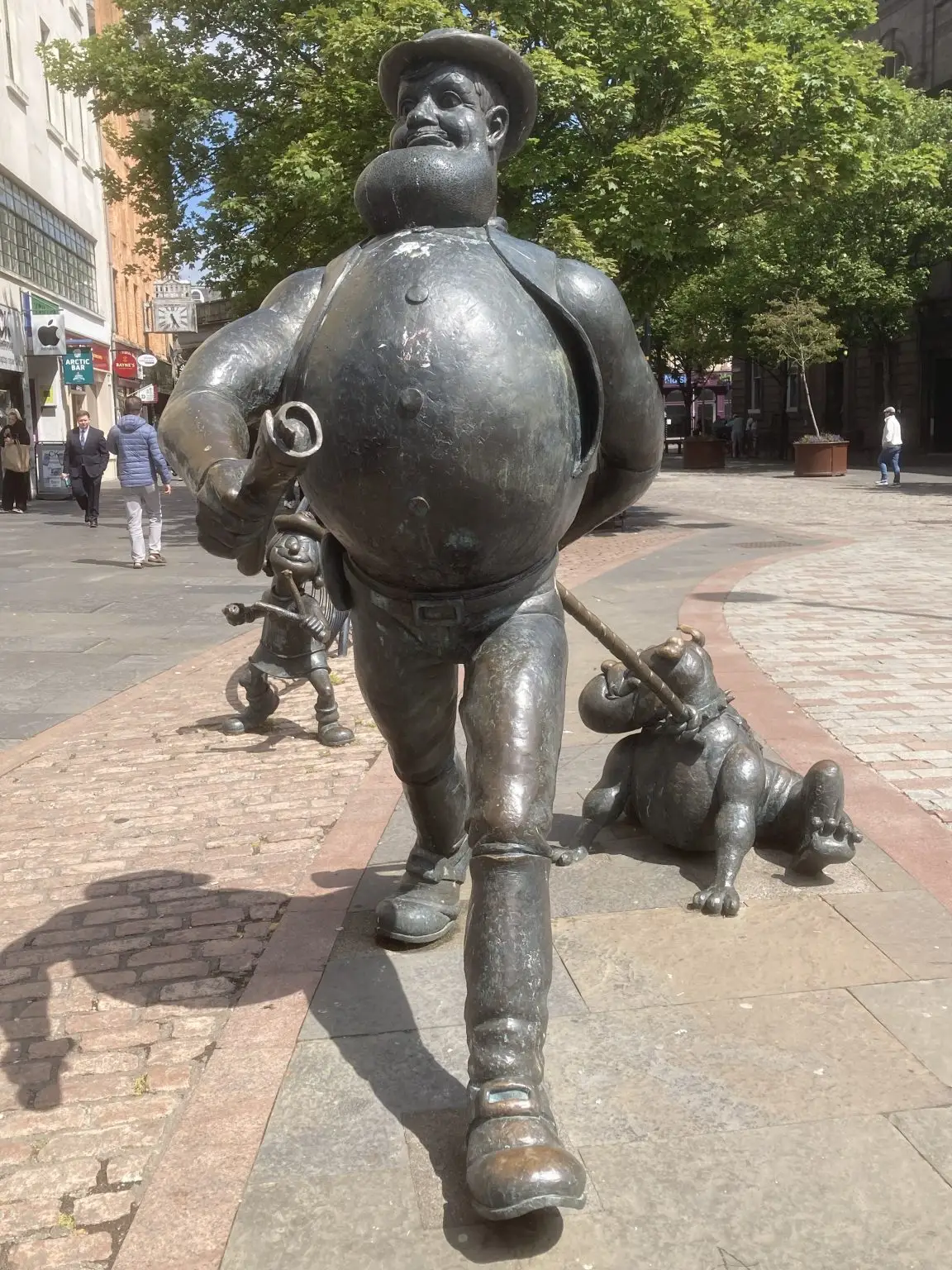
Then to the Dundee Reform branch. I was delighted to see that our Overgate Centre was still full of shops, but the Wellgate Centre at the other end of the main street was almost empty. The average vacancy rate on the main shopping streets was 19.6 per cent, with some as high as 35.7 per cent. What struck me most was that, after 6pm, the centre seemed like a ghost town. Dundee has enormous potential as a tourist destination but only during the day, when the museums and other attractions are open.
My visit to Dundee coincided with meeting Simon Baldwin who lives across the Tay Bridge in Fife. He was the driving force behind CuparNow, a digitally-orientated initiative to connect businesses with each other and potential customers. In a three-year period, it reduced the high street vacancy rate from 18.2 per cent to 8.6 per cent. The secret of success was the lead taken by local businesses. Public sector bodies expressed interest at the start but lacked inertia and were left behind.
There is a dire lack of “can-do” businesspeople in such initiatives
This contrasts with a public sector initiative, BID Scotland, created in 2007, which promised to deliver 150 Business Improvement Districts in towns and cities by 2020. It collapsed in 2015 to be replaced by another quango, Scotland’s Town Partnerships. 100 BIDs were promised by 2024, but only 33 were set up and, if anyone can identify successful local projects, let me know.
There is a dire lack of “can-do” businesspeople in such initiatives. Board members are from the likes of Green Action Scotland, the Scottish Civic Trust, Keep Britain Tidy, Zero Waste Scotland, Scottish Futures Trust and various other “do-gooder” bodies.
During my research, I met an Alloa shopkeeper. Local businesses are charged a levy towards the BID, in addition to council tax, but the public sector board members outnumber the private sector ones. They dictate the level of the levy and what it is spent on. She set up a group to lobby Holyrood to stop this unfair “tax”:unfairnaemair@outlook.com.
But back to Dundee. Simon and I were joined by Reformer David McLennan, a landlord, to consider how the city centre could be reinvigorated.
We first addressed the Low Emissions Zone. People want the convenience of personal transport and seek to pick up items close to shops. Dundee is blessed with car parks on the periphery of the centre, so the council should encourage car drivers. People who live in the middle of town also want parking close to them, not have wide streets outside their door lying empty.
The areas close to bus stops had shops open, while the main, broad pedestrianised street had high vacancy rates. Let’s drop people off outside the shops, not divert buses round back streets.
David and I estimated that about 1,000 people could be housed in the empty floors above retail units. That would help pubs, restaurants and shops in the evening. But the regulatory environment deters developers. The SNP regards landlords as exploitative and penalises them. Council approvals take too long. There could be a “deemed to satisfy” approach for standard block conversions to flats.
Building regulations are packed with “green” stuff that adds up to £30,000 on the cost of a new or refurbished home. Energy Performance Certificates must be stopped. Last year, Dundee Council let a contract for one- and two- bedroom flats at a cost of £355,000 each, when you can buy an existing flat in town for £120,000. Most of the cost was down to a poor procurement process, but they specified heat pumps. Realising they would be useless when a cold wind blew off the estuary, there were also back-up gas boilers. Madness!
An initiative to redevelop the centre could be business-led, like Simon’s project in Cupar, with the local authority supporting as required. To obtain seed funding, Dundee Council could ring-fence non-domestic rates from empty properties in the Central Development Zone. Half of this would be used for infrastructure improvements and half (c.£1.5m) would go to the Development Trust to cover set-up costs.
Dundee would also gain from Reform UK’s energy policy, its harbour adjacent to the centre once again thriving as it services North Sea oil and gas extraction.
I must end with words from Dundee’s most (in)famous poet, William Topaz McGonagall, which ring true today.
Farmers have no protection as the law now stands;
And many of them have lost their property and lands,
And have been turned out of their beautiful farms
By the unjust laws of the land and the sheriff’s alarms.



Comments: 0
Join the debate
Do you agree with this analysis, or is the author wrong? Have your say below.
No comments yet. Be the first to join the discussion.