

IT’S BEEN THE CLOSEST, MOST EXCITING RACE in years and we’ll finally know the winner next month.
I’m not talking about the election, of course, but the utterly gripping league championship. Hearts have topped the table since September and have defied the odds for months.
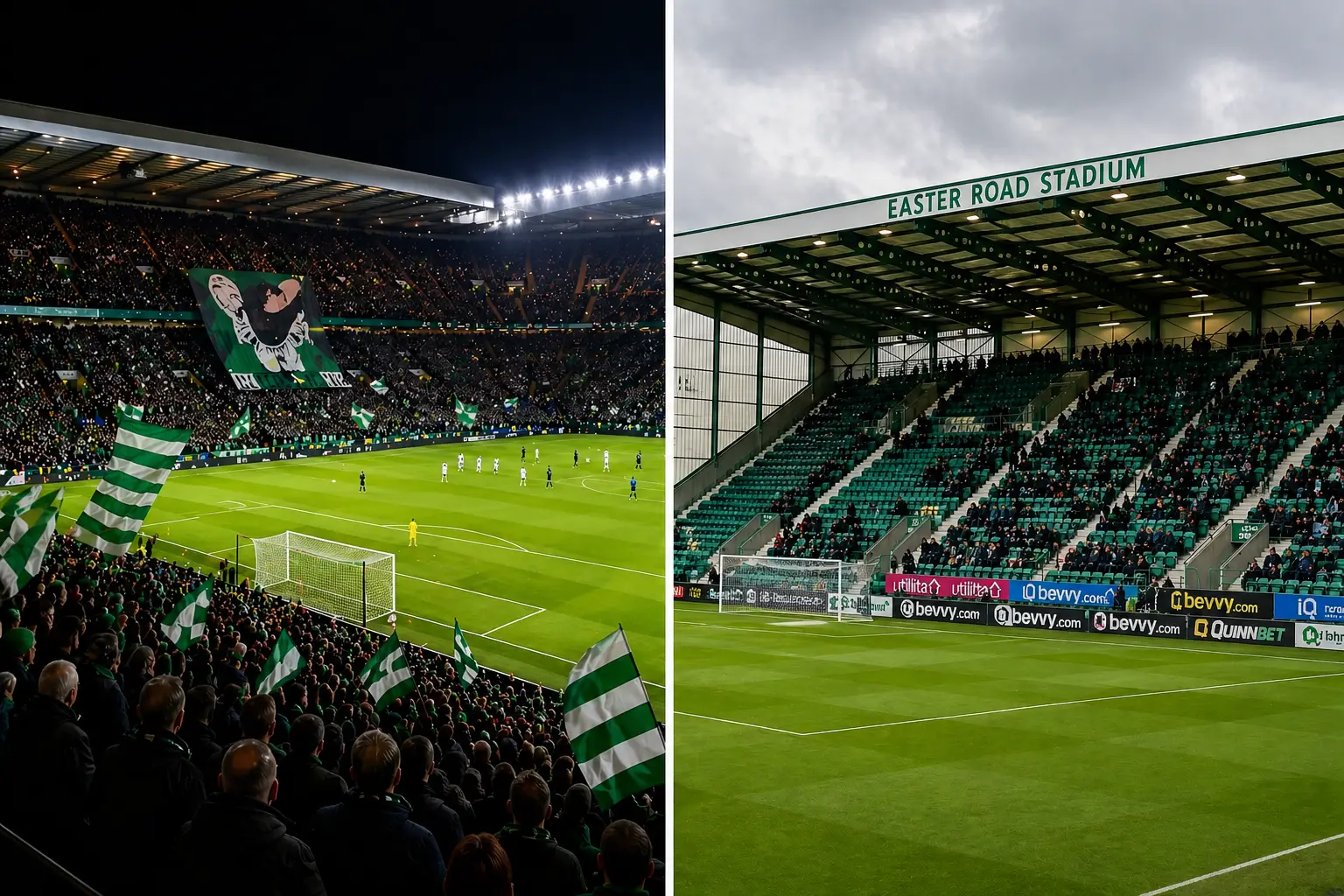
Will their challenge falter at the last? I was lucky enough to be at Easter Road on Sunday for their epic clash against Hibs. The game had everything – noise, tension, goals, red cards, rivalry and skill. Everything, that is, except a cold pint of beer, but more on that later.
Hearts needed a win and just scraped it against nine men with four minutes of regulation time left. As a neutral I really want them to succeed – actually we all need them to be champions, even Celtic and Rangers fans. But the odds still show Celtic as favourites, despite Hearts having a three-point lead.
we are a significant player in world football
This year’s league is so exciting because of Hearts. Like many European leagues, the Scottish Premiership is fundamentally uncompetitive. At least we have two more or less equal clubs who are the only likely title winners. In France, Germany and many other countries, there is a near monopoly, with just one club that is the perennial favourite. Lack of competition and jeopardy sucks the life out of sport
This is a pity because, while Scotland is a small country, we are a significant player in world football. The pantheon of great Scottish football players is broad, and Scots teams have won three major European club competitions – more than France and Russia. Scotland is just about to return to the biggest stage of all, the World Cup, for the ninth time.
A key advantage is mass football attendance, based on historic clubs rooted in working-class communities, driving revenue, interest and a colourful culture. More people per capita attend football in Scotland than any other European country. It’s our national sporting passion.
And yet the sense is that Scottish football is in long-term decline. We have a good crop of players in the national team for the moment, but the pool looks thin and this could well be a blip. We haven’t won a European trophy since 1983, though there have been four finalists since then.
It’s hard to be exact on cause and effect, but it’s noticeable that Scotland’s poor performance internationally (both club and country) has coincided with the lack of competition within the domestic game. No team apart from Rangers and Celtic have won the league since Aberdeen did in 1985.
So you can see why Hearts’ remarkable campaign gives hope not just to their own supporters, but to many others who wish the best for Scottish football. Somehow, the feeling is that a Hearts win could revitalise the game as a whole, returning Scotland to a more glorious age.
This is probably putting too much weight on the moment. The truth is more like a rare alignment of the stars – a good Hearts manager with a dose of luck meets two Old Firm teams that made disastrous managerial picks in transition. But even so, it reminds us how good Scottish football could be with a bit more competition.
clubs in different tiers could challenge those above them, all the way to the top
So if Scottish football needs reform – and this column is about public policy – how can government help the national game?
The key is to look more closely at the 1980s, the last time the Old Firm of Celtic and Rangers had serious competition from the rest. The limelight was stolen by Aberdeen and their manager Alex Ferguson, and Dundee United with Jim Maclean. For sure, these two clubs, with their supremely talented managers, deserve all the credit they get. But a glance at the league tables of the time show that other clubs, too, were much closer to Rangers and Celtic. There was a proper pyramid, or ladder, with clubs in different tiers able to challenge those above them, all the way to the top.
One reason was that attendances were much closer too. In their pomp, Aberdeen’s average gate was only a thousand or two less than Rangers or Celtic (and indeed the big English teams), even though the capacity at Pittodrie was not much bigger than today, in the low 20,000s. Football attendance at big clubs across Britain was much more variable than it is now, with quite small crowds for unimportant matches. Because revenues were largely based on ticket sales, the financial gap between the Old Firm and the rest was not nearly so large.
The main transformation in football as a spectacle since then has been improved all-seater stadia, which are regularly full to capacity. This has transformed the finances of football clubs, particularly in Scotland, where TV revenue is much smaller share of the total. The problem is, from a competitiveness point of view, is that the medium-sized Scottish clubs – those that used to challenge the Old Firm – were unable to invest in their stadia sufficiently to keep up. With Ibrox and Celtic Park full every match, the revenue gap has grown into a chasm. Rangers’ income is nearly five times that of Hearts, and Celtic’s more than seven times. The ladder has been kicked away.
The likes of Aberdeen, Hearts, Hibs and the Dundee teams are caught in a trap. The potential is surely there – many English clubs with much higher attendances thrive in similar sized cities. Middlesborough, Derby County, Cardiff City and Southampton all have grounds that seat around 35,000 that are regularly sold out, even when these teams are not in the top division. Our middle-tier clubs need bigger and better grounds. But they don’t generate the revenue to finance the major investment needed in their stadia, and their revenues, in turn, are dependent on stadium income. They need an outside investor. It can’t be TV (the product is not competitive or exciting enough internationally), and it’s unlikely to be a major sugar daddy (for the same reason).
the Scottish Government could facilitate investment in larger stadia for the middle tier of clubs
This year the Scottish Government is underwriting the Commonwealth Games to the tune of £150m. The intention is that the games will be self-funding with the Scottish Government acting simply as a guarantor, but it is also budgeting £40m for the promotion of sport more generally this year.
I’m not usually an advocate of public subsidy of sport, but government can play a useful role by supporting bids for major tournaments and leveraging these to back the necessary investment. While I respect the Commonwealth as an institution, its Games are a largely forgettable sideshow on the international sporting scene, which is why they struggle to find a host. Who can remember the highlights of previous Commonwealth Games?
The Scottish Government would do better to focus its efforts on a transformation of the Scottish national game by rebuilding the missing rungs of the ladder. That means facilitating investment in larger stadia for the middle tier of clubs. Ideally, Scotland should co-host a major tournament to generate the required revenue. Bids succeed when a really transformational offering is part of the package, rather than the lukewarm “let’s use Hampden” offerings of past Scottish bids.
The relevant clubs should be asked to compete for this investment. That could involve innovative pricing and marketing to encourage larger attendances, and ideas to increase capacity. If the corners at Easter Road were filled in, it could easily have a 30,000-plus capacity. And, while it may sound like anathema to traditionalists, the Dundee clubs could be offered a great new stadium if they share.
Scotland, with a population of five million, is never going to compete financially with the big European countries. But it could be as competitive and as exciting as England or Italy – and overtake leagues like Spain, Germany and France, with their open or two-club dominance, in terms of sporting interest to reclaim its place near the top of European football.
Oh, and going back to that cold beer – or lack of it. It’s been nearly fifty years now since you could enjoy a drink at the football. It’s been allowed at rugby games for two decades. Talk about snobbery! That really should be a target for Nigel, Malcolm and their gang. Trust the people and they’ll trust you.
Comments: 1
Join the debate
Do you agree with this analysis, or is the author wrong? Have your say below.
Scottish football should take the route of Scottish Rugby and enter a league with other countries in a similar position where there is not enough money and talent in small places like Scotland, the Netherlands, Belgium, Denmark and Norway. Glasgow Warriors have won two international championships in recent years and the rise in standards fed into the national team.
I also find soccer boring. England and Scotland had two friendly games last month which produced two goals in three hours. Where the quality of footballer in the Scottish Premier League is poorer, this may lead to more mistakes and goals. But why not think outside the box. Instead of a toenail making a player offside in VAR, why not have the whole body offside with a clear gap needed between attacker and defender? It would advantage goal scorers and make VAR quicker to implement.