

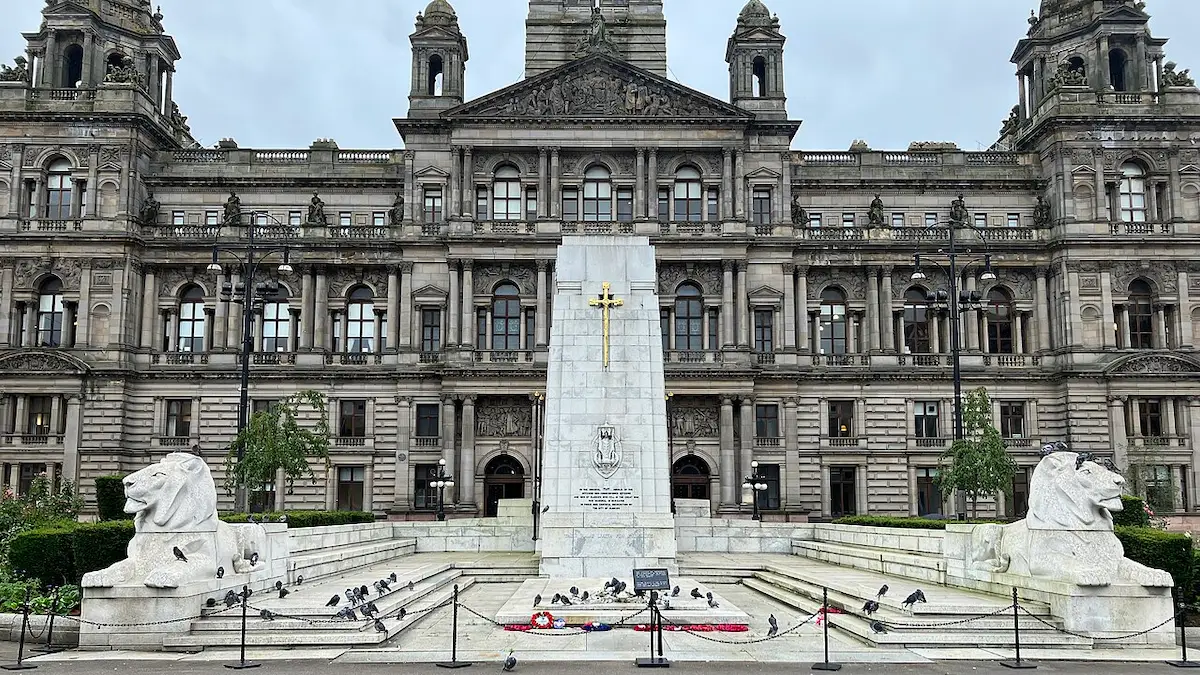
ON NOVEMBER 8, a procession of veterans and families gathered at Glasgow’s Cenotaph to lay wreaths and honour those who have died in service.
During this week of remembrance, the Scottish Secular Society has chosen controversy over respect and dignity, branding the Cenotaph as “non-inclusive” because of the Christian symbolism of the cross.
Glasgow City Council has stated that the Cenotaph “honours all those lost … regardless of faith or belief”, yet Scottish Secular Society chairman Neil Gregory demands the removal of the cross from a war memorial for soldiers who were predominantly Christian.
He also suggests that because the square has imagery of lions, it is “an explicit nod to the British establishment”, despite the fact that Scotland has been using lion symbolism in non-British contexts for centuries.
This is a shameful attempt to turn a war memorial that should have been politically off-limits into collateral damage in the culture war.
While hard-left campaigners are willing to politicise a century-old cenotaph for contemporary ideological ends, their intervention is as poorly timed as it is disrespectful. This rhetoric is a thoughtless dig at veterans, families and everyone who recognises the sacrifices behind the freedoms we enjoy every day.
The Scottish Government created the role of Veterans Commissioner in 2014 to scrutinise veterans’ policy and progress. That role is currently held by Susie Hamilton, a retired Royal Navy lieutenant commander.
While the woke Left is distracted by symbolic gestures, the Commissioner’s report points to the Scottish Government’s continuing failure to deliver on many of its promises to veterans. She expressed disappointment at the lack of progress on finance and the law.
Her 2026 report states also identifies minimal progress on implementing the Veterans Homelessness Prevention Pathway, which was published in 2022. Hamilton concludes that in this regard, “the establishment of a working group would bring rigour and focus to this work – which is long overdue”.
Nobody who has served this country should be sleeping on the streets or in hostels, and Glasgow is the biggest hub of homelessness in Scotland. Neil Gregory’s out-of-touch, attention-seeking rhetoric puts religious symbolism ahead of remembrance itself. It is not welcome in a city where many veterans need action, not ideological antics.
Susie Hamilton welcomed limited progress on veterans’ health and wellbeing, but stated her “disappointment at the limited progression in key activities designed to make meaningful improvements to the lives of our veteran community”. The Scottish Government needs to move further and faster.
The Commissioner’s report also found concerning gaps in the Scottish Government’s understanding of healthcare provision for women veterans.
The SNP’s and Greens’ records tell the same disappointing story, as Glasgow’s Freedom of the City vote demonstrated.
Glasgow City Council voted on a proposal to grant the honour to the Royal Regiment of Scotland in its 20th anniversary year. The motion, brought by councillor James Adams, was defeated by an SNP-Green amendment calling it “inherently problematic to tie the City of Glasgow in perpetuity to another organisation over which it has no control or oversight” because of the regiment’s royal ties.
Granting the Freedom of the City is a civic gesture of gratitude and support, which would have been very warmly received by the regiment. It is an opportunity for the public to see our brave service personnel visiting the city and hopefully inspire the next generation to consider a military career.
With this decision, Glasgow City has become the first Scottish council to refuse the regiment the honour, while more than twenty others, including Aberdeen and Edinburgh, have granted it. Glasgow’s far Left seems determined to set itself against even basic respect for our military.
It is a complete disgrace that left-wing councillors should block such a patriotic civic ceremony, putting political point-scoring ahead of recognition for those who defend us.
The British military deserves credit for the protections and freedoms we all enjoy
Regardless of what independence fanatics might suggest, the British armed forces uphold our collective national security. Their contribution to sustaining our way of life is immense: operations against al-Qaeda, counter-piracy and counter-narcotics missions, Quick Reaction Alert aircraft protecting our airspace, and the continuous at-sea nuclear deterrent, to name but a few. The British military deserves credit for defending our security and the freedoms we enjoy, including freedom of speech and freedom of religion.
This collective act of defiance by elected left-wing councillors demonstrates how little they understand how the world actually works.
The lack of empathy and understanding extends to military families. England’s Service Pupil Premium gives schools extra funding to support the children of armed forces families, particularly with emotional and pastoral support. However, Scotland has no equivalent, on the principle that every child should receive the same treatment.
The Scottish government thinks this is fair, but that approach fails to account for the effects of deployment and bereavement on a child. It is another sign of how detached this government is from military families, whose needs it rarely surveys.
Cadet programmes have been in decline in recent years, but they offer community cohesion, discipline and strong role models, bringing enormous benefit to our young people who join. Refusing the regiment Glasgow’s Freedom of the City risks sending the message that British military organisations are not welcome in Scotland and could dampen young people’s enthusiasm to take part.
Veterans are a credit to our society, and a career in the armed forces can give young people skills and opportunities that serve them both during and after their service.
The Forces Employment Charity’s Op ASCEND scheme, backed by the UK government, shows what practical support looks like: free advice on employability skills and career pathways, with direct access to veteran-friendly employers.
In Scotland, grassroots organisations and charities have had to step in where the SNP falls woefully short.
The Veterans Awards celebrate achievement every year in entrepreneurship, employment, fundraising, volunteering and charity work. Charities including Erskine Veterans, SSAFA and Sight Scotland Veterans do outstanding work across Scotland.
This year also marks the 100th anniversary of Lady Haig’s Poppy Factory, a century of disabled veterans handmaking poppies so that we may never forget the sacrifice of our fallen heroes.
Lady Dorothy Haig remains a shining example of Scots answering the call to show support and gratitude to those who serve, regardless of political belief or personal background. That spirit is still alive in our communities, and the Scottish Government needs to do more to match it.
Decent, respectful Glaswegians will always maintain our traditions of remembrance and recognise that the freedoms we enjoy today were secured by the war heroes who fought to protect them.
The most effective way to honour veterans this Remembrance is to prioritise action over ideology: deliver the homelessness pathway, identify and address the needs of military families, and give those who serve the recognition they deserve.
Veterans have given Scotland their best, and Reform will give them our best in return.
Photo of Glasgow Cenotaph, by DaHuzyBru – Own work, CC BY-SA 4.0, via Wikimedia Commons;


Comments: 0
Join the debate
Do you agree with this analysis, or is the author wrong? Have your say below.
No comments yet. Be the first to join the discussion.