

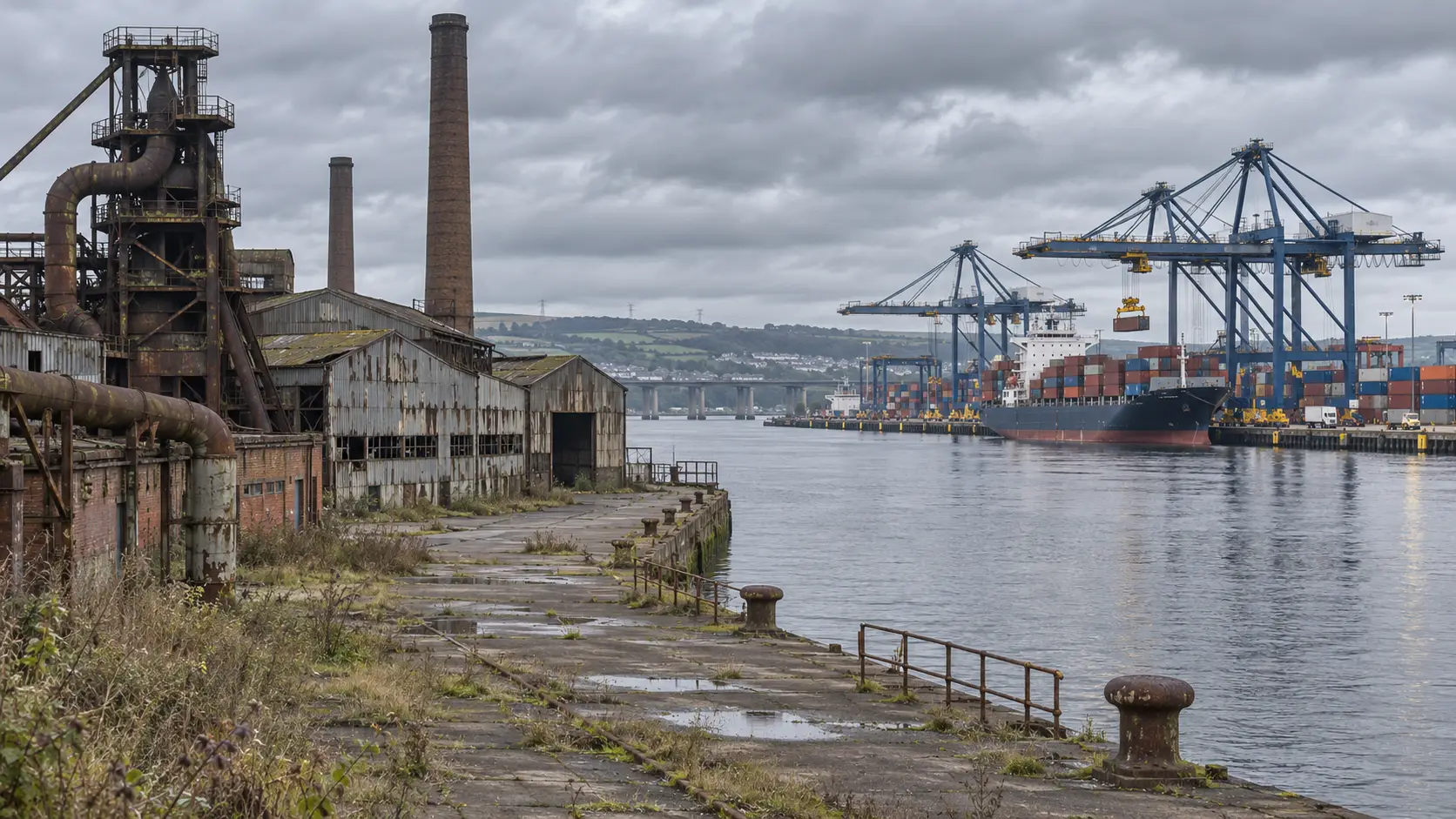
BRITAIN AND SCOTLAND are facing a resilience crisis. We can already see the effects in sky-high food and energy prices which are driving a cost-of-living crisis. The risks of far worse outcomes are significant, and there is a growing realisation that the UK has become alarmingly vulnerable to shocks.
So, what do we mean by resilience in the context of a nation? Simply put, resilience is a nation’s capacity to withstand, absorb, adapt to, and quickly recover from crises – such as natural disasters, economic shocks, and particularly geopolitical conflicts. It is whether a country can feed itself, power itself, heat itself, defend itself and retain the industrial capability to build, produce essential supplies and maintain its military in a conflict.
Yet across the board, Britain is producing fewer of its own essential products and importing more: food, energy, steel, chemicals, pharmaceuticals, fertilisers and other essential materials.
British governments of both Labour and Conservative persuasions, along with devolved governments, have been asleep at the wheel. They have lacked any sort of strategic thinking. Net Zero has been the default priority, resulting in huge damage to many areas of the economy. There has also been an uncritical embrace of globalisation, meaning that we have sought out cheaper imported goods with no attempt to ensure that we retain home-grown capability and strategic security.
The official thinking has been that Britain will always be able to import what it needs at the right time and at the right price.
Recent events have shattered that assumption. The Covid pandemic, war in Ukraine and war in Iran have exposed the fragility of international supply chains and, in particular, the sheer naivety of the UK approach. We are seeing much of this disruption reflected in rising fuel and gas prices.
our energy system is simply not working
This has deepened the huge cost-of-living crisis and made many UK businesses uncompetitive. The real concern is that the current situation could become much worse, and our enemies now recognise the fragility of our systems.
Energy represents perhaps the clearest example of this failure. Across Scotland, the UK, and indeed much of Europe, our energy system is simply not working. British households and businesses face some of the highest energy prices in the developed world. And it looks as though we are facing a significant energy crunch this winter, with continuing war driving high prices for gas, diesel and other refined fuels.
Conflict in Iran and Ukraine is the proximate cause of the crunch. But decades of delusional policymaking have left Scotland, Britain and much of Europe badly exposed to energy reality. The main underlying issue is that we have prioritised Net Zero above all else, pushing intermittent renewables too far and too quickly, with no understanding of the cost of the system needed to support them or the vulnerabilities it creates.
Despite acknowledging that we will need oil and gas for decades, we have crushed our own industry through deliberate policy choices: imposing a 78 per cent tax rate, banning new exploration and deliberating for years over whether to allow new projects. Only belatedly did the UK Government approve the Jackdaw Gas Project, yet it continues to pontificate about the Rosebank field. As a result, our production has declined far more rapidly than it needed to, making us even more reliant on imports.
our energy security cannot depend on hoping for favourable wind conditions
Meanwhile, our electricity grid is also becoming increasingly vulnerable. We have become ever more reliant on additional imports from interconnectors, mainly from French nuclear power stations. Renewable energy should be part of our energy mix, but as reliance on intermittent generation has increased, we are starting to see significant grid management difficulties, and blackouts are becoming a serious risk, especially during cold winter spells with little wind—the conditions known as dunkelflaute. Simply put, you cannot power a modern economy on intermittent generation alone, and our energy security cannot depend on hoping for favourable wind conditions.
Energy is a key component for industry. High energy prices, along with carbon taxes and other environmental costs, have meant that many of our industries have become uncompetitive.
These policies and high costs have resulted in the closure of five UK refineries since 2009. We have crushed the manufacture of steel, petrochemicals, pharmaceuticals and ceramics in the same way.
The result is that industry simply moves abroad. Britain loses both jobs and industrial capability. We become hugely dependent on imports for the key components and building blocks of society, such as steel, chemicals and fertilisers. We may even have to start importing salt for the first time in modern history if a proposed plant closure goes ahead. Pharmaceuticals and medicines are also typically imported; for example, more than ninety per cent of our penicillin and other antibiotics now comes from China.
And for all the Net Zero rhetoric, this deindustrialisation means we simply offshore emissions. Worse, global emissions tend to rise as industrial production moves to countries like China that rely heavily on coal.
Food production is going in a similar direction. Britain has become less self-sufficient in eggs, fresh vegetables, beef and many other staple commodities than it was three decades ago. Food imports have risen by seventy per cent since 1997, with around forty per cent of the food consumed in the UK now imported.
And yet, successive UK and Scottish Governments, rather than acknowledge this trend, continue to prioritise environmental incentives over producing more home-grown food. For example, farmers are being paid to turn productive crop fields into grass meadows while various government bodies are desperate to reduce our livestock herds.
Our other great source of domestic food production is the sea and our fishing industry. Yet we constantly undermine it, giving away quotas to European countries, reducing our fleet and processing sector and doing nothing to promote seafood for domestic consumption.
Rebuilding our armed forces must be central to that effort if we are to meet the threats of this new world
And of course, at the heart of our vulnerability is the desperate state of our military. Despite the continued professionalism of our personnel, years of cuts, alongside weak procurement and a lack of strategic direction, have reduced the size and capability of our armed forces to de minimis levels. Our deindustrialisation also makes reversing this decline all the more difficult.
As an island nation dependent on maritime trade, we have a Navy that looks significantly under-strength as it faces an array of new threats. Our critical undersea cables and energy pipelines are vulnerable and need constant monitoring, while the wars in Iran and Ukraine have shown how new technologies like drones can shut down essential trade routes. Even the formerly all-powerful US carrier groups are struggling to fully reopen strategic pinch points.
Britain now faces a major choice. It can continue down a path of deindustrialisation, energy poverty and growing dependency, hoping that increasingly unstable global conditions never seriously threaten vital supply chains or our security. Or it can begin rebuilding national resilience through affordable and secure energy, support for strategic industries, renewed domestic oil and gas production, and increased food production. Expanded storage capacity in food and energy must also become a core government responsibility.
Rebuilding our armed forces must be central to that effort if we are to meet the threats of this new world.
We need urgent change. I believe only Reform understands the scale of these issues and has the vision, courage, and determination to act. Delay is no longer an option and the time for action is now.


Comments: 1
Join the debate
Do you agree with this analysis, or is the author wrong? Have your say below.
No comments yet. Be the first to join the discussion.