
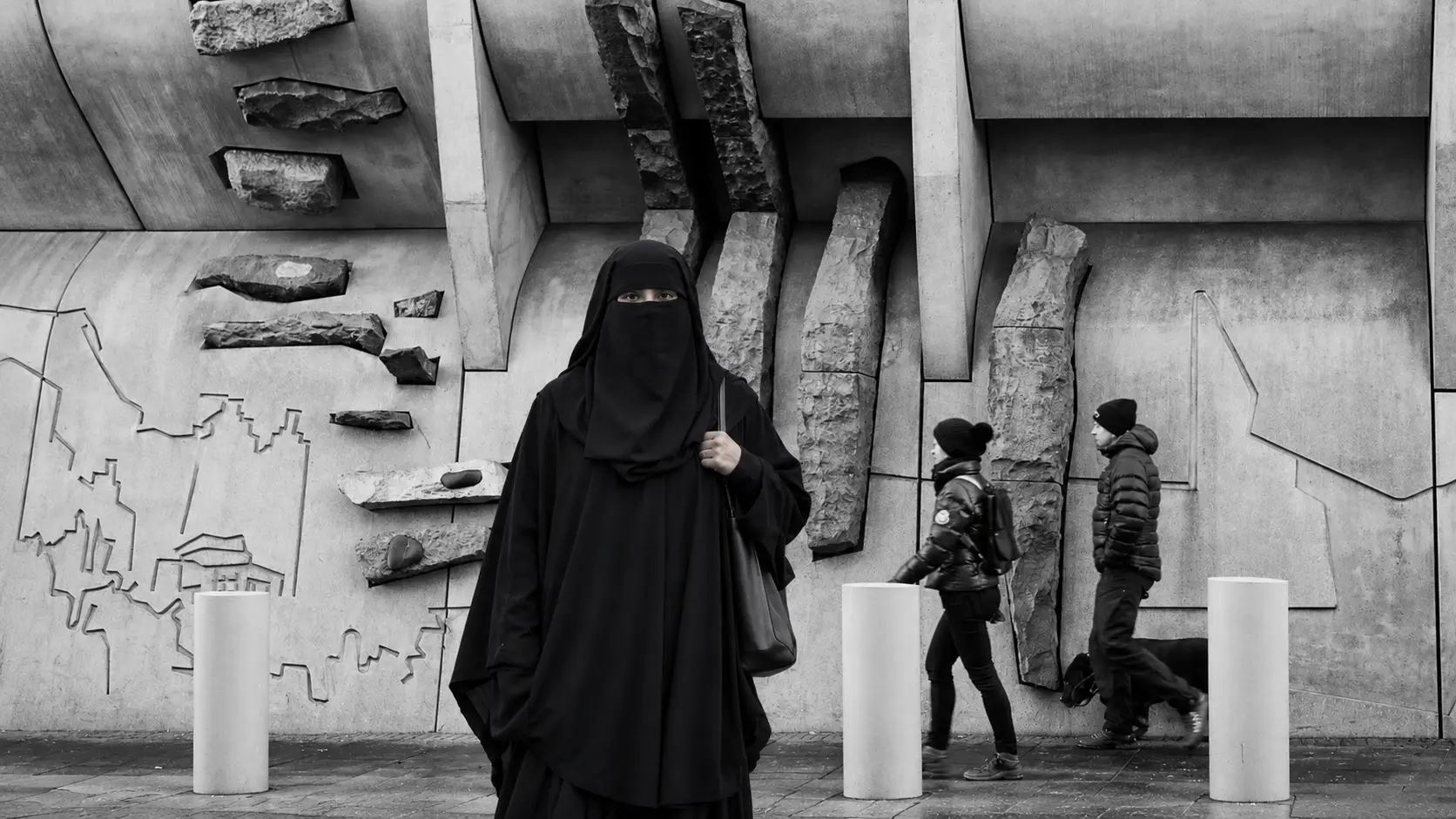
ON THURSDAY EVENING THE SCOTTISH PARLIAMENT held its last members’ business debate of the week. Thomas Kerr had lodged a motion on face coverings in public places. He thanked Stephen Kerr for supporting it, allowing the chamber could hear an argument many of us believe is overdue. The gratitude was sincere because without that support the debate would never have reached the floor. What followed was less a debate than a demonstration of how little the establishment parties are prepared to discuss anything that touches on the burqa.
The motion was carefully drawn. It noted the existing police powers to require the removal of a face covering where there are reasonable grounds to suspect it is being used to conceal identity in connection with criminality or disorder. It recorded the Scottish Government’s view that those powers are sufficient, and observed that a number of European countries have already introduced restrictions. It asked the Government to set out its assessment of the potential benefits of further restrictions, weighing public safety, individual liberty and community cohesion. That is the text. It is not a manifesto for a culture war, but an invitation to examine a practical problem.
The chamber treated it as something else. When Thomas Kerr described the burqa as medieval and oppressive, and said it had no place in modern Scotland, the atmosphere changed. The usual labels were applied – racist, Islamophobic, far-right – and they were allowed to stand. In a political climate in which Reform politicians have already been threatened and, in one case, murdered, the casual use of such language is not cost-free. It marks people out and tells others that the target is fair game. The Presiding Officer did not intervene. Members opposing the motion took few interventions and used their speeches less to examine it than to attack the party that had brought it.
Britain is now the clear outlier
There was then an attempt to extend the debate so that more members who had requested to speak could do so. Thomas Kerr moved the motion without notice. The Deputy Presiding Officer, Clare Adamson, appeared uncertain how to proceed once it became clear there was no consensus. Proceedings were suspended while she consulted the clerks. After some minutes a division was called. Fourteen voted for the extension; fifty-one voted against. The division bell had finally rung, the opposition parties had their way, and the debate was brought to an end.
The irony is difficult to ignore. On the same day the European Parliament adopted a resolution, by 381 votes to 167, supporting national measures prohibiting full-face coverings, including the niqab and burqa, in public spaces. The text cites public security, law enforcement and the rights and freedoms of others. It does not create an EU-wide ban; it endorses the approach already taken by member states. France banned the full-face veil in 2011, Belgium the same year, Austria in 2017 and Denmark in 2018. Portugal has recently joined them. The grounds are consistent: security, identification, and the practical requirements of living together in a shared public space. Britain is now the clear outlier.
The security case is not theoretical. In 2013 Mohammed Ahmed Mohamed, a man subject to a terrorism prevention and investigation measure and believed to have links with al-Shabaab, entered a London mosque in ordinary clothes and left wearing a burqa. He cut off his electronic tag and disappeared. CCTV recorded both moments. That is what a full-face covering can do. It defeats the ordinary means by which people are identified in public.
Is it any wonder that two million Scots did not vote at the last election?
Reform’s position is that this risk, together with the garment’s role as a visible symbol of the subjugation of women, is incompatible with the kind of society we want. Faces matter. They are how we read intention, build trust and hold one another to account. A society that treats the concealment of the face as a protected choice is choosing, whether it admits it or not, a lower standard of integration and a higher tolerance of risk.
None of this required the chamber to descend into fury. It required only that members treat the motion as written and answer the questions it posed. They preferred not to, reducing a serious issue – public safety, women’s autonomy, the conditions of common life – to a contest over who could most forcefully denounce the party that had raised it.
Is it any wonder that two million Scots did not vote at the last election? Reform is here to give the almost 400,000 who did vote for us a voice in that chamber, even when the other parties would rather the discussion did not take place at all.
The record of Thursday evening will show which side preferred silence.



Comments: 4
Join the debate
Do you agree with this analysis, or is the author wrong? Have your say below.
I agree
This is a story which makes one proud to be a member of Reform. Unfortunately, another article, by Owen Polley, does not. The article by Owen Polley is a propaganda piece on behalf of the Orange Order. Is the Reform Party the political wing of the Orange Order in Scotland? There are worrying signs on the issue. There were, for example, Malcom Offord’s comments on Catholic schools. Hastily withdrawn but the cat was already out of the bag. Then there is the decision of Reform Scotland to admit a former Conservative Councillor who was suspended from that party because of his use of a derogatory word to refer to Catholics. If Reform Scotland simply becomes a political wing of the Orange Order then it will deprive itself of the support of a large section of the Scottish electorate. (In case anybody should wish to argue that The Reformer Scotland is not an official publication of Reform UK in Scotland, I have been told that it replaces the Reform UK Scotland newsletter which is no longer published.)
The Reformer is NOT an official publication of Reform UK; it is entirely independent and self-financing. Contributors express their own opinions – not the editors’ and not the party’s unless they expressly say so.
You seem to be under some misunderstanding: The Reformer has not published an article by Owen Polley. His recent article on the dispute at Garvaghy Road, Portadown, was published on ThinkScotland.org, a sister website of The Reformer. ThinkScotland has existed for twenty years publishing views from many political perspectives as it seeks to encourage reasoned debate. You are correct in believing The Reformer is NOT an official publication of Reform UK Scotland and therefore does not replace anything produced by Reform UK Scotland, which has its own website. The Reformer does have a newsletter and each issue promotes one of many articles published in the last week from ThinkScotland to get people thinking (the clue is in the name). There is no requirement to accept what an author writes, indeed we welcome critical debate on both websites. Please comment on Owen Polley’s article on the ThinkScotland Facebook post [https://www.facebook.com/ThinkScotland.org/posts/pfbid0KAkcJqWXXHbnV3XxiF9LFhWkzDt9V1X17QLBiCayd9HMfcn2jQwWPVAa92GLcd5Ql] where you are most welcome to explain why you disagree with his article which argues the rule of law should apply equally to everyone, including Northern Ireland’s first minister, Michelle O’Neill, or anyone else.