
LAST YEAR’S drug death toll was 1,133 – for the period from 1 January to 31st December 2025. That is an average of just over three deaths a day. Unless there has been a significant change in outcomes, already some 844 more deaths are likely to have been recorded this year, including eighteen already since the publication of the 2025 figures last Wednesday.
This is a current and continuing tragedy, and politicians have a great deal of responsibility for the pall of death.
There is of course a significant degree of personal responsibility; there are many causes but self-harming recklessness, misplaced self-confidence or naivety can, for instance, lead to drug addiction. Once someone is addicted, however, treatment requires specialist care and support to help arrest that personal decline.
Simply shifting people into harm reduction through managed dependence, using alternative free drugs that are themselves addictive is clearly not the solution the Scottish Government believes it to be. More than 11,000 deaths over the last ten years – many of them avoidable through different approaches already available – tells us this.
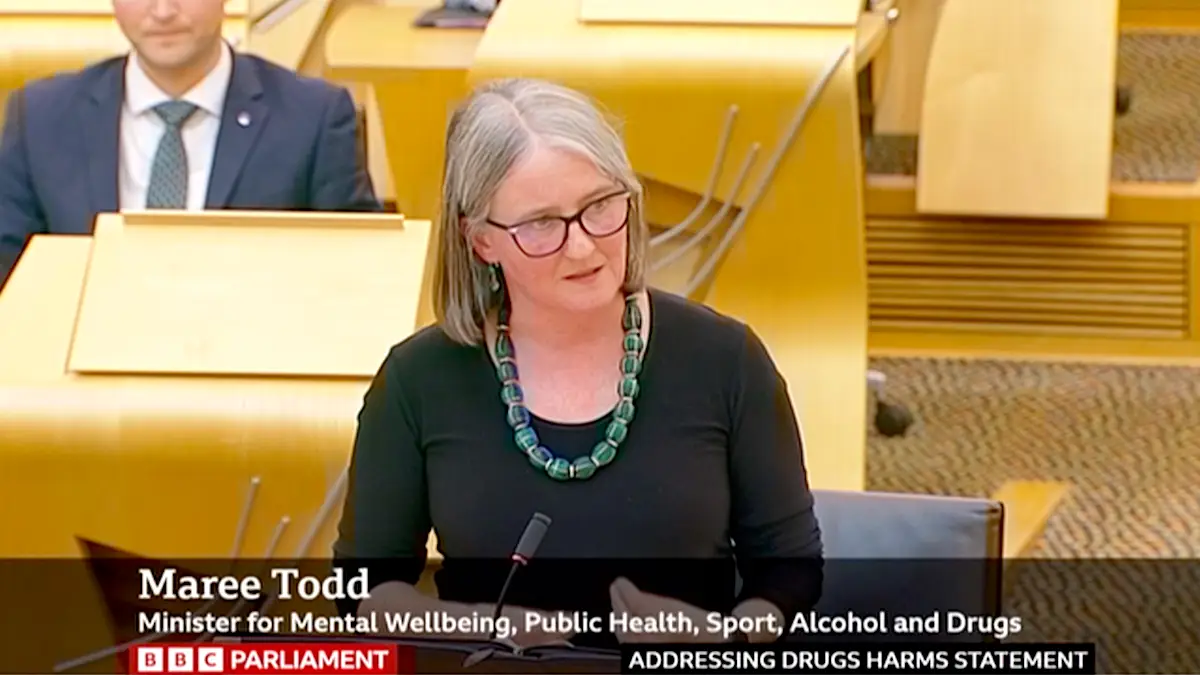
Something has to change and, on becoming the minister responsible over a year ago in June 2025, Maree Todd had the opportunity to change course. She did not, and drug deaths rose by 11 per cent as a consequence. The rise in male deaths was 19 per cent.
How should politicians respond? Well, it is not a “stunt” to decide to propose a vote of no confidence in a minister who has failed so badly – and tragically – for those who needed help but didn’t get it.
Forcing ministers to recognise their failings and change or go is a vital part of our democratic process. Unfortunately, in our “be kind” reality-free times, politicians are not to be confronted or challenged but allowed to carry on regardless.
Offering to work with the SNP when it has squandered repeated opportunities to take a fresh approach with the support of opposition parties – such as when it voted down Douglas Ross’s Right to Addiction Recovery Bill – shows that the SNP needs to be pushed hard to change direction.
Had the newly elected leader of Scottish Labour, Michael Marra, hit the ground running, he would surely have rallied the opposition parties and proposed a vote of no confidence. A vote of concern or censure would have been an insult to the dead. But he was slow to act.
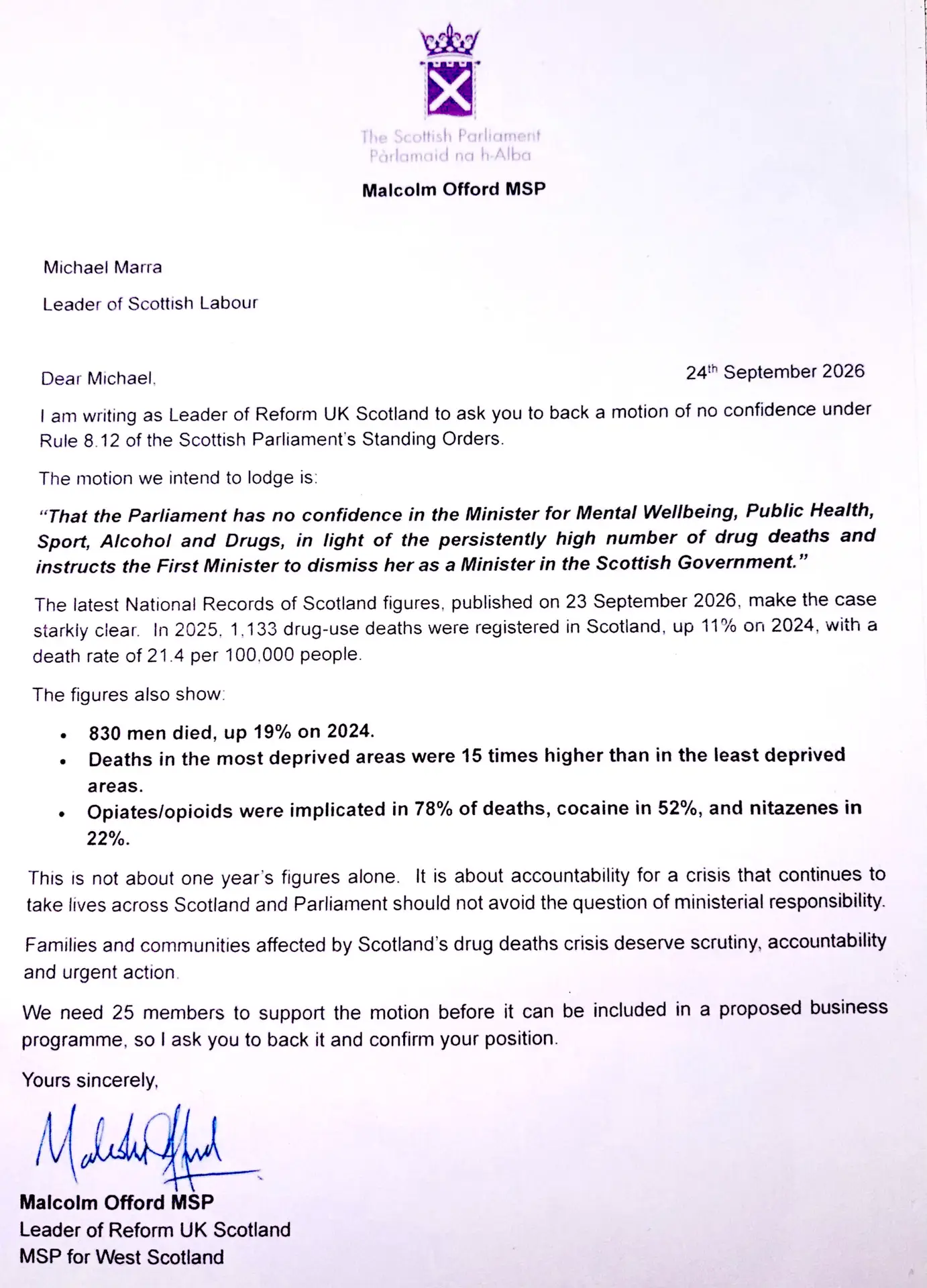
Instead, Reform UK leader Macolm Offord stepped forward and took up the torch of accountability, seeking to shine a light on SNP failure and appealing in an open letter to the other opposition parties to join him. He had good cause to expect his initiative to be well received.
Only two days before, the new Labour leader Michael Marra had said in the Scottish Parliament:
“just because we do not agree on everything does not mean that we cannot agree on anything … it is incumbent on us all to find common ground and work together to address those fundamental issues in people’s lives and to deliver change now.”
Nor was Labour alone in striking this consensual note. Conservative leader Russell Findlay had said previously in the Scottish Parliament “we can forget party allegiances sometimes and work for the common good”.
The seventeen MSPs of Reform required only eight members from Labour or the Conservatives to support the motion so that it could proceed to debate.
Disgracefully, the Labour and Tory leaders declined, putting partisan disdain – and perhaps embarrassment at not having taken the initiative themselves – before their duty as opposition politicians to expose the Government to proper scrutiny. All that was being asked was that Maree Todd justify her inaction. Indeed, she doubled down on repeating the same mistakes.
These are the shameless hypocrites running the country while claiming to be kind
Worse still, First Minister John Swinney sought to deflect responsibility by blaming Westminster for not giving him the powers to decriminalise drugs. Yes, the same man who supports minimum alcohol pricing, which has made Scottish booze dearer than many street drugs, and supports a generational ban on tobacco being introduced next year, wants class A drugs to be legally traded. These are the shameless hypocrites running the country while claiming to be kind.
By putting Reform’s motion before Parliament for debate, the Labour and Tory MSPs need not have voted for Offord’s motion as it stood. They could have amended it or, after hearing Maree Todd’s response, abstained or voted against it. Holyrood would at least have shown it is willing to act robustly. It failed, or rather, Labour and Conservative MSPs failed. Not one MSP put the issue ahead of his or her own self-interest by defying the party Whip.
That the motion would never have passed is not the point. What is Holyrood for if it is not to hold to account the irresponsible and incompetent decisions of the Executive that runs our public services? The point was to show Holyrood has a purpose – that it will hold to account those responsible for ensuring that the services on which the poorest and weakest in society depend are appropriate, competently managed and efficiently delivered.
I have no doubt that had Michael Mara promoted such a debate through a motion of no confidence, or had the now junior opposition party, the Conservatives, first taken the initiative, Malcolm Offord and his Reformers would have embraced it willingly and offered their support – or at the very least been shamed into supporting the debate.
Like Swinney, it now appears Labour and the Conservatives have no shame, for they could not put the plight of past victims – and of those undoubtedly dying daily now, with more victims still to come – before their reluctance to work with Reform UK.
The failure of the Conservative MSPs to put their personal views of Reform to one side is especially disappointing. Last year Douglas Ross’s private Bill would have broken with the current self-serving policy of relying on harm reduction by giving addicts a right to seek recovery through rehabilitation. It failed because the ruling SNP had the support of Green MSPs in opposing it (voting record is here) – and no SNP member would break ranks. Notably, the sole Reform MSP at the time, Graham Simpson, voted in favour of it.
You might think the Conservatives would have learned from the experience that a divided opposition is more effective when it works together on issues of common public interest.
There are alternatives available, but Labour and Conservative opposition remains performative rather than real, and too many of our MSPs are simply not listening. Holyrood remains a disgrace to Scotland.




Comments: 0
Join the debate
Do you agree with this analysis, or is the author wrong? Have your say below.
No comments yet. Be the first to join the discussion.