

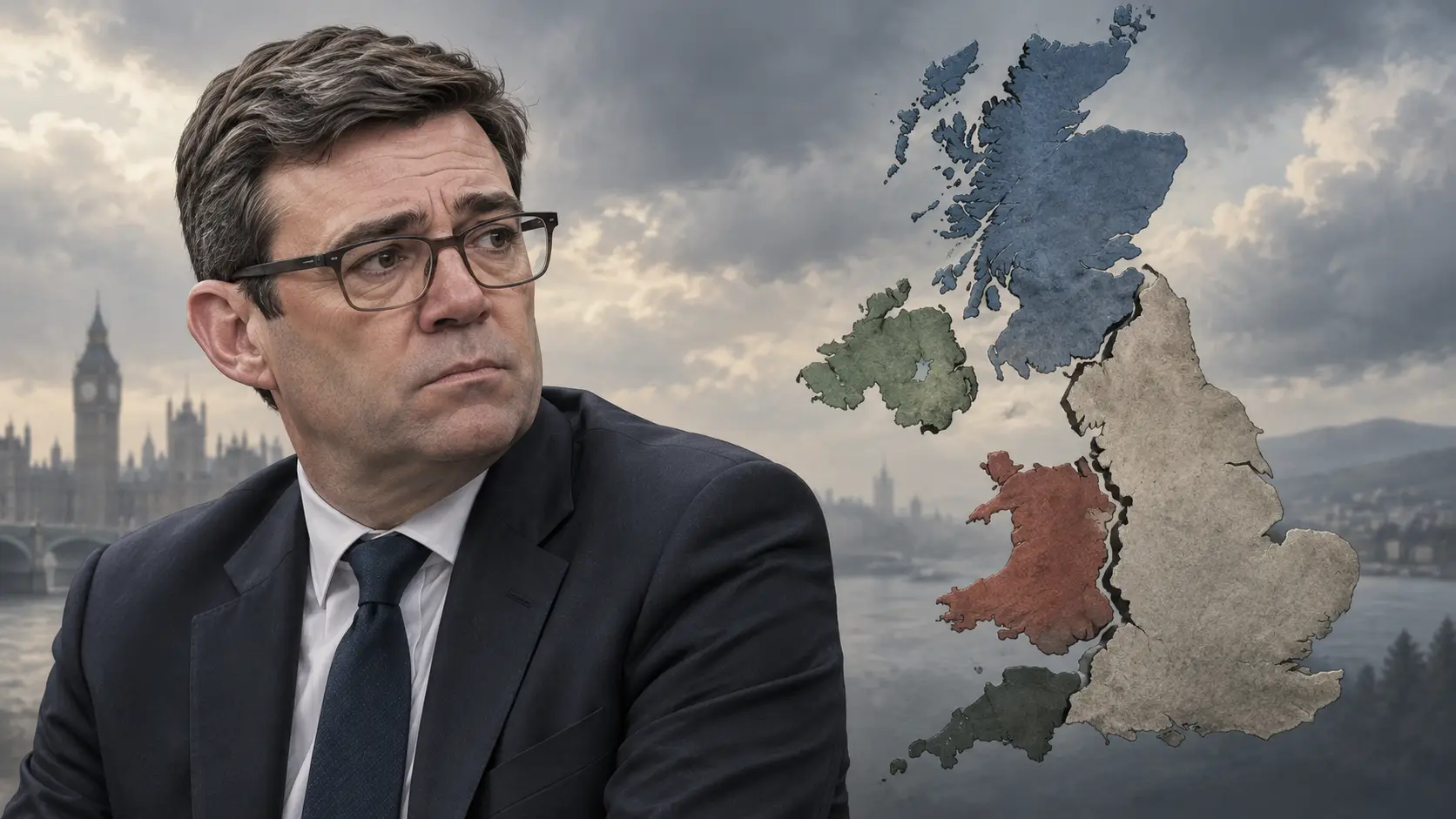
LAST WEEK, THE LEADERS OF THE SNP, PLAID CYMRU AND SINN FÉIN met in Cardiff to sign a memorandum calling on Westminster to “prepare, plan and facilitate constitutional change in Wales, Scotland and Northern Ireland” – including the right to hold referendums on leaving the United Kingdom. They were meeting as party leaders rather than representatives of their respective governments, with Sinn Féin president Mary Lou McDonald also attending.
That distinction matters. They are entitled to meet. They are, after all, separatist parties. Breaking up the United Kingdom is, in one form or another, what they exist to achieve. But let us not pretend this is simply three governments getting together to discuss better cooperation. It is politics – and constitutional politics at that.
Andy Burnham should take notice. The Prime Minister has embarked upon an ambitious attempt to decentralise Britain. There is much to commend in that. Decisions should be taken closer to the people affected by them wherever practical, but there is a fundamental difference between devolution and dissolution.
Burnham wants to rewire the United Kingdom. The nationalists want to dismantle it.
The distinction matters particularly in Northern Ireland. Michelle O’Neill is perfectly entitled to argue for Irish unity as vice-president of Sinn Féin. What she cannot do is present Sinn Féin’s constitutional ambition as though it were the settled view of the people of Northern Ireland – because it isn’t.
Northern Ireland’s constitutional position is not determined by Donald Trump, Gordon Brown, Sinn Féin or, for that matter, me. It is determined by the people of Northern Ireland. That was one of the central achievements of the Belfast/Good Friday Agreement.
The principle of consent means Northern Ireland remains part of the United Kingdom unless a majority of its people decide otherwise.
Northern Ireland’s position is unique because it is governed by an international agreement and legislation that specifically establish the mechanism through which its constitutional status can change.
the Belfast Agreement leaves the decision on constitutional change to the people
The weekend before the Cardiff meeting, Donald Trump wandered into the debate. During his visit to Ireland, the President said he would “love” to see a united Ireland and predicted that it would eventually happen. He is obviously entitled to his opinion, but Northern Ireland isn’t a property deal, nor is its constitutional future something to be casually negotiated between presidents and prime ministers.
We have been here before. Former prime minister Gordon Brown recently predicted Irish unity too. Now Trump has joined him. What is striking about these interventions is the confidence with which people who do not live in Northern Ireland tell those of us who do what our constitutional future will be.
Geography is not political destiny. There are powerful economic, cultural, political and security arguments for Northern Ireland remaining within the United Kingdom. There are arguments on the other side too. That is precisely why the Belfast Agreement leaves the decision to the people.
The Cardiff gathering therefore tells us something important. Nationalism is becoming better organised across the United Kingdom. Sinn Féin, Plaid Cymru and the SNP increasingly see their constitutional campaigns as mutually reinforcing. Unionism needs to understand that.
But the answer is not to panic every time nationalists meet, nor is it to try to prevent constitutional arguments being made. The answer is to make the case for the United Kingdom.
And that case is becoming stronger, not weaker.
Britain’s economy is finally showing signs of growth. GDP rose by 0.4 per cent in July and by 0.4 per cent over the latest three months. There are still serious problems – inflation remains above target, household budgets are squeezed and parts of the economy remain weak – but surely this is the moment to concentrate on strengthening our economy rather than embarking on years of constitutional upheaval.
Then there is security. We are living through the most dangerous period Europe has faced since the Cold War. There is war on our continent, growing Russian aggression, daily cyber-attacks and renewed concern about the security of our seas, energy supplies and undersea infrastructure. The Government itself now says Britain must prepare for the possibility of the UK homeland coming under direct threat in a wartime scenario.
Northern Ireland’s position within the United Kingdom has strategic importance for Britain’s maritime and wider defence
Is this really the moment to start dismantling one of Europe’s major military powers?
This is why the work of the Together UK Foundation, of which I am chair, matters. The Union is not some historical curiosity to be defended out of nostalgia. It is a living economic, social, cultural and – increasingly – security-conscious partnership between England, Scotland, Wales and Northern Ireland.
Indeed, Together UK has already been examining precisely this question. At our recent defence lecture, former senior NATO commander Rear Admiral Chris Parry argued that Northern Ireland’s position within the United Kingdom has strategic importance for Britain’s maritime and wider defence.
That debate is becoming more urgent. A United Kingdom of nearly 70 million people, pooling its tax base, Armed Forces, intelligence capabilities, energy resources, industrial capacity and international influence, has weight in an increasingly dangerous world. Break it apart and you don’t simply redraw a few lines on a constitutional map. You divide resources, institutions, military infrastructure, public finances and political power.
the argument for the Union is increasingly about the future
For too long, nationalists have been allowed to talk about the future while unionists are expected merely to defend the past. That has to change.
The argument for the Union is increasingly about the future: how we grow together, how we pay for the public services we expect, how we protect ourselves and what influence we want these islands to have in a world becoming more dangerous by the month.
If Sinn Féin, the SNP and Plaid Cymru are going to coordinate their arguments for breaking up the United Kingdom, those of us who believe in it must become much better at explaining what would actually be lost.
A confident Union should not be frightened of debate. It should be frightened of complacency.
Andy Burnham says he wants to rebuild Britain from the bottom up. Good. Let’s make sure we look to the future together.



Comments: 0
Join the debate
Do you agree with this analysis, or is the author wrong? Have your say below.
No comments yet. Be the first to join the discussion.