

ANTON MUSCATELLI SAYS Scottish universities face a £200 million blow, and that we must act. He is right. The new funding-gap analysis he led for the Scottish Government and Universities Scotland is not an opposition briefing. It is the sector’s own costing method, applied to the system ministers still call world-class. The picture, he writes, is bleak.
In 2023/24, Scotland’s universities spent about £200 million more than they took in, once you measure the full cost of keeping the sector at its present size and shape. That headline is the leftover. Underneath it sit larger holes.
Publicly funded teaching of Scottish students recovered only about 82 per cent of cost – a gap of some £288 million, or roughly £2,700 per Scottish student. Research recovered about 72 per cent, a shortfall of around £580 million. The repairs backlog on the estate is more than £1.1 billion.
Only one year in the eight-year window looked healthy, and that was the pandemic year, when emergency public money flattered the books.
Those are the figures. The political story is how a country arrived at them while congratulating itself.
Free undergraduate tuition for eligible Scots is popular, and it is not a trivial achievement. A student in Edinburgh does not leave with the same tuition-fee debt as a student in Manchester. Ministers still reach for that contrast, and for widening-access numbers, every time the accounts look ugly. The Education Secretary, Màiri McAllan, did it again last week: ability to learn, not ability to pay; a sustainable model to follow; the problem is not unique to Scotland.
All of that may be true, but it misses the point. A price of zero is not a cost of zero. Somebody pays. For years that somebody was meant to be the Scottish Government, through the teaching grant and the fee payment that stand in for an English tuition fee. In real terms that public rate did not keep up. The Scottish Funding Council’s own analysis has shown a large real-terms erosion of core funding over a decade. Universities were told, in effect, to do the same for less, and to keep the funded-place numbers politically palatable. The shop window stayed free while the stockroom was cut.
The substitute paymaster was the international student. Ten years ago, overseas fees were less than a third of teaching income. By 2023/24 they were about half, and higher still at the ancient universities. Non-publicly funded teaching threw off a surplus in the region of £445 million. That surplus was no bonus. It was poured into the teaching gap, the research gap, and buildings that were not being maintained. When recruitment dipped – because of visa policy, a stronger market elsewhere and a boom that could not last – the unofficial treasurer had a bad year. Edinburgh went looking for £140 million of savings. Dundee found a hole measured in tens of millions. Robert Gordon, Glasgow Caledonian and others cut posts or faced action over jobs at risk. That is what a crutch looks like when it wobbles.
None of this is only an SNP story in the childish sense. England’s fee-and-loan model is also under strain. Research costs are not fully recovered across the UK. Westminster holds the visa lever. Rises in inflation, energy and National Insurance did not stop at Gretna. A fair argument admits all of that.
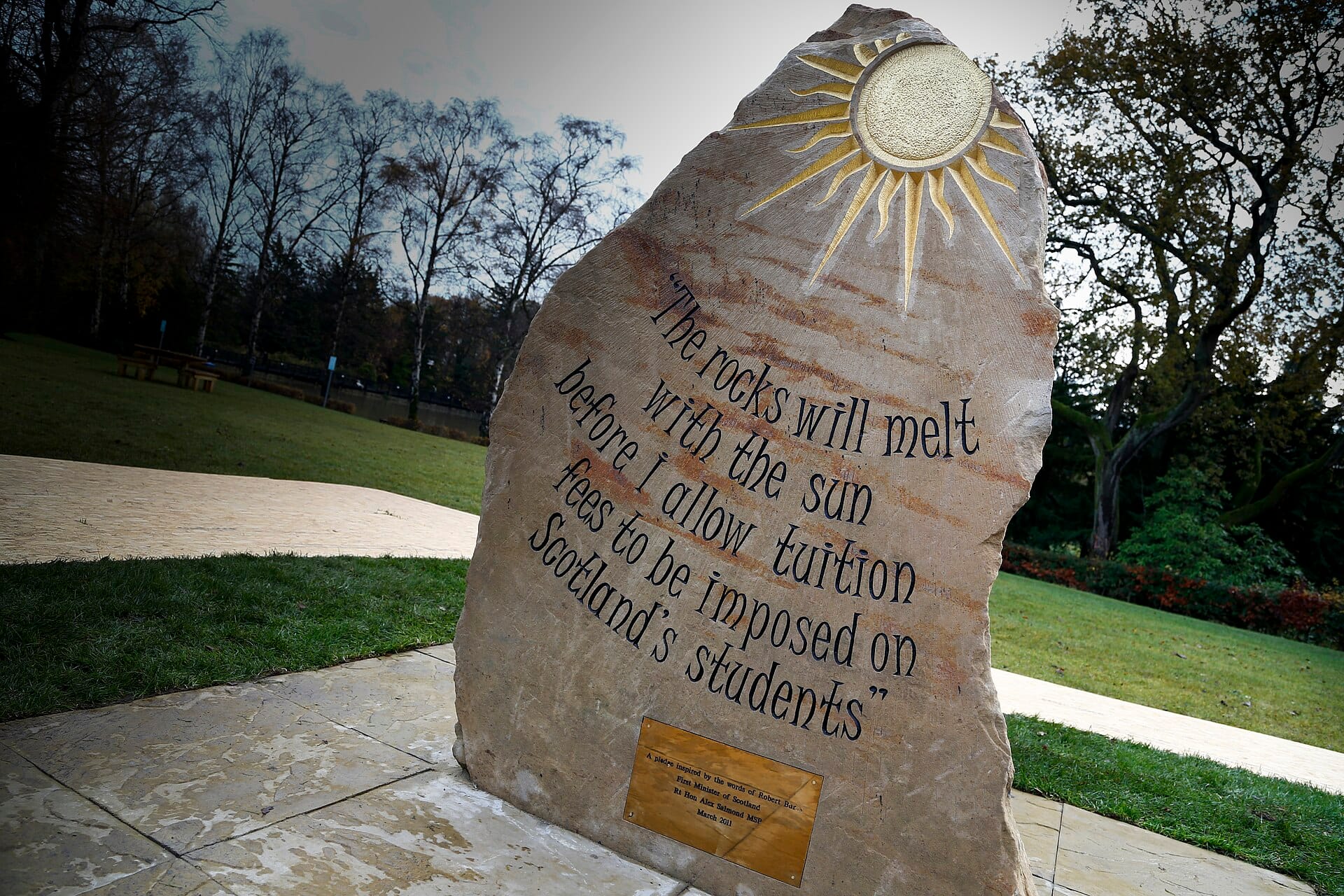
A serious argument still asks who, for nineteen years, chose to treat a zero fee as an untouchable identity while the unit of resource fell behind cost. After 2007 the graduate endowment was abolished. After 2011 the policy was carved into folklore, as proclaimed by Alex Salmond: the rocks would melt before a Scottish undergraduate paid a fee.
Difference from England became the product and international volume became the escape hatch. Each year of squeeze was easier than reopening the principle. Nineteen years is long enough to own the model that followed.
There is a fairness argument that deserves to be met, not sneered at. Fees can deter. Living costs already do. A zero tuition fee with a weak bursary and a high rent is not the egalitarian settlement advertised on the conference stage. If the next “sustainable model” keeps the sacred invoice at zero and shoves more hardship into loans and part-time work, poorer students will have won the slogan and lost the ability to make ends meet. Widening access while cutting the staff who teach the extra students is the same trick in a different hat: volume without the funding to support it.
Free tuition can still be defended as social democracy. It cannot be defended as magic. Nordic-style prices on an Anglo-American research mission, paid from a mid-sized budget, only balance while someone abroad writes a large cheque. This is not moral superiority, but an export strategy wearing a slogan.
What “act” means is now a short menu. One: keep the zero fee and pay for it – raise the teaching rate toward full cost, fund the research shortfall properly, and put capital against the billion-pound backlog and the net-zero duties that have been announced without a cheque.
Two: keep the name“free” but restore a graduate contribution after an earnings threshold, so the people who capture most of the private return share more of the cost, while living-cost grants at the bottom actually rise.
Three: ration the free good – fewer funded places, fewer duplicated courses, a smaller map of campuses – and say so, instead of letting deficits close departments in the dark.
Shared services, “efficiencies” and philanthropy will be offered as a fourth way. Some waste exists and should go.
None of it closes a £288 million teaching gap, a £580 million research gap and a billion-pound backlog on any timetable that helps a student starting next autumn.
What is no longer available is the option that was the last decade’s real policy: announce the principle, underpay for the student, hope the rest of the world keeps balancing the books, and call the arrangement a wellbeing economy.
One cannot create a wellbeing economy by running down the places that train the next generation. This produces thinner staffing, slower feedback, closed modules, leaking labs, and a research base that wins grants it cannot fully afford to host. Quality is a lagging indicator. League tables will still flatter a famous name for a while after the staff who made the name have taken redundancy.
Colleges, too, are part of the same settlement. The college-to-university route, known as articulation, only works if the receiving university still has the second- and third-year places to receive students. A policy that saves the famous names and lets regional provision quietly thin out is not a national education policy but a rankings strategy.
Muscatelli asked for action without turning his report into a manifesto. The manifesto writes itself from the tables. If Scotland wants the system it boasts about, it has to put money next to the boast, or change the boast, or admit it wants a smaller system. Anything else is branding. Branding does not teach, repair a roof, or fund a laboratory. It only postpones the bill until it arrives as a redundancy list.


Comments: 0
Join the debate
Do you agree with this analysis, or is the author wrong? Have your say below.
No comments yet. Be the first to join the discussion.