


WHILE CULTURAL AND GEOPOLITICAL EXPLANATIONS are often invoked, much of the most durable pressure still sits in what used to be called bread-and-butter politics.
I sense a new social type emerging in Britain that doesn’t sit neatly within the country’s inherited class vocabulary. This is not a strict category, but an attempt to name a recurring mood produced by shared structural pressures. They are not the old industrial working class of collective bargaining and stable identity, nor are they the securely established middle class with predictable housing trajectories and intergenerational stability. They occupy a more uneasy middle ground: economically active, educationally credentialed, socially fluent – and structurally unsettled. They are the generation shaped by the massive expansion of university education under Blair.
Let’s call them the “Working Class Tonies” – a class based on mood, as ultimately all social classes are.
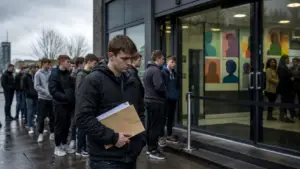
The label matters less than what it is trying to describe: a cohort of people who come from working-class backgrounds, often in post-industrial towns or suburbia, who have acquired degrees, entered professional or semi-professional work, and followed what was supposed to be a straightforward route into stability. On paper, they have done everything right. In reality, the outcome feels incomplete.
They are people who have “almost made it – though it doesn’t feel like it.”
That line is not decorative but diagnostic.
They are not a group defined by crisis. They are defined by lack of completion.
The pattern is not dramatic rupture but deferred settlement: milestones reached in one register and withheld in another. The first man in the family to go to university is the first not to own a home. The young woman who topped her psychology cohort enters adulthood without the prospect of children. The last generation to remember the texture of coal-fired streets moves through a present in which basic bills feel increasingly elastic. A doctor walks through an ageing hospital wing and sees equipment stamped “Made in England,” now functioning less as memory than as an industrial echo.
Contentment keeps them inside the system while resentment keeps them sceptical of it
None of this presents itself as crisis in the immediate sense. It accumulates instead as a quieter mismatch between expectation and outcome: a society that expanded qualification faster than it expanded settlement, and now experiences that gap as routine rather than exception.
It captures the central condition of their lives: quite content, yet quietly resentful. Not in contradiction, but in coexistence. Contentment keeps them inside the system while resentment keeps them sceptical of it. One prevents rupture, the other prevents trust. And over time, neither resolves – both accumulate.
They are highly policy-literate. Not in the abstract, but in a lived, evaluative sense. They recognise when housing targets function as aspiration rather than delivery. They understand when NHS funding increases collide with workforce constraints. They notice when migration policy is discussed without reference to infrastructure capacity. They do not judge politics by intent. They judge it by the likelihood of execution.
They live inside that system, not outside it. They work alongside migrants in offices, hospitals, warehouses, schools. There is no clean ideological framing available because experience refuses simplification. But alongside that normality sits a quiet arithmetic: housing supply has not matched population pressure. The result is less visible in debate, than it is in rent levels, shared housing, and delayed household formation.
They reject crude racial caricatures, but they are not free of contradiction. When another child is stabbed, and the perpetrator is from a background they do not identify with, it produces a tension they may rarely articulate: a clash between liberal self-understanding and a growing sense of social incoherence. It is not ideology that fractures here but interpretive stability.
They are also net contributors, and they know it. Tax is not an abstraction but a deduction: income tax, National Insurance, VAT, council tax. At the same time, they observe patterns of contribution and consumption around them that feel uneven, even when not formally measured. The effect is cumulative rather than declarative – a slow shift from assumed reciprocity to assumed imbalance.
That shift rarely becomes overt anger. Rather it becomes language.
Brenda next door becomes “No-Neck Brenda”. Mike with a beard over the road, out of work for years, becomes “Father Splifmas”’. These are not simply insults. They are informal classifications – attempts to map perceived contribution, dependency, and decline in a world where formal categories feel insufficient.
Private taxonomy, rather than collective judgment, replaces older forms of cohesion. No sociology degree is required.
Parties are no longer identities, but service providers
The generational texture has shifted further. This is a cohort that orders online by default. This necessarily involves a reconditioning of expectation: systems are judged by whether they deliver, not by how they are justified. As high streets become interchangeable and institutions become comparable, politics begins to drift into the same logic.
This produces the “Just Eat Just Voter” — not loyal, not ideological, but comparative. Parties are no longer identities, but service providers. Manifestos are not commitments, but listings. Politics becomes a retail environment under conditions of low trust and high switching ease.
And in that environment, political language loses its inherited anchors.
A voter who barely remembers the Spice Girls will not be moved by references to Thatcher or Hardie. This is temporal displacement. The emotional grammar of twentieth-century politics does not automatically transmit into a cohort whose reference points are late-90s culture, early-2000s consumer expansion, and the digital comparison economy of adulthood. As shared memory fractures, political language may remain, but its resonance thins.
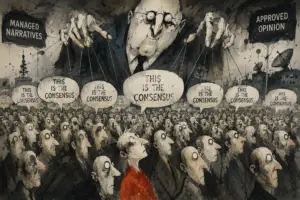
That creates a deeper discontinuity: politics is still often spoken in the language of inherited ideological history, while a growing share of voters operate in a different temporal frame entirely. One is narrative politics. The other is evaluative politics.
This is why the Working Class Tonies matter. They are not disengaged, but continuously processing. Their politics is not identity, but judgement under constraint.
The significance of that judgement is increasingly visible in places such as Makerfield and similar post-industrial constituencies where Labour and Reform UK now compete most intensely for support. These voters are not politically homeless, but neither are they politically settled. They are multiple undecided constituencies contained within a single electorate.
And the judgement is unstable because their condition is unstable: quite content, yet quietly resentful. A balance that holds for now, but does not naturally settle into equilibrium.
Because contentment without confidence produces drift and resentment without outlet produces search.
In that search lies the political volatility of the present: not a collapse of belief, but a continuous re-evaluation of whether the system still delivers what it implicitly promises. To that extent, they are not a lost constituency. They are many undecided ones.
The condition has a visual grammar of its own: a child reaching toward a red balloon pinned just beyond contact against an indifferent wall. This not a metaphor for hope or loss in isolation, but for proximity without attainment – the lived geometry of “almost”. The object is visible, even close, but not convertible into possession. This is what completion feels like when the distance is structural rather than personal.


Comments: 0
Join the debate
Do you agree with this analysis, or is the author wrong? Have your say below.
No comments yet. Be the first to join the discussion.