

WELSH POLITICS is different to the rest of the UK in a way those who seldom venture outside the Westminster bubble, or even the M25, fail to appreciate.
The headline story of the Senedd elections, that Labour has lost power and been eviscerated, is only a part of the story. Analysing the result is further complicated by yet another change to the voting system in 2026, alongside changes to the electorate with the voting age reduced to sixteen and the expansion of the Senedd from 60 seats to 96.
At Senedd level, since 1999 Wales has been ruled by Labour and Plaid Cymru. In 2026 the electorate has chosen to be ruled by Plaid and Labour. For those who haven’t read the Plaid manifesto, it is long on promises and very short on how these will be paid for. Plaid’s economics make Rachel Reeves look sensible and the Welsh should brace for penury.
There is no reason to suspect that Plaid will be any better at finding efficiency savings than Labour. Nor is there any evidence to suggest that increasing the use of the Welsh language improves education standards, shortens waiting lists or fills potholes. Yet the Welsh have chosen Plaid, who have advanced from occupying thirteen of the 60 seats in the old Senedd to 43 of the 96 in the new one.
What of Reform?
The macro view is that they have gone from one seat in the old Senedd – formerly a Tory seat – to 34 in the new one. Many would consider that an astonishing result and, probably rightly, claim that an increase from 1/60 to 34/96 is a heck of a performance, and better than Plaid’s ascent from 13/60 to 43/96. Mathematically they would be correct.
Wales will remain in the grip of economically illiterate progressive idealogues for another Senedd term
Reform are now the second largest party in the Senedd, but even if they allied with the seven Tories they still would not possess a blocking vote, or anything close to it. They can make a lot of noise, but Wales will remain in the grip of economically illiterate progressive idealogues for another Senedd term.
I’ve spent a fair amount of time in Swansea and set up the Reform Gower & Swansea West branch, so I’ve been looking closely at the data there.
For those who hail from the other side of the Welsh Marches, Swansea is Wales’ second city. Originally an extraordinarily wealthy town courtesy of copper – it had fourteen of the UK’s fifteen copper smelters – like all of south Wales it has suffered heavily from deindustrialisation. It has a deep harbour and a very long, wonderful sandy beach, a university and Amazon’s fourth largest depot in the UK.
Dylan Thomas called it a “pretty, ugly town”, later reinterpreted in the late-1990s cult film Twin Town as a “pretty, shitty city”.
A fair amount of Swansea lies within the Gower parliamentary constituency, proof that that Electoral Commission either has a sense of humour or an expensive drug habit. The Gower Peninsula itself is predominantly rural, with a fabulous coastline and beaches, tourism being a major industry.
The non-Swansea part of the Gower constituency is relatively wealthy. By contrast, Swansea households are 56 per cent deprived and six per cent severely deprived. Historically Swansea and Gower are Labour bastions. To some extent they still are and one of the – just – nine Labour members in the Senedd was elected in Gower & Swansea West.
The chart below shows Westminster and Senedd election results since 2019 for Gower and Swansea West treated as one constituency – which it is for the Senedd, though not Westminster. Reform was known as the Brexit party in 2019 – Swansea and Gower voted 52:48 to leave the EU. Results are shown by percentage of those who voted, with the oldest selection on the left.
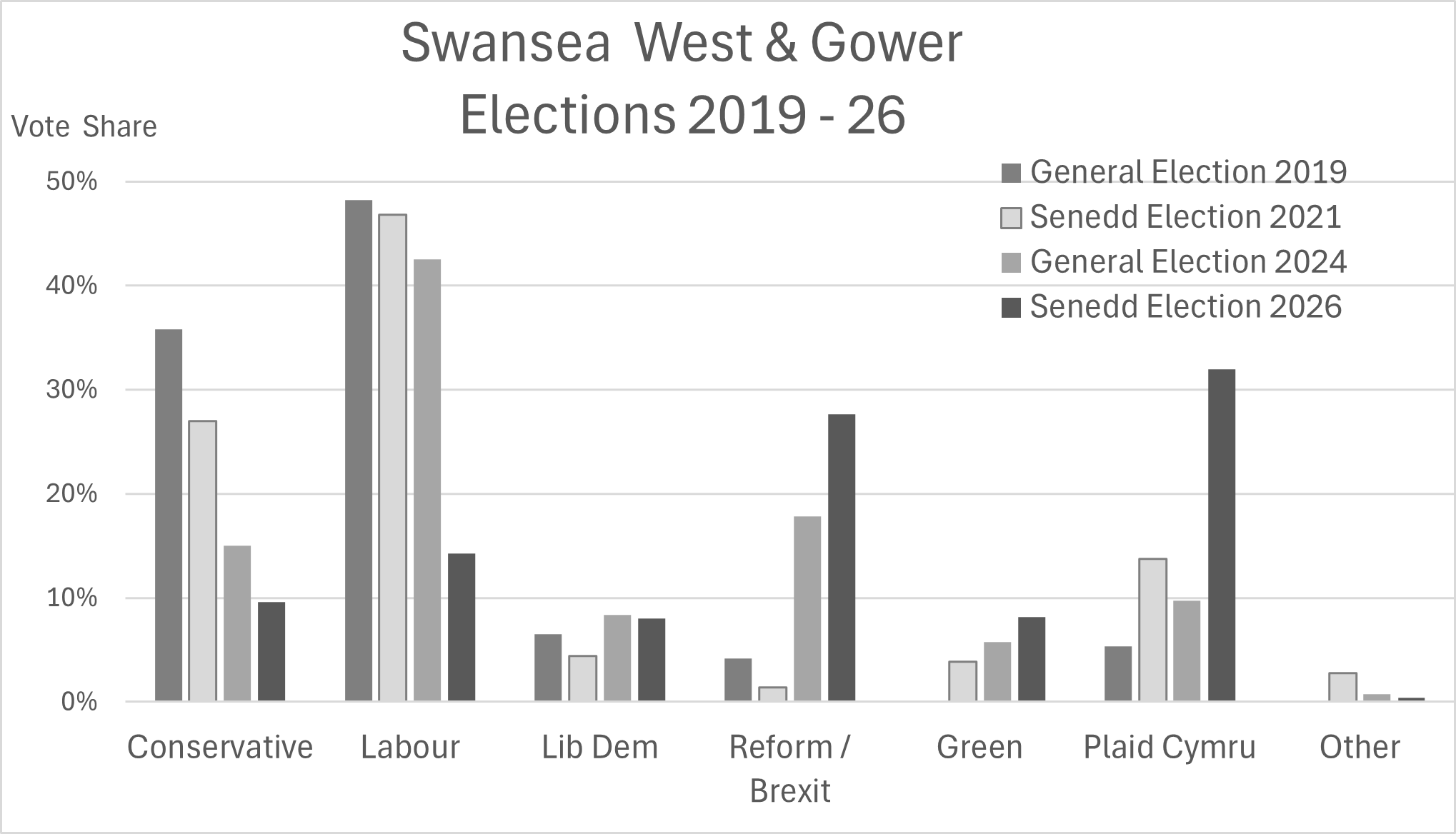
The general story of declining Conservative and Labour support started in or before 2019. Reform surged in 2024, when Plaid declined. The Reform vote grew again last week, but the astonishing story is Plaid’s growth. Reform’s vote share increased by 50 per cent, Plaid’s by 230 per cent.
Part of Plaid’s growth will have come from former Labour voters switching to another progressive party. Hatred of the Labour-run Senedd is universal, and focuses on the ineffectual leadership – or, during Covid, quasi-dictatorship – of Drakeford, Gething and Morgan.
More of Plaid’s rise likely comes from will the track record of Plaid leader Rhun ap Iorwerth, who has led the party since 2023 and consequently has enjoyed rather more media exposure than the Reform Wales leader Dan Thomas.
The Green vote was up too, no doubt helped by the exploits, if not necessarily the politics, of Zack Polanski, providing another progressive option for disillusioned Labour voters. The Lib Dem vote remained about the same, as it has for other elections.
The lead candidate for Reform was a former Tory who defected just nine months before the poll. No doubt much of the drop in the Tory vote was linked to her personal following, which was substantial. If that’s correct, Reform’s increase in vote share becomes rather less unimpressive.
And, frankly, it is unimpressive.
Election spending limits in parliamentary elections are about £12,000 per constituency. In the 2024 general election I spent less than half of that as, like every other Reform candidate, I was funding myself. The total spent across both constituencies was therefore no more than £18,000.
Senedd elections are more generous: £72,000 per Senedd constituency, roughly four times as much. Reform is flush with cash, so it will have spent it.
the party has a management problem
It’s not just about money; you need people to leaflet and campaign. In the general election I started with a team of two – and a rescue dog – eventually building that into a team of ten including myself. At the start of this campaign Reform could field twenty or more people. I had a Facebook page; Reform now has an impressive and comprehensive social media operation.
And yet, despite vastly greater resources and an electorate desperate for change, Reform failed to take power.
Winning a majority in the Senedd is tricky under the electoral system, but Reform failed by some margin to be the largest party, which had previously been the stated aim. My personal view last September was that Reform could potentially win a majority. That may have been optimistic, but Reform’s showing in Wales was still distinctly sub-par.
I’m no longer part of Reform – I resigned due to dissatisfaction with the integrity of the candidate selection process. Having observed at first hand the changes in Reform since the general election, I know the party has a management problem, particularly in Wales.
This has been exacerbated by what could be described as a reverse takeover by former Tories, which in Wales is not a sound vote-winning strategy.
Reform may learn from its mistakes, but that’s no longer my problem, so I will leave further comment to others.




Comments: 0
Join the debate
Do you agree with this analysis, or is the author wrong? Have your say below.
No comments yet. Be the first to join the discussion.