

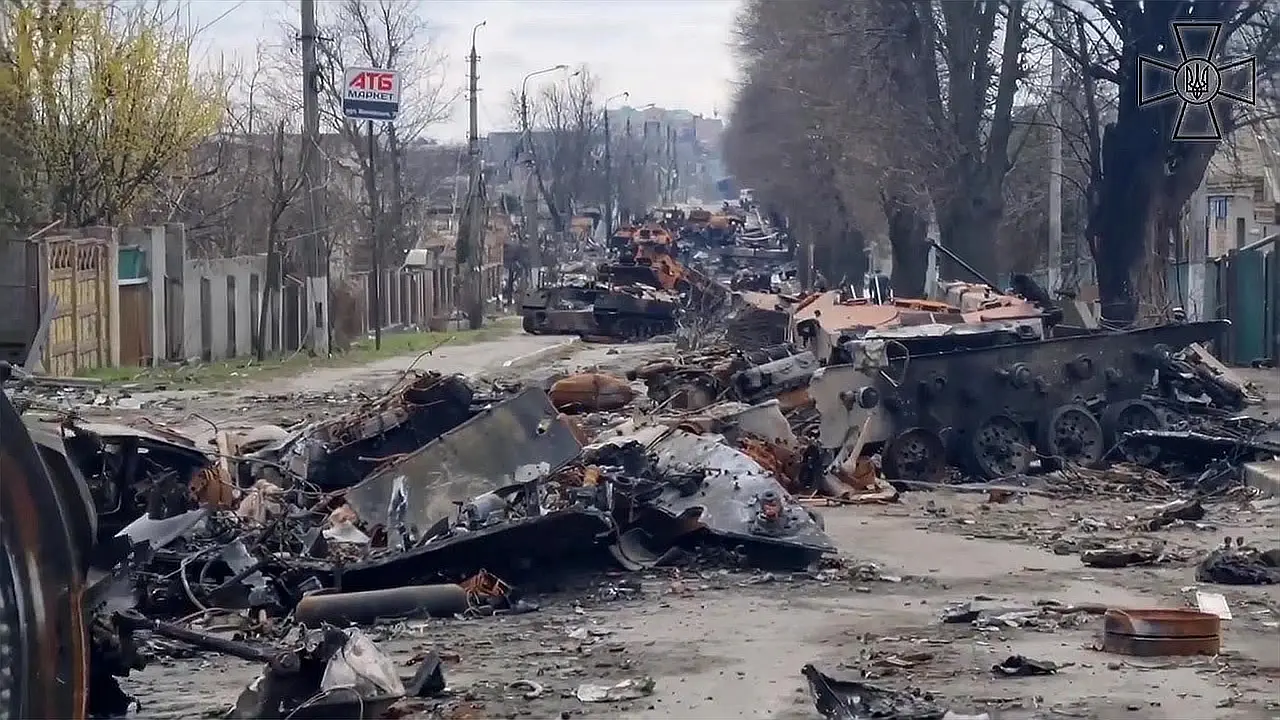
RIGHT AT THE BEGINNING OF THE RUSSO-UKRAINE WAR in February 2022 I was asked who I thought might be the victor. My trite and somewhat smug answer at the time was that Russia would lose if it did not win, and Ukraine would win if it did not lose.
Fast forward four years and the conflict rages on, but my rather offhand prediction looks as if it has come to pass. Ukraine still exists as a sovereign state, and the Zelenskyy administration still governs in Kyiv.
Russia’s “special military operation” stalled after limited initial successes. The frontlines have been essentially static for the past three years, and casualties on both sides have been enormous, but at a ratio of roughly three to one in favour of Ukraine.
At sea the Russian Black Sea fleet has either been sunk, crippled or confined to port. Neither side has been able to establish any form of air superiority, meaning that large-scale armoured manoeuvre warfare is effectively out of the question.
The defining weapons systems of the war to date have been drones. Ukrainian uncrewed surface vessels (USVs) have driven Russian naval vessels from much of the Black Sea and attacked the Kerch Bridge repeatedly.
On land Ukrainian uncrewed ground vehicles (UGVs) are increasingly being used instead of soldiers in some situations and have been recorded forcing the surrender of Russian troops with nary a Ukrainian soldier in sight.
But it is in the air that drones have made their most notable impact. Both sides have used them extensively, but here the balance seems to be tipping in Ukraine’s favour. Ukraine is now out-producing the Russians, and the range of its systems has increased to the extent that airfields and oil installations far into the Russian hinterland are now targets which are being struck successfully.
the traditional Moscow Victory Day Parade was much reduced
Drones are not the answer to the maiden’s prayer in all aspects of combat, but there is no doubt about their central role in this war.
So we now have a stalemate along the front which has lasted, more or less, four years. Territorial gains by the Russians in recent months have been minimal and have been achieved at heavy cost.
And now even the traditional Moscow Victory Day Parade – the annual military parade of the Russian Armed Forces on Moscow’s Red Square each 9 May – was much reduced. No serious display of armoured vehicles, no missile systems, little beyond marching troops. Why? Because Putin feared the long-reach capabilities of his Ukrainian enemy would disrupt anything more substantial. How are the mighty fallen!
As I said at the beginning, Russia will lose if it doesn’t win and, at the moment, it isn’t winning. On the other hand, Ukraine will win if it doesn’t lose and, again at this time, it doesn’t look like there is any chance of its stout and courageous defence collapsing.
It is becoming ever more apparent that Kyiv is winning, it’s just that the rest of the world doesn’t quite recognize it yet.
Comments: 0
Join the debate
Do you agree with this analysis, or is the author wrong? Have your say below.
No comments yet. Be the first to join the discussion.