

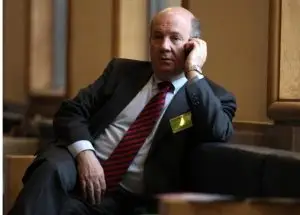
ON SATURDAY The Times ran an interview with the Scottish Parliament’s new Presiding Officer, Kenny Gibson, under the headline: “I won’t stand for any misgendering”.
Gibson said:
“You have to respect what that person wants to be called. And if someone doesn’t do that, then you have to call that out in the chamber and you have to take the appropriate action. If there’s a clear issue of it looks like it’s being deliberate, then you have to act on that because you can’t have someone, a member of the parliament, feeling undervalued or disrespected. So whatever your personal views are of what they call themselves, it is what they want to call themselves, I think, which is significant.”
According to the article, Gibson “made it clear that he would not tolerate politicians deliberately or maliciously refusing to use the chosen pronouns of the newly elected Green MSPs Iris Duane and Q Manivannan”.
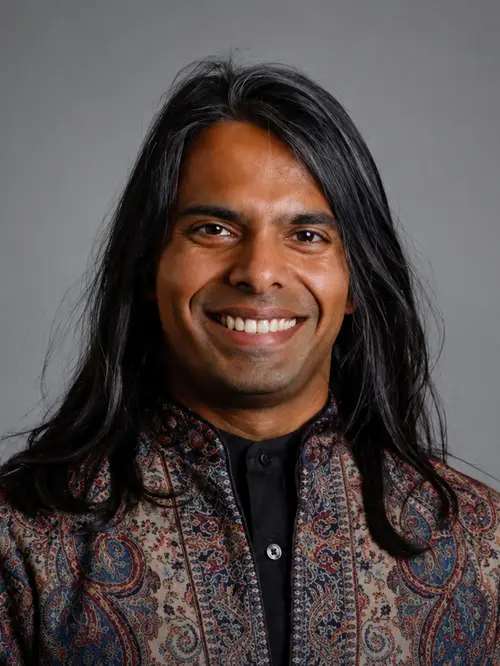
This is the first time openly trans MSPs have been elected to Holyrood. Iris Duane is biologically male but was listed on the Scottish Parliament website as “female”; he uses she/her pronouns. Q. Manivannan, also biologically male, was listed as “non-binary” – an opaque category with no standing in law; he uses they/them pronouns.
Until Sunday, the Scottish Parliament website categorised MSPs by “gender” as male, female and non-binary. That facility has now been removed, presumably following complaints that it distorted sex-based statistics.
The essential background to Gibson’s declaration is that his election as presiding officer depended on Green Party votes, which blocked the SNP leadership’s preferred candidate. The Times reports that Gibson “said he had addressed the issue with Green MSPs in a meeting before his election”.
It is surely not too much of a leap to suspect that Gibson’s prohibition on scientifically and legally accurate language on sex and gender in the chamber was the quid pro quo for securing his position.
The shoddiness of this deal is only enhanced by the fact that Gibson was one of the few SNP MSPs to oppose Nicola Sturgeon’s Gender Recognition Reform bill in 2022. The irony is that that bill, which was blocked from becoming law by the Westminster government at the time, sought to legalise gender self-identification, and now Gibson is trying to sneak gender self-id by convention into the proceedings of the Scottish Parliament itself.
Scottish schools still enforce trans names and pronouns on staff and pupils alike
Neither Duane nor Manivannan appear to possess a Gender Recognition Certificate (GRC) – though, following For Women Scotland’s Supreme Court victory last year, that is legally beside the point.
The Court ruled unanimously that, for the purposes of the Equality Act 2010, the terms “sex”, “woman” and “man” refer to biological sex – meaning sex at birth – not acquired gender identity or legal status. A GRC does not alter a person’s sex under the Equality Act.
Nor is this an obscure or fringe legal position. In Maya Forstater v CGD Europe, the Employment Appeal Tribunal ruled that gender-critical beliefs — including the belief that biological sex is immutable — are protected under the Equality Act.
Yet governments in both Edinburgh and Westminster continue to drag their feet over implementation, delaying updated guidance following the Supreme Court ruling. Scottish schools still enforce trans names and pronouns on staff and pupils alike, in open defiance of biological reality.
Now, before Holyrood has even properly convened, Gibson has effectively handed the Greens a veto over language itself.
He has allowed the Greens to hijack the political arena, by effectively outlawing sex-realist speech and coercing MSPs to collude in a political fiction: to pretend that Duane, who is visibly male, is female, and that Manivannan, also visibly male, is neither male nor female, or either, or both, depending on how he happens to feel on a particular day.
This matters because the claim that men can become women is not a harmless abstraction. It has direct consequences for women’s spaces, safeguarding, and the coherence of sex as a legal and scientific category.
Presumably Gibson’s injunction will also apply when members refer to Adam Graham – better known as Isla Bryson – the notorious double rapist in pink leggings who was sent to a women’s prison and helped bring down Nicola Sturgeon in 2023. After all, Duane and Manivannan might end up “feeling undervalued or disrespected” if someone calls Graham “he”.
By taking a side on one of the most contentious political questions in modern Scotland, Gibson has already compromised the impartiality his office is supposed to embody.
Reform MSPs could establish themselves immediately as institutional disrupters by refusing compelled language outright
That partiality is evident in the fact that he consulted the Greens but not the many MSPs who hold gender-critical views. Had he done so, he might have realised that his noble principle – that “you can’t have someone, a member of the parliament, feeling undervalued or disrespected” – cuts both ways. How can a parliamentarian compelled to speak against his or her own judgement not feel demeaned and disrespected?
Should Gibson stick to his guns, he may well invite legal challenge.
However, before that, in fact this week, as soon as Parliament convenes, there should be a political challenge from the parties – Scottish Conservatives, Scottish Labour and Reform – who oppose gender identity ideology.
Reform was slow during the election campaign to grasp the political salience of gender ideology and women’s spaces, to the frustration of many voters, especially women.
Here, then, is a golden opportunity: Reform MSPs could establish themselves immediately as institutional disrupters by refusing compelled language outright.
They could even, as wags on social media have suggested, enter the chamber announcing an ever-changing set of neopronouns — ze/zir, xe/xem, ey/em — of the kind increasingly associated with queer and non-binary identity politics.
Absurd? Certainly.
But no more absurd than a Parliament attempting to compel belief through parliamentary procedure.

Comments: 0
Join the debate
Do you agree with this analysis, or is the author wrong? Have your say below.
No comments yet. Be the first to join the discussion.