

THE SEALINKS BETWEEN THE SCOTTISH MAINLAND AND ITS ISLANDS are vital, both for exporting goods from the islands and for providing islanders with food, fuel, medicines, other supplies and tourists. The transport of fresh produce is particularly time-sensitive, with cancellations caused by failures in an aging fleet proving expensive. In summer, islanders are often stranded when they wish to attend appointments on the mainland at short notice because sailings are booked out over a month in advance.
Loganair also has a charmed existence with its monopoly guaranteed. This too should be reviewed.
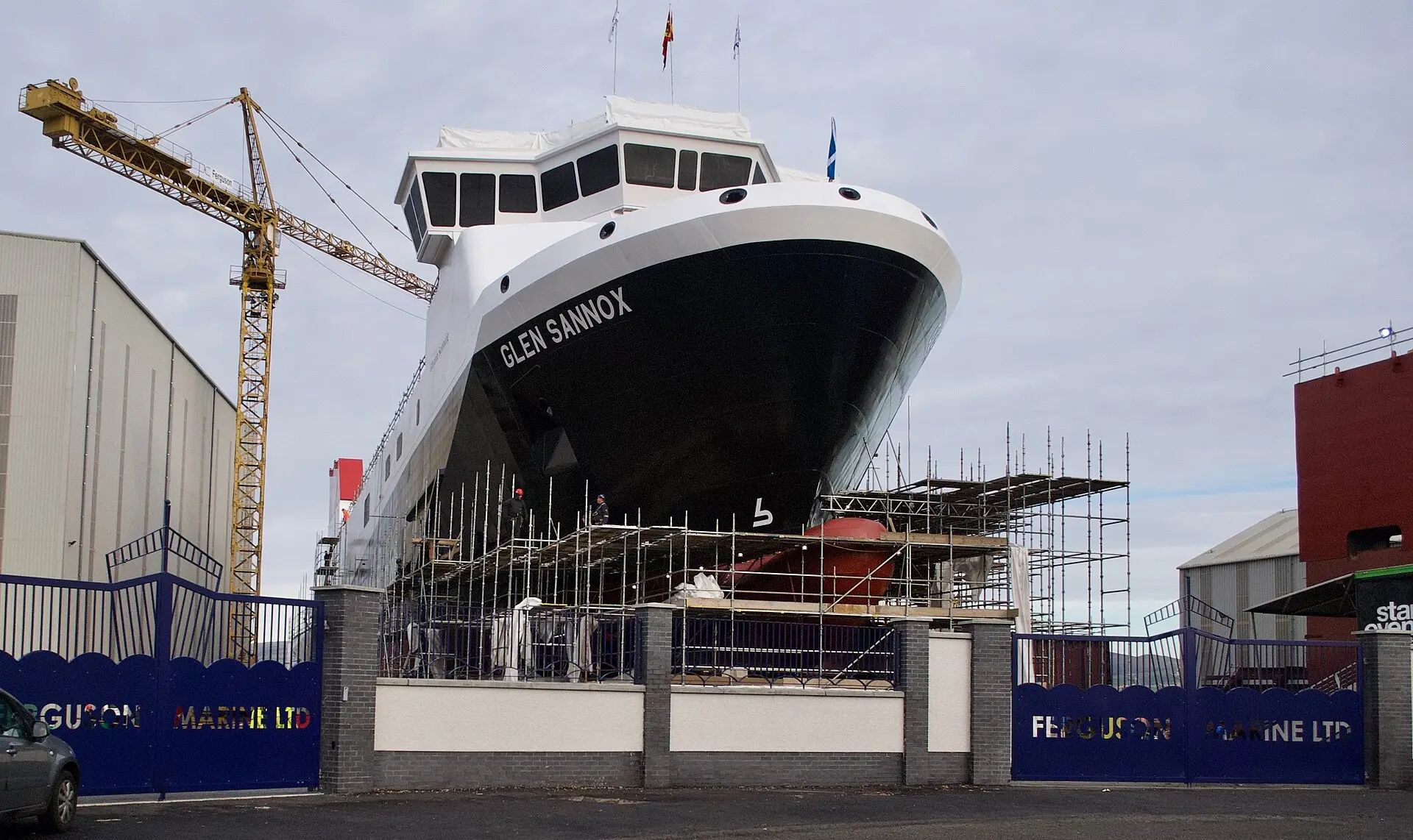
Ferry services have been newsworthy in recent years because of the controversies involved in replacing aging ships in the nationalised CalMac fleet. The two replacements for the Arran service have been plagued by delays, soaring costs, and the failure to upgrade the harbour at Ardrossan to accommodate them. They were originally due to be completed by 2018 at a cost of £97 million. The Glen Sannox was delivered seven years late, and there is still no completion date for the Glen Rosa. The 2025 estimate of £335 million does not include the £83 million paid to Ferguson Marine before it was nationalised, nor the £45m written off in loans before the company collapsed.
The residents of South Uist have been particularly badly hit, relying on the 37-year-old MV Isle of Mull, which has been restricted to just 45 passengers since the start of 2025. When the fourteen-year-old MV Finlaggan, which serves Islay, went in for its annual overhaul in 2025, unexpected problems emerged – hardly unusual for a vessel of that age – and services were badly disrupted. The Scottish Government has even penalised its own ferry company £10.5 million in poor performance fines during the six-and-a-half years of the second concession period.
The fear of failure, which keeps private enterprises on their toes, is missing
There is often a debate about whether public services should be nationalised. The socialist argument is that a non-profit making venture can devote all its funds for the public good. But there is often little incentive to maximise efficiency and no profits available for investment in the future. Public companies instead rely on the government’s largesse, which may or may not materialise. The fear of failure, which keeps private enterprises on their toes, is missing.
ScotRail is effectively a monopoly and relies on Network Rail for much of its reliability, so nationalisation can be justified. It is effectively run by the trade union ASLEF. But sea routes are different.
There are various other ferry companies which might be candidates to run some or all the current CalMac services: Pentland Ferries, Western Ferries, West Coast Motors, P&O, Serco (NorthLink) and DFDS. While subsidies are necessary on many routes because of low traffic volumes, these are commercially successful companies.
Western Ferries has been operating profitably on the Dunoon to Gourock route since 1973. When it needs a new vessel, it approaches Merseyside shipbuilder APCL Cammel Laird and negotiates a-value-for-money deal delivered on time – whereas if it were nationalised, it would likely be forced into accepting the cheapest bid. Western Ferries made an annual profit of £2.87 million to March 2024 and wishes to expand into more routes. In contrast, the competing CalMac Clyde service attracts only a quarter of the passengers, while during 2025 one of its ferries was again out of commission.
Pentland Ferries is a family-run business which has operated a service from the Scottish mainland, near John O’Groats, to Orkney (St Margaret’s Hope) since 2001, the shorter of the two routes to the island from the north coast. It runs two catamarans, the MV Alfred and the MV Pentalina. Not only is it profitable, but in 2025 it was even able to lend CalMac a catamaran for the Arran route when one of its ferries broke down yet again. It achieves this without the generous subsidies enjoyed by Serco on the competing route.
In 1990, Caledonian MacBrayne was nationalised. Under EU rules, the Clyde and Hebrides Ferry Services (CHFS) concession was subject to competitive tendering and CalMac Ferries Ltd won, starting a six-year contract in 2007. In 2009 it started a Sunday service to Lewis, claiming it was required by EU rules to provide a service to the whole community, even on the Sabbath.
“The Earth belongs unto the Lord
And all that it contains.
Except the Kyles and the Western Isles
And they are all MacBrayne’s.”
The CHFS contract was due for renewal last year. SNP ministers sought to “move from a profit model to a public sector model”, by awarding the contract to nationalised CalMac. But that risks entrenching permanent losses and even greater waste of public money. The annual subsidy is expected to rise from £120 million to £370 million. Only socialists could be that spendthrift. The SNP claimed it would save £1.1 million in tendering costs, but that is trivial compared with the losses inflicted on island economies by unreliable services.
The SNP sought to use the ‘Teckal exemption’ in EU law, allowing authorities to award contracts directly to publicly owned suppliers without a competitive procurement process. However, the Scottish Government must still comply with complex state aid rules. The UK’s business regulator asked Scottish ministers to explain why privatising ferry routes would not reduce costs to taxpayers The Competition and Markets Authority also fired warning shots. It has questioned why the Scottish Government was against unbundling routes, where individual packages might be attractive to private operators, including local firms.
The Ferries Community Board, formed as the voice of island communities, declared its opposition to a direct award to CalMac, preferring the contract to go out to tender, “to test the market for best value and encourage innovation and best practice”.
No private operator would willingly bind itself to such virtue-signalling green ideology
There are effectively two scales of ferry, the short-route small ferries and the larger long-distance vessels. The former are more suited to smaller operators, potentially local firms with a direct stake in the communities they serve. Large ferries or small, the routes to the Hebrides from Kennacraig, Oban, Mallaig, Uig and Ullapool could have competing operators, as could the Firth of Clyde routes. Competition works for Orkney and Cowal, so why not the Western Isles and perhaps Arran?
One of the reasons the Arran ferries cost more and were delayed was the introduction of a facility for dual fuel systems, in a vain attempt to save a few carbon emissions. The operational costs and unreliability of the seven electric ferries on order may yet continue this expensive folly. Electric power will probably not be “man enough” for the job in cold, stormy weather, lithium batteries pose an obvious fire hazard, and charging infrastructure may prove problematic in remote locations. No private operator would willingly bind itself to such virtue-signalling green ideology.
The SNP remains obsessed with centralisation and control. The traffic volumes on Clyde routes should make profitability achievable with minimal – or perhaps no – taxpayer subsidy. But the issue should not simply be who offers the lowest cost. If anything, contracts should be awarded primarily on proven reliability. On that basis, CalMac might struggle even to make the shortlist.


Comments: 0
Join the debate
Do you agree with this analysis, or is the author wrong? Have your say below.
No comments yet. Be the first to join the discussion.