

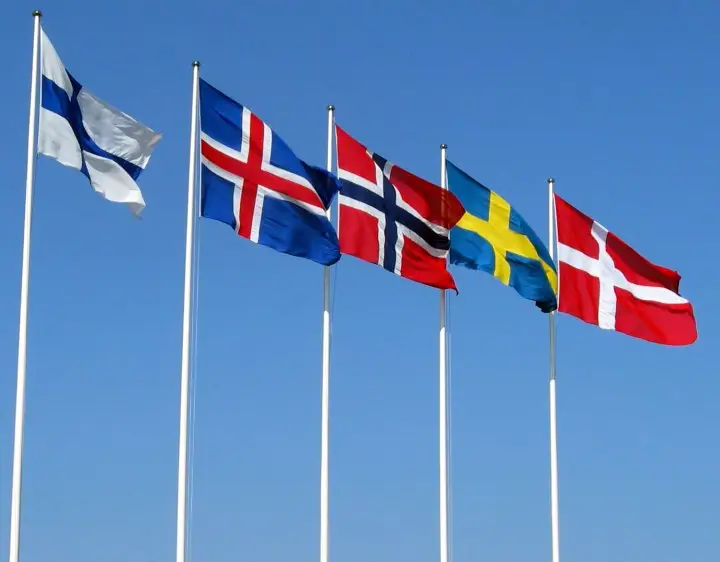
THE RISE OF REFORM UK is often discussed as though it were an isolated British phenomenon: a reaction to Brexit, Westminster dysfunction, or the collapse of trust in the Conservative Party. Yet viewed in a wider European context, Reform looks less like a uniquely British anomaly and more like part of a broader Northern European, even Nordic, political tradition that has steadily expanded over the last two decades.
Long before Reform UK existed under its current name, its political lineage was tied into a continental network of nationalist, sovereigntist and populist parties. The precursor movement, the UK Independence Party, sat in the European Parliament’s Europe of Freedom and Direct Democracy grouping — the EFDD — alongside parties such as the Finns Party and Italy’s Five Star Movement.
That alliance mattered politically and psychologically. British Eurosceptics were not operating in isolation; they were participating in the early formation of a pan-European current that combined opposition to deeper EU integration with concerns about migration, sovereignty and democratic accountability.
Over time, many of those parties moved from the political margins into the mainstream. In Finland, the Finns Party evolved from a protest movement into a major governing force. In Sweden, the Sweden Democrats transformed themselves from a fringe nationalist party into one of the country’s largest political blocs, influencing government policy even before formally entering governing arrangements. Similar patterns emerged in Denmark, Norway, the Netherlands and elsewhere.
Across Northern Europe, parties once dismissed as temporary populist eruptions became durable institutions capable of winning between twenty and thirty per cent of the vote.
British observers often fail to notice how closely this trajectory parallels Reform UK’s own development. The Brexit referendum did not create these politics from nothing. Rather, it accelerated a political current already embedded within a wider European realignment. Reform inherited not just UKIP’s voter base but also its intellectual environment: scepticism toward supranational governance, support for stricter migration controls, and a belief that democratic legitimacy rests primarily within the nation state.
Reform’s electoral appeal increasingly rests on issues familiar across Northern Europe
Crucially, these parties do not fit neatly into older left-right categories. The Nordic populist right is not simply Thatcherism translated into Scandinavian languages. Parties such as the Sweden Democrats or Finns Party frequently defend elements of the welfare state while arguing that social solidarity depends upon cultural cohesion and controlled borders. They are often economically interventionist by Anglo-American conservative standards, while remaining culturally conservative and deeply sceptical of liberal internationalism.
That combination increasingly resembles the political space Reform UK is attempting to occupy. While Reform retains some free-market instincts inherited from British conservatism, its electoral appeal increasingly rests on issues familiar across Northern Europe: migration, national identity, distrust of technocratic elites, housing pressure, public services and the perceived weakening of democratic accountability under globalisation.
Even symbolically, the connections are striking. Reform UK’s turquoise-blue colour scheme echoes the visual branding associated with the old EFDD grouping in the European Parliament. That may partly reflect coincidence and marketing evolution, but it also serves as a reminder that the movement emerged from a shared European political ecosystem rather than from purely domestic British conditions.
This wider context also complicates some long-standing assumptions in Scottish political debate. During the 2014 independence referendum campaign, Scottish nationalists frequently presented their vision of the country as part of a northern arc – a kind of “Arctic diversity” stretching across the North Atlantic and Scandinavia.
Advocates of independence often extolled the virtues of Sweden, Denmark and oil-rich Norway, portraying Scotland as naturally aligned with the high-trust, prosperous democracies of Northern Europe rather than with the political culture of Westminster.
Reform’s outlook resembles aspects of contemporary Norwegian or Finnish politics more closely than its critics admit
Yet the Nordic countries of the 2020s are not the Scandinavia imagined by many progressives in 2014. They remain wealthy and socially cohesive societies, but they are also countries in which nationalist and populist-right parties command major electoral support and exert growing influence over migration, crime and identity debates. In Norway, too, support for domestic oil and gas production remains politically resilient despite ambitious environmental rhetoric elsewhere in Europe.
That creates an intriguing paradox in Scotland today. Reform UK is arguably becoming the most unapologetically pro-oil party in Scottish politics at precisely the moment when parts of the Scottish political establishment are retreating from North Sea extraction. In that sense, Reform’s outlook may actually resemble aspects of contemporary Norwegian or Finnish politics more closely than some of its critics would care to admit.
The Finns now, interestingly, sit in the European Conservative and Reformist group in the European Parliament. Meanwhile Sinn Fein and numerous Green and left wing parties form another group, the European United Left/Nordic Green Left – a grouping that would fit comfortably with the SNP-Green governing block. Translated to Holyrood, a Scottish Conservative and Reformist block, is hardly impossible, though it is not yet on the scene.
Seen in this light, Reform’s emergence in Scotland is not necessarily evidence of Scotland drifting away from a Nordic model. It may instead reflect Scotland finally developing the same kinds of political divisions that now exist across much of Northern Europe itself: between globalist and sovereigntist politics, between liberal cosmopolitanism and national solidarity, and between older assumptions about multicultural consensus and newer anxieties over migration, identity and state capacity.
Whether Reform UK ultimately consolidates itself into a lasting political force remains uncertain. But its rise is not occurring in a vacuum. It belongs to a political family that has spent twenty years moving from protest to permanence across Europe – and Scotland, like much of Britain, may simply be arriving later to a transformation already well underway across the northern edge of the continent.
In imagining how Scandinavia fits their ideals of Scotland, nationalists have missed how Scotland fits with the Scandinavia of the past ten years. Perhaps it’s time for unionists in general, and Reform in Scotland in particular, to grasp the opportunity and embrace the country as an oasis of Arctic diversity.

Comments: 0
Join the debate
Do you agree with this analysis, or is the author wrong? Have your say below.
No comments yet. Be the first to join the discussion.