

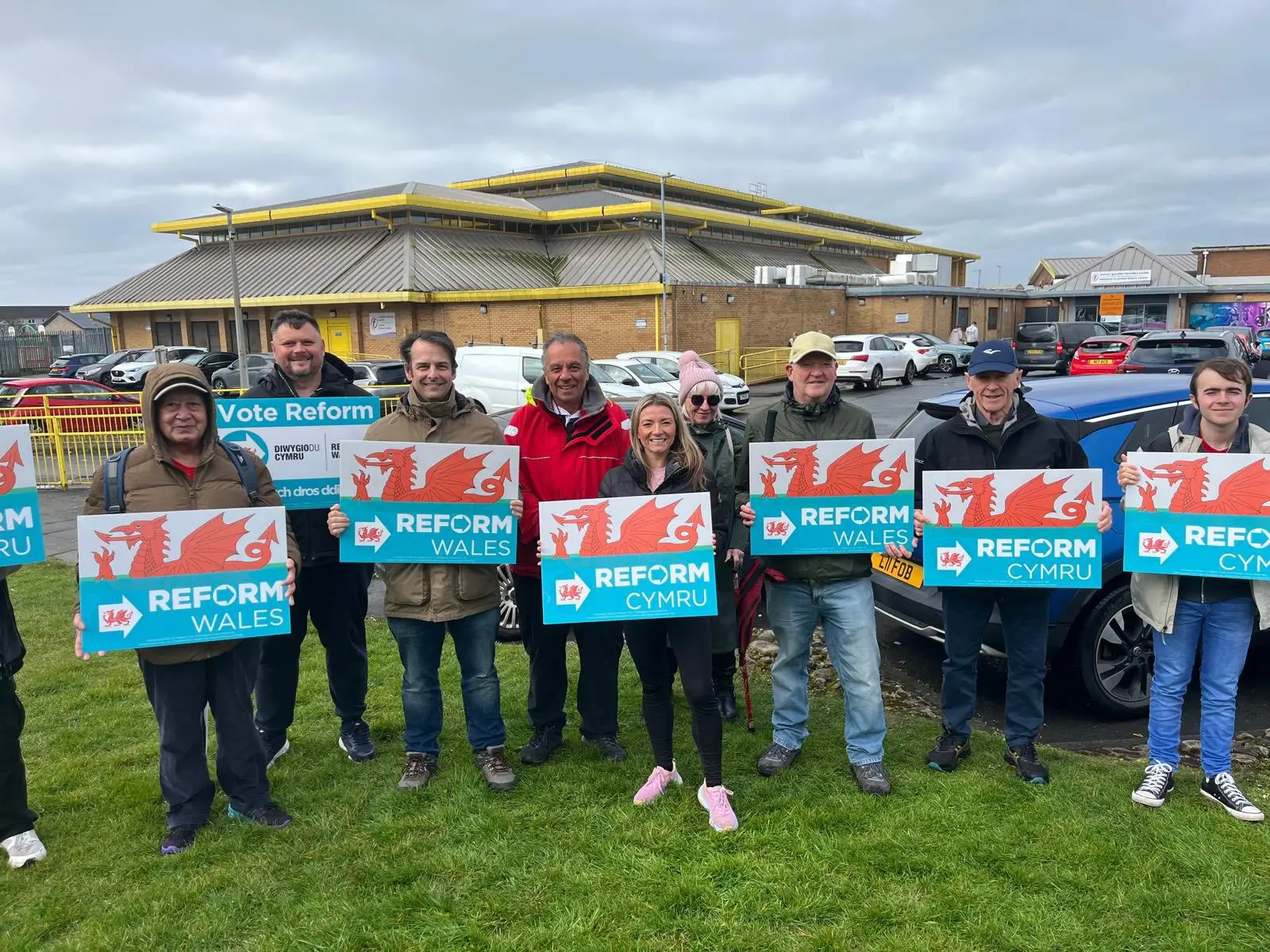
OVER THE PAST DECADE OR SO, as a Brexit Party, then Reform activist, I’ve knocked on a fair few front doors asking people about their voting intentions. I’ve pushed leaflets through tens of thousands of letterboxes. Postman Pat is my hero and I hope that there is a special circle of hell for those who have low-level letterboxes.
Until this year people’s reaction was almost universally polite, whatever their political orientation. In the 2024 general election I personally delivered some 10,000 leaflets when I stood in Swansea West. A couple were returned, and one was torn up. The rest of my team experienced similar tolerance. (The worst incident involved a psychopathic cat).
The bit of Swansea I live in is on the front line of the battle against immigration, the drug trade, money laundering and lawlessness. Several of the many large churches have been turned into mosques. (The remaining ones are mostly abandoned and in disrepair). One of the mosques is used as a polling station.
It’s not wealthy, although other parts of the ward are. Student accommodation and multi-occupier homes nestle uncomfortably alongside owner-occupied homes, whose owners tend to be older and disconcerted by the way the area has changed. Some houses have magnificent gardens; others, poorly paved parking lots. Swansea’s magnificent beach is a mere ten minutes’ walk away. The area is not a slum; it’s probably “rough”; it’s definitely in decline.
much of politics isn’t driven by rational judgements
Earlier this month I was delivering leaflets for the Senedd elections in my local area. Of perhaps 300 delivered I had three abusive responses, including one chap who effectively chased me off his property. His speed of action was quite impressive. When the leaflet dropped on his mat I was already walking down his short drive (slightly longer than the Toyota pickup parked on it). He had his door open and was shouting at me before I had reached the passenger door. Usain Bolt couldn’t have been much quicker. He then advanced on me, shouting and gesticulating, on the cusp of violence. I retreated to the safety of the pavements just as he screamed at me to get off his land. “I have done,” I replied and walked away. Discretion, valour and all that…
I wasn’t shocked by the vile language he deployed, nor was I much disturbed by his obvious menace – courtesy of the British Army I’ve been insulted and threatened by experts. But I did wonder how some jobbing builder could be so full of hatred and on such a short trigger. The Reform leaflet may have challenged his worldview, but it was hardly a physical threat to him. The man was not merely a “progressive activist”, as More In Common defines it, but he was furiously angry, almost speechless with rage and quite close to violence, all triggered by a logo on an A5 leaflet.
Why?
The progressive agenda is based on an intellectual construct, combining socialism, environmentalism plus a few other isms of choice. If the progressive logic is correct, it should be able to withstand a challenge. In any election most households will get at least five leaflets through their door, at least four of which will be from parties they won’t vote for (turnout being around fifty per cent in Swansea). Sensible, rational people put the ones they don’t like in the bin, along with the offers for cheap pizza and the latest impenetrable instruction from the council on how to recycle waste. They don’t succumb to apoplexy.
But of course much of politics isn’t driven by rational judgements. Rather than consider the credibility of candidates and the agenda of the party they represent, many people vote emotionally. As the disastrous Net Zero demonstrates, if thermodynamic and financial bilge is placed on the moral high ground, people will fall for it. See also the Palestinian State, Black Lives Matter and rewilding – to name but a few. Political support is more about image than reality. Ed Davey’s ludicrous antics on TV during the general election won him more seats (but fewer votes) than Reform, without him having to do much in the way of policy justification.
In much of Wales there is absolutely no chance of a Tory ever being elected (due to the perceived history). That loathing predates Thatcher and is visceral. Obviously this favours the progressives, Labour and Plaid Cymru. The Green surge may translate to votes, and the Lib Dems remain in the wishy-washy middle (that middle being well to the left of centre). Reform’s explosion into an electoral force in Wales threatens this cosy arrangement. Their appeal is primarily to the fifty per cent who don’t vote, which includes old Labour and Tory Brexiters and those who vote rationally and refuse to endorse the incompetents of Cardiff Bay.
Electoral power moves from the taxpayer to the party apparatchiks
So the progressives changed the electoral rules to protect their lifestyles. The already complex proportional representation voting system became centred around a closed list. That further strengthens political parties – voters pick the party, and the party picks the candidates. This undermines the relationship between elected representatives and their voters. Electoral power, the last resort of a desperate population, moves from the taxpayer to the party apparatchiks, whom taxpayers fund.
The new system, introduced by Labour and Plaid, primarily provides them with free party infrastructure and a taxpayer-funded career path of party activists. Every parliamentary constituency will have three Senedd members and three offices, all paid for by the taxpayer. (Remember here that £4 out of every £5 spent by the Senedd comes from Westminster, more accurately from you – wherever you live.)
Before the rise of Reform, the likelihood was that at least two of these offices would be occupied by Plaid and Labour, with the other either being a second Labour office or perhaps a Lib Dem or even a Green. No matter, they’re all progressives and their agenda can progress unchallenged.
There are three flies in the progressives’ ointment. Firstly, their policies demonstrably don’t work. The large state, net zero and (for Plaid) Welsh independence are paths to economic ruin. Secondly, the Welsh people are noticing that things in the valleys are far from tickety boo. Thirdly, there is now a party offering an alternative course, and that is Reform.
there is now a party offering an alternative course, and that is Reform.
Following the general election Reform in Wales was on the front foot. As has become obvious, Reform’s run-up to the Senedd election has been sub-optimal. The candidate selection process was a disgrace. Worse, “approved” leaflets weren’t available until the beginning of March. With 100,000 dwellings per constituency to cover, the de facto delay to the start of the campaign has increased the workload – some places won’t get covered and that’s votes being thrown away. The maths is stark; two people can deliver about one hundred leaflets an hour. With perhaps twenty volunteers, that’s fifty hours’ work for every volunteer for every leaflet drop. In a ten week campaign that’s five hours a week – an entire and long Saturday morning. Delaying the announcements and failing to produce leaflets increased the workload, but not the resource.
The d’Hondt system makes winning a majority a huge task that is seldom achieved. Reform could have won one had it immediately built on the general election success. By delaying its candidate selection, Reform denied itself spokespeople who could have taken the battle to Plaid and Labour and won it.
Current polling shows Reform unlikely to even be the biggest party. Even if it were, it’s unlikely that any of the progressives would ally with it. Reform can’t suggest that it might ally with the Tories or it gives further substance to the “teal Tory” argument. Reform may lead the opposition and from that it may be able to expose the craven, self-serving incompetence of progressive Wales.
That poll had a turnout of 46 per cent, so it’s all still to play for. The Welsh at last have an alternative to yet more years of the waste and despair. Plaid ridiculously pretends that it is the party of hope after a quarter of a century of supporting Labour-led Welsh decline.
Wales is at a crossroads. Most political activists are lefties, and their policies have ground Wales into despair. Reform has had its problems in the run-up to this election and it has its faults. I challenged them; I was ignored and so I resigned. That’s not the point right now.
The question is how to save Wales from the Senedd. Welsh voters may:
• Stay at home and take whatever the system decides – probably more of the same, but worse.
• Vote for Plaid, Labour, Lib Dem or Green and support more of the same, but worse.
• Vote Reform and start rebuilding Wales.
I’m voting Reform. I urge you to do the same.



Comments: 0
Join the debate
Do you agree with this analysis, or is the author wrong? Have your say below.
No comments yet. Be the first to join the discussion.