

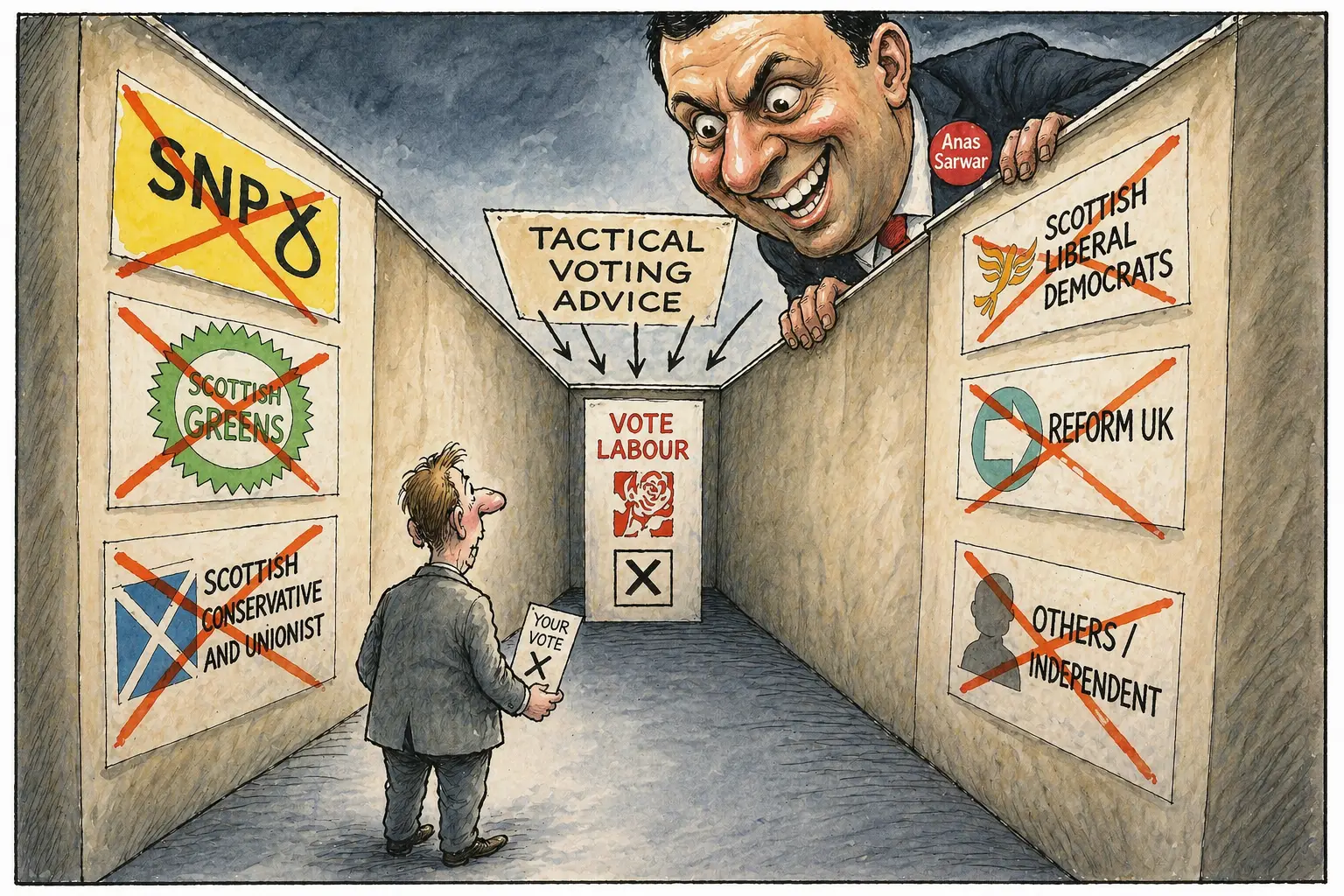
IT’S NOT LONG NOW before we face those two ballot papers and put our crosses in the right box. But what is the right box for Scotland – that is the question?
The SNP, despite a record of endless failures that would shame most parties, appear to simply brush them aside and once again proclaim that independence is alive and well. Undoubtedly, for too many Scots this one issue outweighs far more pressing concerns. Hence the need to change political leadership in Scotland is now absolutely critical as the election approaches. One thing most pro-Unionists agree on is that if Scotland is ever to thrive again, it will not be under an SNP regime.
Some people, groups and organisations have for years promoted what they see as the best way to defeat the SNP, namely “tactical voting” – where you don’t vote for the individual or party you truly want, but instead for the party most likely to defeat the SNP and their Green allies.
This approach claims past success, but it is impossible to verify whether outcomes were driven by coordination or individual voter choice.
Tactical voting advocates point to Labour’s landslide in the 2024 general election, which many commentators attribute to voters backing Labour as the most effective way to oust the Conservatives. It also reduced the number of SNP MPs from 48 to just nine.
What is important to recognise, however, is that if there was a tactical vote, it appears in Scotland to have been driven primarily by SNP supporters switching to Labour to remove the Tories at Westminster, rather than by any coordinated unionist tactical effort.
There is little evidence of a comparable unionist tactical vote. Hatred of the Conservatives may have motivated SNP voters to switch to Labour in 2024, but it does not follow that hatred of the SNP will translate into a similar shift to Labour among unionist voters in Scotland.
That dynamic has not materialised in previous elections, and current polling shows no clear indication that it is about to happen now in the context of the 2026 Holyrood contest.
tactical voting is a form of managed exclusion
Where tactical voting advice was once welcomed, in some cases, it now feels unsolicited, unwanted, and at times verging on bullying and coercion.
Like many others, I have supported tactical voting in the past because it seemed a practical way to achieve results. But looking back, I now have serious reservations.
Tactical voting, based on previous election performance, effectively blocks new or emerging parties – including Reform – from gaining traction. They are treated as if they do not exist, which I believe is not democracy, but a form of managed exclusion.
Below is the advice from Alistair Cameron, who has run Scotland in Union (SIU) for many years. Only recently — perhaps belatedly on my part — have I recognised that SIU is aligned in practice with Labour interests. Consider what that implies: Keir Starmer, ECHR commitments, two-tier policing concerns, higher taxes, record levels of immigration, and more. Yet most tactical voting tables still encourage backing Labour over the SNP, sidelining other parties entirely, leaving many voters repeatedly having to “hold their nose.”
This is Cameron’s advice:
“Our impartial advice encourages people to back candidates from established pro-UK parties with a track record in previous elections, to help keep the SNP and the nationalist Scottish Green Party out of power in Scotland …”
That does not appear impartial. It clearly excludes new parties from gaining any foothold. That is not my idea of democracy. His emphasis on “established parties” automatically rules out Reform and any future challengers.
It’s not just SIU. Other well-known sites and social media groups on Facebook and X do the same – sometimes more aggressively – even blocking those who question their guidance, particularly regarding Reform. Good people seeking honest discussion have been branded as de facto SNP supporters for failing to follow the tactical voting advice. Some have been excluded simply for disagreeing. That is a fact – and a disgraceful one. It resembles bullying. I would go further: it is the manipulation of political choice, and ahead of this election it has grown into something far more entrenched and concerning.
Yes, these decisions are difficult. But one thing clear-minded voters should recognise is that we need change. We cannot keep going round in circles, repeating the same failures and expecting different outcomes. This is your vote. Change only happens if you allow it to begin, and it takes time to build.
As for me, I am voting for change. And to those trying to steer voters through tactical voting, I say: no thanks. It hasn’t delivered meaningful change – the nationalists remain in Holyrood, and polling still looks strong for them. Despite claims of success, Scotland has not fundamentally changed because of tactical voting. Perhaps honesty really is the better approach.
All I am saying is this: give change a chance. Vote with both your heart and your head. Believe in a better future for Scotland — and do not allow yourself to be directed or constrained by others.
Because in the end, if nothing changes, nothing changes.


Comments: 0
Join the debate
Do you agree with this analysis, or is the author wrong? Have your say below.
No comments yet. Be the first to join the discussion.