

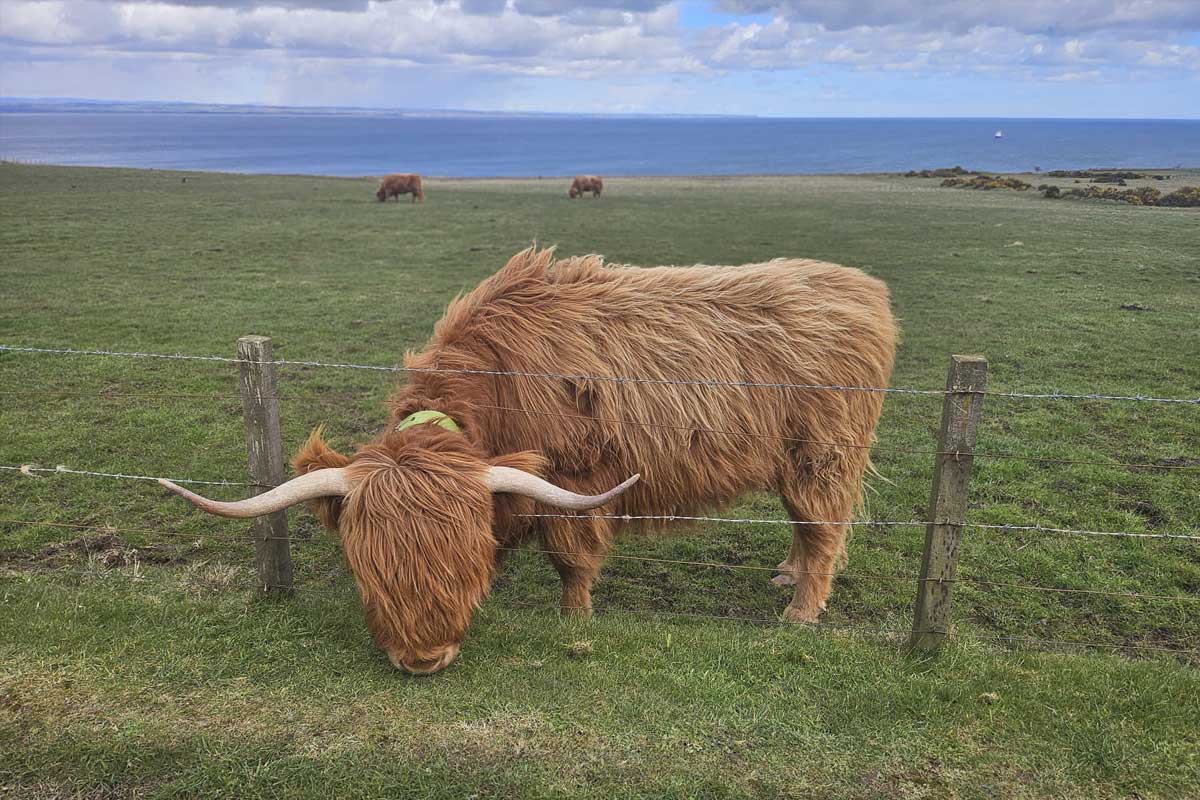
I WAS ABOUT to putt on the seventh green when a farmer started shooting, no more than a hundred metres away. I texted him to complain about him disturbing my concentration. Farmer Reformer Richard Fairley saw the funny side.
On the occasions I drove him to consultations with various rural organisations during 2025, I learned a lot about how “townie” regulators infuriate farmers.
Richard spends too much of his time filling out worthless forms instead of being out in the fields producing food. Scottish farmers must use a different cattle registration system to the rest of the UK, imposed by the SNP as a prelude to “independence”. This causes problems with cross-border trading.
Richard can shoot crows but not gulls, unless they happen to be close to crows. Gulls can be a nuisance to farmers, and they take out lapwing chicks. Farmers know that endangered lapwings breed between mid-March and June on spring-tilled arable land or short grassland, and can time their activities to avoid nesting sites.
Like deer, the lack of predators means that badgers greatly exceed their natural numbers and take out lambs to make up for a shortage of food in the wild. But to woke activists like Brian May, they are cute, so are protected. Mary Colwell (Curlew Moon): “There is a general perception that protecting wildlife is soft and nurturing, but the reality on the ground is often raw and bloody. Some animals may have to die so that others can live.”
cherishing the environment and making money are very compatible
Another farmer contact came via a friend who purchased a house from him twenty years ago when he was losing money applying traditional farming practice. The estate is now a model of regenerative farming and is profitable. He proved that cherishing the environment and making money are very compatible and has written books on the subject.
When cows are inside, either in winter or for milking, a false floor carries slurry away, to generate enough methane to power an off-grid village. In the pasture, each cowpat produces 6,000 insects which, at six cowpats per day over a grass-growing season of 220 days, produces 8 million insects per cow per year for birds to eat. Woodland and hedges at field margins host nests, and ponds provide water for cows and wildlife.
We should promote Scottish beef, lamb and dairy more because we have the ideal climate to grow grass and rear healthy livestock. At present, meat can be labelled as British if it is packaged here. We must clearly differentiate between British grass-fed beef and intensive US and Argentinian soya-and-cereal-fed beef, which is far from sustainable.
Sheep graze pasture in spring, clearing intestinal worms that affect cows, and reducing poisonous ragwort, with less herbicide use. In autumn, they produce a tight sward, which is good for grazing winter geese, and spring growth for ground nesting birds. EU subsidies encouraged too many sheep and overgrazing, leading to lots of bracken and molinia. Sheep collect moorland ticks on their wool which are killed when they are dipped. This helps reduce Lyme disease in people and livestock.
Some chemicals are essential. Minimum tillage ground preparation retains the organisms of the soil. Once the surface has been disturbed, glyphosate herbicides (Roundup) finish the weeding process by killing emerging shoots. Its half-life in the soil can be as little as three days in certain conditions, allowing quick crop seeding or planting after treatment.
The Dumfriesshire farmer had nothing good to say about environmentalists who oppose all chemicals. They might promote a vegan lifestyle, but a litre of almond “milk” needs 158 litres of water to make, against eight litres for a litre of cow’s milk. In the 1960s, Rachael Carson said that many bird species would disappear with intensive agriculture, but only one European bird has become extinct since the Industrial Revolution.
He had scathing comments about RSPB land management and the performance of various public bodies. Farmers can be more sensitive to the needs of nature than urban “experts”, as they observe it daily.
Woke environmentalism is very bad for the environment and people
I met the beautiful pack of hounds which the farmer had nostalgically retained. Hunting with hounds was the closest we got to replicating nature. A wolf-like bite to the throat was a quick death and the least healthy foxes died, strengthening the strain. A gun shot can wound and may be inflicted on a fox in its prime. But, in a Tony Blair left-wing world, hunts were frequented by toffs, like Nigel Farage, and must be banned.
Muirburn involves burning heather to provide fresh growth for game and livestock. Birds, insects and reptiles also benefit. Some environmentalists oppose it because burning releases carbon into the air, and it doesn’t fit with their class warfare ideology. Yet grouse shooting provides employment for many people, mostly outside the main tourist season.
And, if heather is not kept in check, wildfires have more fuel and gain enough heat to ignite the underlying peat. That is very dangerous for fire fighters and bad for moorland habitats.
Satellites show that the area of the world affected by wildfires is reducing as farmers in poorer parts of the world manage vegetation better. But in rich areas like California, where green ideology regards trees as “precious”, fire load and fire breaks are poorly managed. Devastating fires break out. Woke environmentalism is very bad for the environment and people.
One thing the farmer said stood out for me: why should the public sector own land, except perhaps the MOD?
The state (aka “Scottish Ministers”) owns 2,235,958 acres. With a conservative estimate for rural land of £6,000 per acre, that amounts to a value of £13.4 billion. Local authorities own 88,000 acres. Most councils have debts that attract interest payments – money which would be better spent on services.
The largest owner is Forest and Land Scotland, which requires annual taxpayer subsidies of around £30m because it cannot sell wood and run tourist facilities at a profit. What if private sector partners were introduced to seek efficiencies and have a license to develop tourism, housing and community facilities, using the £11 billion+ asset as collateral to raise funds for capital projects?
David Cameron considered using the value of English forestry land to “reboot” the rural economy but the plan fell by the wayside.
Doubtless there will be cries of selling off our “wee bit hill and glen”, perhaps to foreigners, but Scottish Gas, distilleries, fish farms, offshore wind turbines and many more ventures are foreign-owned. Raising £2bn would upgrade the A75, A77 and A96, bypassing towns like Newton Stewart, Girvan, Nairn, Elgin and Keith. £1bn would subsidise 25,000 new affordable rural homes. £3bn would clear the national debt.
When my business was suffering after the 2008 crisis, and I risked losing the roof over my head, we sold our office and rented it back, releasing cash to stop the company going bust. Scotland is effectively bust. What’s the point in having an asset sitting there without maximising its potential?


Comments: 0
Join the debate
Do you agree with this analysis, or is the author wrong? Have your say below.
No comments yet. Be the first to join the discussion.