

I AM A LITTLE UNEASY when a Reformer says we should restore our Christian traditions. Not all Iron Age morality stands the test of time. In the decades after the Second World War, when churches were full, homosexuality was a crime, women were second-class citizens, and primary school children were assaulted by teachers as a matter of course. I can quote chapter and verse of scripture to justify all this.
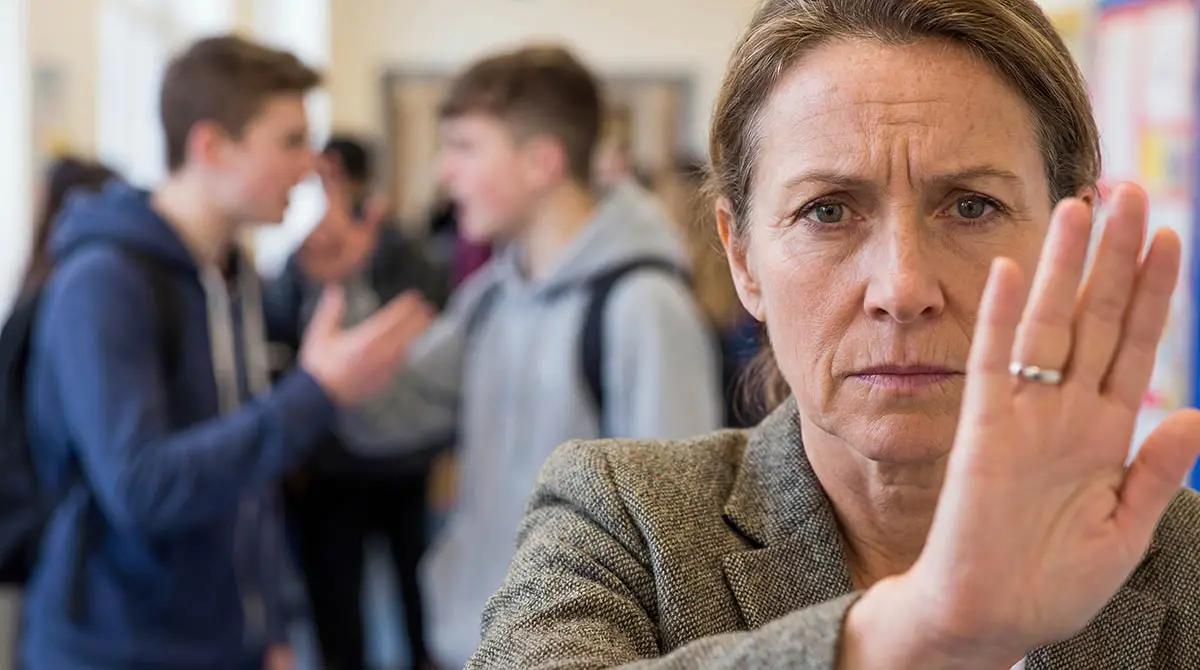
Of course, today you are a sinner if you believe trans people with male appendages should not share female toilets, natural masculine qualities are regarded as toxic such that male mental health is at epidemic levels, and children routinely assault their teachers.
In 2024/25, there were 24,387 assaults on Scottish teachers. One study reckoned that eleven per cent involved a sharp instrument. And yet you can count on one hand the number of exclusions each year. So much for an equality and inclusion policy where troublemakers are kept in class instead of receiving specialist attention.
Statistics for pupil-on-pupil violence are poor because many bullying incidents go unrecorded. A girl who is upskirted must endure the presence of her molester, who is allowed to stay in school. If she were over sixteen, she could take out a restraining order. And if the perpetrator comes from an ethnic minority, he cannot be treated the same as a white boy for fear of the teacher being branded racist.
It is no wonder that pupil non-attendance rates are sky-high and teachers are leaving the profession. You cannot teach in a war zone.
the SNP and the unions have kicked the can down the road for years
In 2023-24, 40.6 per cent of secondary school pupils were absent for ten per cent or more of the school year and for primaries the figure was 23.9 per cent. A further 11.9 per cent of pupils were absent for twenty per cent or more of the school year and 2.5 per cent were absent for more than half. This doesn’t include “lappers” – children who register in the morning but wander the school during the day, interrupting classes.
In England, absence rates had been reduced from 6.5 per cent in 2007 to 4.5 per cent in 2014, but rose to 7.4 per cent in 2023 after COVID, although this is still much better than Scotland.
With all this chaos and truancy, it is no wonder that Scotland’s education standards have plummeted, and it is the drugs capital of Europe. Yet the SNP and the unions have kicked the can down the road for years.
Reading skills are inherent to all learning. Scotland doesn’t subscribe to the Progress in International Reading Literacy Study (PIRLS) for ability near the end of primary education, so we don’t know how illiterate our children are. Around 43 per cent of Scottish schools have not been inspected in the last ten years. Parents should know the reading age of their children as they progress, and when they reach the magic “9.5” – the definition of functional literacy.
Using teaching methods developed in Scotland in West Dunbartonshire and Clackmannanshire, England raised its PIRLS reading ranking from nineteenth to fourth. Michael Gove and the Conservatives did something right while Scotland prevaricated. His initiative also raised science standards (slightly) and mathematics on the OECD’s Programme for International Student Assessment (PISA) rankings from twenty-sixth to eleventh.. Scotland dropped from fifteenth to thirty-second in science and from nineteenth to thirty-second in maths.
boys are being left behind, and no one seems to care
The number of sixteen- to twenty-four-year-old male ‘NEETs’ (Not in Education, Employment or Training) has increased by forty per cent since the pandemic, compared to an increase of just seven per cent among females. According to the Centre for Social Justice, young men earn less on average than their female counterparts. Boys are being left behind, and no one seems to care.
We need junior academies where youngsters who are poor at academic subjects can gain vocational skills so that, at age sixteen, they have the chance to apply them or enhance them through further study or apprenticeships.
In 2014, about 184,000 children and young people in Scotland had additional support needs (ASN), or 26.6 per cent of pupils. EmpowerED Scotland reckons this is now 284,448 children or 40.5 per cent, yet the number of ASN teachers has dropped from one per forty pupils to one in 89. Failure to diagnose learning difficulties in the first 36 weeks of schooling – some of it could be done in nursery school – leads to greater incidence and more entrenched learning problems that teachers cannot cope with.
The decline in Scottish education standards coincided with the introduction of Curriculum for Excellence in 2010, which effectively politicised teaching.
Lindsay Paterson is professor of education policy at Edinburgh University:
Instead of requiring students to study the great novels, we get them to read contemporary novels that deal mainly with the kinds of experience that the children already have… Instead of requiring students to study the complexity of Scotland’s role in the British Empire, we get them to study selected aspects which reduce colonialism to a simple binary of oppressors and oppressed.
Instead of requiring students of a modern language to use that language to engage with the cultures of the countries where that language is spoken, we get them to write mini essays about their holidays in these countries. Instead of encouraging students to engage with the difficult rigour of proper science, we get them to speculate about the moral and political questions raised by controversial scientific topics. Of course, the latter matter. But engaging with these controversies requires a sound understanding of science first.
It’s now possible to pass Higher maths without ever having internalised the idea of rigorous mathematical proof… If we don’t have the idea of logically deductive proof, of the kind that’s been around since Euclid, then we no longer have mathematics – we have something else.
It is no wonder that unscientific concepts like climate change alarmism are easily swallowed.
The academy system in England has been a great success, with teachers being at the centre of everything. It demonstrated that local authorities need not run mainstream schools. Cabinet Secretaries for Education at Holyrood have absolved themselves of responsibility for Scotland’s declining standards by using local government as the whipping boy. MSPs need to stand up and sort out the problems. Cutting out the middleman would also save money that could be redirected into front-line and special needs teaching.
“England is producing more highflyers.” Paterson fears that English pupils will become tomorrow’s leaders and entrepreneurs, leaving Scotland behind. His solutions are from “the bottom up”. It is teachers who know how to teach. “They’ve struggled with the Curriculum for Excellence for fifteen years and they know what to do – they’ve lots of ideas… Listening to the wisdom of teachers is the only way forward.”
We need a teacher-led, information-rich curriculum.
On 15 October 2025, a conference in Glasgow highlighted these issues. The organiser had invited all MSPs to attend but none was present. It was a pity that no political party was represented. I could announce that seven Reform UK members were in the audience, three from the Scottish policy group. “Our party is listening to teachers.” There was loud applause.



Comments: 1
Join the debate
Do you agree with this analysis, or is the author wrong? Have your say below.
No comments yet. Be the first to join the discussion.