

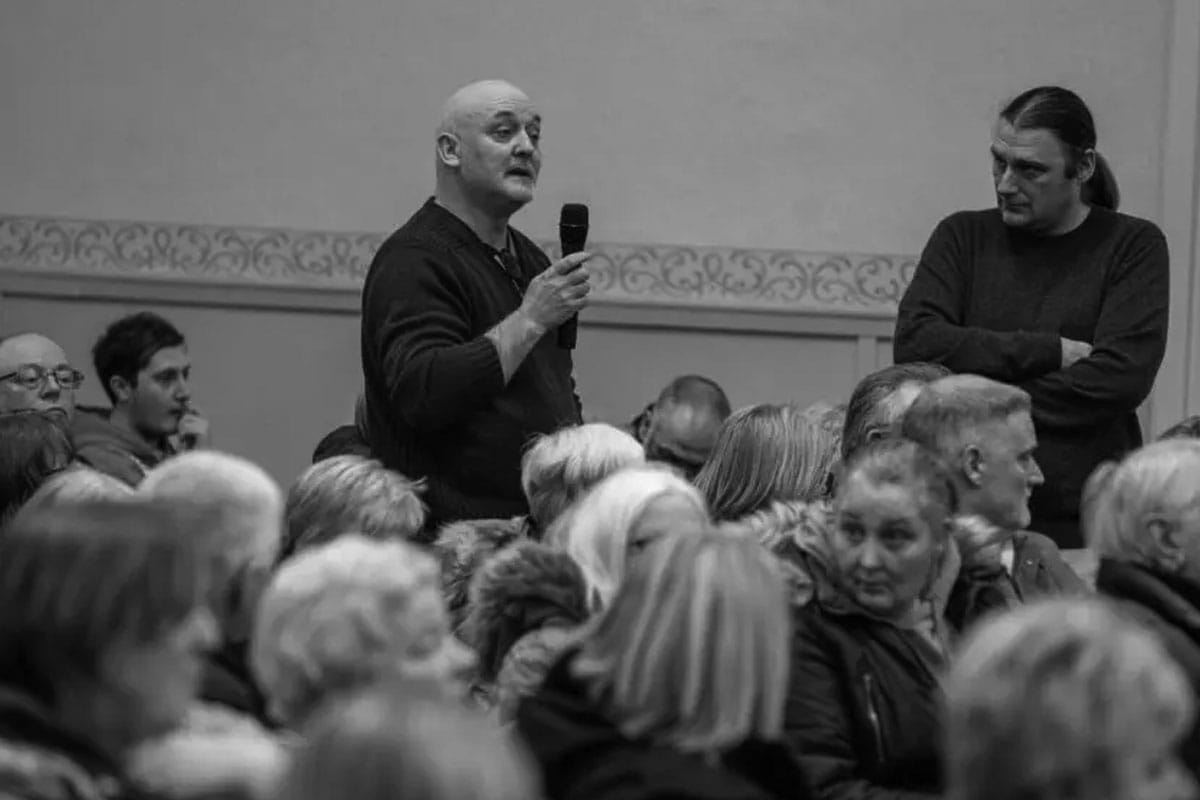
CONRAD RITCHIE ALERTED me to a public meeting in Fraserburgh on 1 May 2025 about cuts to a local day care facility. I attended to learn more about social care, but the event was a microcosm of everything that is wrong with local government. It is no wonder the public can’t be bothered to turn out for local elections. The councillors on the panel were embarrassed by their lack of knowledge and impotence.
The event was on a Thursday so the local MSP could avoid attending, claiming more pressing work at Holyrood, but sent a letter of support to the community. The SNP had supplied funds to the local authority, so cuts were apparently its fault, not hers.
Who was the local, accountable politician? There were four councillors representing the ward the care centre was in, but it served several wards. Take your pick from perhaps a dozen elected representatives.
None of the panellists had visited the facility in years and council officials had not kept them up to date on cost-saving plans for social care. They would be given a report about a week before a council meeting with limited time to read and understand it, and no opportunity to grill the officials who prepared it, who must remain anonymous.
But in a small community where “I kent his faither”, some audience members knew the key officials and that a “no service cut” option had been prepared which was quickly buried.
Who betide any elected councillor who challenges an unelected official to supply the truth, the whole truth and nothing but the truth. Councillor Fiona Higgins tried this in Glasgow. A footnote on an education budget report said that a “reform process” would take place but failed to say this involved a cut in teacher numbers. The budget was passed.
Fiona is one of many frustrated elected officials who are kept in the dark
Fiona had to pursue a Freedom of Information request to find out more, being unable to access it within the council. Instead of the mandated 28 days, it took six months to get the information.
Back at an education committee meeting, the chairman suspended it and prevented it being minuted until Fiona stopped asking questions. She made the alleged malfeasance public. In doing so, she was accused of wanting to “undermine the system” and “bullying” the relevant official. She was reported to the Standards Commission which found her guilty. Fiona is one of many frustrated elected officials who are kept in the dark.
The Commission is not the only body in civil society that influences policy and impairs democracy. COSLA’s cosy 2023 Verity House Agreement with the SNP government had tackling poverty as one of its three key objectives, but the other two were “recognising climate change as one of the biggest threats to communities across Scotland” and “delivering sustainable person-centred public services”. Yet net zero and woke sustainability policies are drivers of poverty.
COSLA has effectively produced a socialist manifesto for the 2026 election.
Councillors with extra roles can receive up to £71,519
NatureScot should promote good environmental practice, but its 2023 report Understanding the Indirect Drivers of Biodiversity Loss in Scotland calls for radical societal change. There must be “a shift in values along a spectrum from materialism to intrinsic self-transcendent values/goals … taxation could move towards resource use rather than income or wealth … monetary based performance indicators like GDP are not fit for purpose”.
Enter Land Reform legislation which challenges property rights going back to Magna Carta, and National Planning Framework 4 which restricts rural development unless you want to industrialise our countryside with net zero paraphernalia. NatureScot, SEPA, Environmental Standards Scotland, the Crofting Commission, the Scottish Land Commission, Highlands and Islands Enterprise, local authorities, the national parks and others are the enforcers, with local community councils left powerless.
You might not expect a trades union to be politically independent (why not?) but the Educational Institute of Scotland urged its members in October 2025 to ban Reform UK from hustings because the party wishes, “to replace democratic principles with autocratic rule … [Reform] often legitimises violence as a means to achieve political or social goals … only the far-right frames gender and gender roles as determined by biology”. Who cares about high court rulings? How dare Reform be “pro-business and pro-wealth”!
Do EIS members teach their pupils this dangerous baloney?
This demonstrates how deeply the left-wing agenda has pervaded society so that many people acquiesce who should know better, for example traditionally right-wing people who vote for the LibDems and turn their noses up at Reform UK.
As Donna Rachel posted: “The left has academia which has radicalised the youth, the whole public sector including schools, the NHS, local government and the civil service, the unions, political bodies such as the British Medical Council, the BBC from which 49 per cent of Britons still get their news, and the charity sector.
“The right has podcasts.”
But back to Fraserburgh. An audience member asked why councillors had given themselves a big pay rise when cuts were being made. The reply that an independent body determined the £25,982 basic salary is only true if you believe that the members of the Scottish Local Authorities Remuneration Committee have no political interests or prior affiliations.
Councillors with extra roles can receive up to £71,519 (plus access to a generous pension scheme), while the average remuneration for an English councillor is around £7,000.
There are 1,226 councillors in Scotland because we have a proportional representation system at ward level, but three or four councillors in a ward makes no sense, unless you are a political party raking in all the £25,982 “donations” whether your councillors do anything to earn them or not. Many towns are split into two or more wards which blurs social identity.
At the 2027 local elections, with at least five parties seeking to stand in the great majority of wards, that will mean finding about 6,000 competent candidates. I fear numpties will proliferate and many will be elected.
If we had proportional representation at council level instead and made (especially urban) wards larger, we could reduce councillor numbers from 1,226 part-time (some are ‘no-time’) to around 350 full-time. They must be fully committed, so give them a salary between £35,000 and £50,000, depending on their responsibilities.
Council officials are also well paid. Aberdeenshire’s Chief Executive earns £160,249, just less than the Prime Minister’s £166,786. Many other officials in Scotland obtain six-figure sums. Why do we need as many as 32 local authorities, all with their associated overheads?
Holyrood also has its weaknesses which should be addressed, and goodness knows quangos need reform, but let’s make local government more efficient and more democratic so that money is spent on frontline services rather than perpetuating jobs for the boys (and girls).
Comments: 0
Join the debate
Do you agree with this analysis, or is the author wrong? Have your say below.
No comments yet. Be the first to join the discussion.