

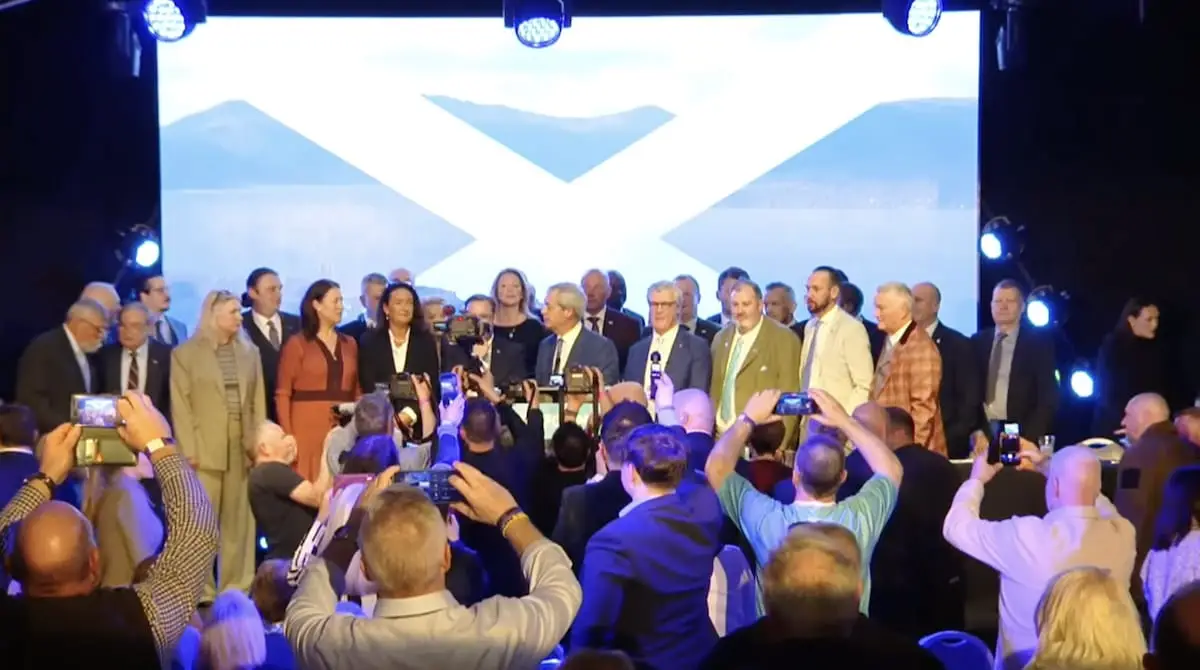
REFORM’S Scotland conference at Bishopton last Thursday marked another watershed for the party. The party introduced its 73 candidates and unveiled its manifesto for the Holyrood election, becoming the first party to do so, despite all the jeering from opponents that Reform had no policies.
With more than 450 members attending, the atmosphere was more than upbeat and entirely different from the staid and dutiful air that the tired old party faithful usually bring to party conferences – because, of course, those attending were overwhelmingly new members who had joined a political party often for the first time.
There was a sense of optimism and excitement in the air: after years of having nothing to look forward to but more dreary decline and hollow words from the established parties, I found myself deeply moved by the enthusiasm and hope expressed in the unalloyed cheering that followed the speeches by Nigel Farage and Malcolm Offord.
In truth, it was more of a rally than a conference – which is hardly surprising given its truncated nature and proximity to the Holyrood election – but it was also what attendees wanted, as evidenced by their lively responsiveness to the speeches. The message from the podium was that Scotland might be broken, but Malcolm Offord and Reform had a positive vision and plan to make Scotland the most successful part of the UK – wealthier, healthier, better educated and happier.
You can watch the conference here, but several things stood out for me. The latest polling for the Holyrood election shows Reform running second in around 57 per cent of constituencies, so there are plenty of seats up for grabs, despite the almost universal assumption that Reform can only win regional list seats.
almost one third of Scottish children don’t attend school regularly
The most shocking statistic about Scotland’s declining education system is that, out of over 700,000 children of school age, 223,000 don’t attend school regularly. That’s damaging the life chances – sometimes irrevocably – of almost a third of Scotland’s young people. The Scottish Government has declared national emergencies for drug deaths and for housing; the only reason it doesn’t for education – which surely merits it – is that it would involve the SNP recognising the problem, acknowledging its responsibility for it and implementing effective reform.
There is much fuss made by Reform’s opponents that the party cannot possibly fund its proposed tax cuts without cutting frontline services. The party’s position is that the tax cuts can be funded by reallocating the £1bn currently spent on net zero projects and some of the £6.5bn spent on 132 quangos, as well as through economic growth.
Malcolm Offord spelt out the potential for savings in a concrete way by asking the audience how many attending were business owners, and whether these business owners agreed they could cut 3 per cent off their overheads (the amount a Scottish Government would have to cut its spending by to afford the tax cuts) without harming the service they deliver. The many business owners in the audience all agreed. Offord clinched his argument by pointing out that for at least 10 years the SNP Government had cut real-terms funding to councils, requiring annual efficiency savings and all had complied – but the same discipline had never been applied to the Scottish government, whose sprawling bureaucracy has grown significantly since Covid.
The final point that struck me was that, just as Malcolm Offord wants to get Scottish people off benefits and into work, because a dependency culture is bad for one’s health and bad for one’s pocket, so he wants to reduce Scotland’s dependency on the Block Grant from the UK Treasury by turbocharging the Scottish economy. This can only be a good thing, and a Scotland that can stand on its own feet should be heartily welcomed by every nationalist.
By accident, I found myself sitting among the press pack, a miserable, scowling phalanx who barely made any notes. The contrast with the audience could not have been starker – particularly when the first journalist was announced as being from GB News and the room erupted in spontaneous cheering. Subsequent journalists from BBC Scotland, and to a lesser extent STV, were met with boos. I wonder when the disconnect between the media and the audience in the room – and the hundreds of thousands of Scots who will vote Reform on May 7th – will give the journalists pause for thought?
the elephant in the room was net zero
When the two leaders took questions from the assembled reporters, it was clear few had read the manifesto provided for them as they largely recycled questions that had been asked at previous press conferences. The elephant in the room was net zero, and Reform’s plan to abolish it and boost the oil and gas industry: not one journalist asked about it, despite the growing oil-price crisis caused by the latest war in the Middle East ensuring Reform’s policy the only one which makes economic sense.
As ever, Farage and Offord parried the questions robustly and with good humour. The most striking thing about the media questions – apart from the lack of originality – was their interchangeability; it was as if all the journalists, regardless of whether they worked for The National or The Daily Mail, sang from the same hymn sheet.
It was difficult not to conclude the Scottish media are afflicted by the same apparently unconscious cosy consensus as Holyrood; Reform isn’t just up against the uniparty, but the unimedia. Like the legacy parties, the legacy media act like a distant elite, blithely disengaged from the significant number of ordinary people who agree with Reform’s stance.
This was all too evident in the subsequent media coverage which is, as I write three days after the conference, universally focussed on attacking candidates for past social media activity. It’s difficult not to see this frantic muck-raking as the last breath of an establishment that senses its days are numbered.



Comments: 0
Join the debate
Do you agree with this analysis, or is the author wrong? Have your say below.
No comments yet. Be the first to join the discussion.